
3,142 views ·
8 replies
3k views
8 replies
Installing vinyl on existing tiles in wet room WITHOUT waterproofing
Hi, everyone!
My bathroom in the townhouse has no documented moisture barrier, so I assume there isn't one / or that it is insufficient by modern standards.
I talked to a plumbing company that advised against laying vinyl flooring on the existing tile floor as there is likely just a bare concrete slab underneath that breathes through the floor, and that if I lay vinyl (which acts almost as a moisture barrier), the moisture from the bottom slab will creep along the walls and cause moisture damage.
My question now is whether it's still okay to install vinyl panels on the walls, or if the walls also need to "breathe"?
It doesn't seem like walls have that function compared to a floor whose concrete slab is in direct contact with the ground.
Here is a picture of my disastrous shower room (sorry for the mess) where I am currently installing a new fan, rerouting unnecessarily long water pipes, and tearing out the existing shower cabin to replace it with a new one.
My bathroom in the townhouse has no documented moisture barrier, so I assume there isn't one / or that it is insufficient by modern standards.
I talked to a plumbing company that advised against laying vinyl flooring on the existing tile floor as there is likely just a bare concrete slab underneath that breathes through the floor, and that if I lay vinyl (which acts almost as a moisture barrier), the moisture from the bottom slab will creep along the walls and cause moisture damage.
My question now is whether it's still okay to install vinyl panels on the walls, or if the walls also need to "breathe"?
It doesn't seem like walls have that function compared to a floor whose concrete slab is in direct contact with the ground.
Here is a picture of my disastrous shower room (sorry for the mess) where I am currently installing a new fan, rerouting unnecessarily long water pipes, and tearing out the existing shower cabin to replace it with a new one.
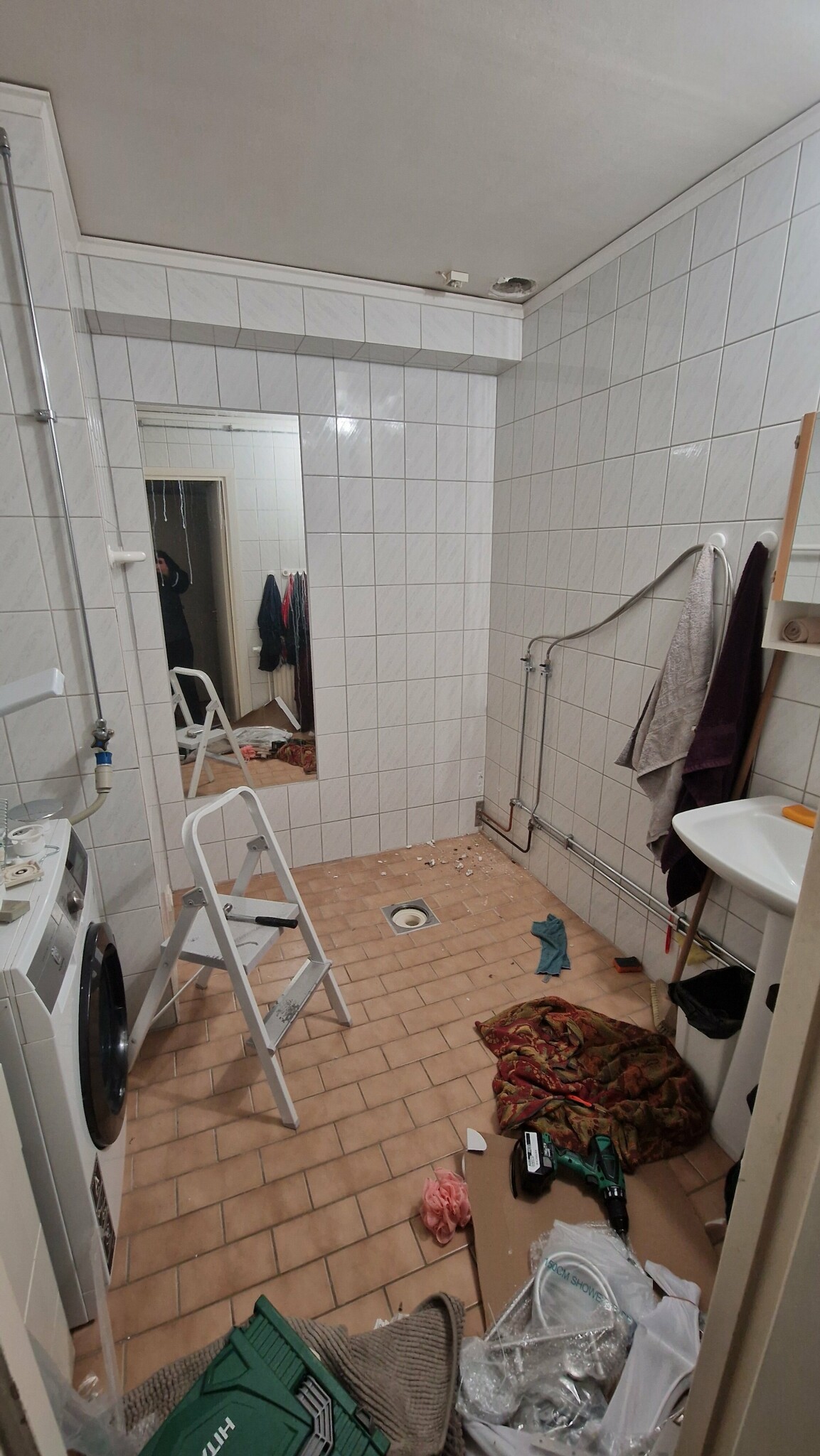
When was the bathroom last built/renovated? What material are the walls made of? If there is a waterproof layer on the walls and you add another waterproof layer on the outside, it will create problems.
In general, you shouldn't change a functioning construction. With your circumstances, I would probably try to find other ways to spruce up the bathroom. Have you, for example, looked into painting? You should be able to use epoxy on the floor?
In general, you shouldn't change a functioning construction. With your circumstances, I would probably try to find other ways to spruce up the bathroom. Have you, for example, looked into painting? You should be able to use epoxy on the floor?
Thanks for the answer! The bathroom was renovated in 1997, but there is no documentation left at all. There is a drill hole in the wall from where a washer/dryer stood before, and now because I have a combo machine, there's nothing that builds in height. In that hole, it doesn't seem like there's any moisture barrier, it's plaster and wood underneath.mexitegel said:
When was the bathroom last constructed/renovated? What material is in the walls? If there is a moisture barrier on the walls and you add another impermeable layer on the outside, it will cause problems.
In general, you shouldn't change a functioning construction. With your conditions, I would probably try to find other ways to spruce up the bathroom. Have you, for example, looked into painting? You should be able to use epoxy on the floor.
Would it be possible to paint on the wall tiles and floor without creating any moisture barrier? I'm thinking wouldn't epoxy act like a vinyl floor on the tiles?
Aaah okay! And then it becomes like the floor of a warehouse in style (if you don't add pigment)?
I suppose you paint until the floor tiles are leveled with a substantial layer?
Is it something that's used on walls as well? I'm mostly bothered by the walls considering there are dozens of previous drill holes and cracks. 4 pilot holes for the water to the shower and sink that you see in the lower right corner of the picture.
You can't use epoxy to “fill” the joints in the tiles. Then you'll probably need to first use a suitable filler, but then the project starts to grow, and you should ask yourself what is reasonable considering the age. In that case, you also need to carefully check that the filler works for what you have in mind. On tiles and covered with epoxy.
It can also be used on walls, but for both cases, one should be aware that it is difficult for paint to adhere to tiles and tiles.
Consult with the paint manufacturer, they often have very good support even for private individuals.
It can also be used on walls, but for both cases, one should be aware that it is difficult for paint to adhere to tiles and tiles.
Consult with the paint manufacturer, they often have very good support even for private individuals.
Thank you very much! I'll take a look at that! I don't want to mess too much under the tiles since I also heard yesterday that there's plenty of asbestos in the walls and ceiling in the bathroom just 3-4cm into the wall.You cannot use epoxy to "fill in" the joints in the tiles. You probably need to self-level first with a suitable filler, but then the project starts to grow and one should ask what is reasonable considering the age. In that case, you also need to carefully check that the filler works for what you have in mind. On tiles and to be covered by epoxy.
It can be used on walls as well, but in both cases, one should be aware that it is difficult for paint to adhere to tiles.
Consult with the paint manufacturer, they often have very good support for private individuals as well.


In the 90s, it was well known that waterproofing was needed on the walls and floor if it was intended to shower directly on them. Since there are wooden studs in the wall, it probably doesn't apply to a basement with penetrating moisture through walls and floors. However, waterproofing has periodically looked completely different than today; at one point, it was just like a thin layer of paint (and it might have been skipped right next to an electrical outlet).
Holes through the waterproofing are sealed with silicone in a suitable color.
But be aware that insurance companies often have depreciation policies that result in bathrooms having no value in the event of damage after 25-30 years, i.e., if there is water damage, it is not only a question of the costs that a regular renovation leads to but also additional costs for replacing water-damaged structures in walls and floors.
On the walls, you can paint with tile paint.I Inarius said:
Holes through the waterproofing are sealed with silicone in a suitable color.
But be aware that insurance companies often have depreciation policies that result in bathrooms having no value in the event of damage after 25-30 years, i.e., if there is water damage, it is not only a question of the costs that a regular renovation leads to but also additional costs for replacing water-damaged structures in walls and floors.

Waterproofing layers have always existed in one way or another. Rolled layers in the 80s/90s were sensitive. Tiles/ceramics directly on concrete are mostly in basements and similar places; older apartments in concrete/stone had asphalt/tar behind them.
Click here to reply