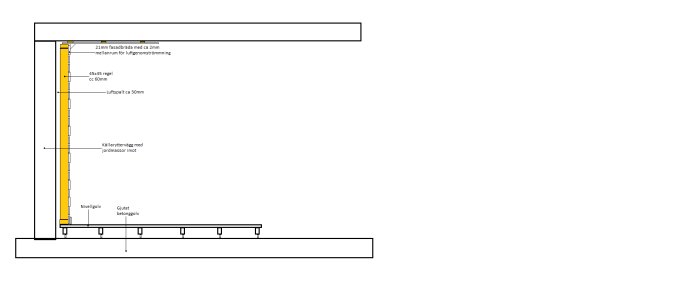
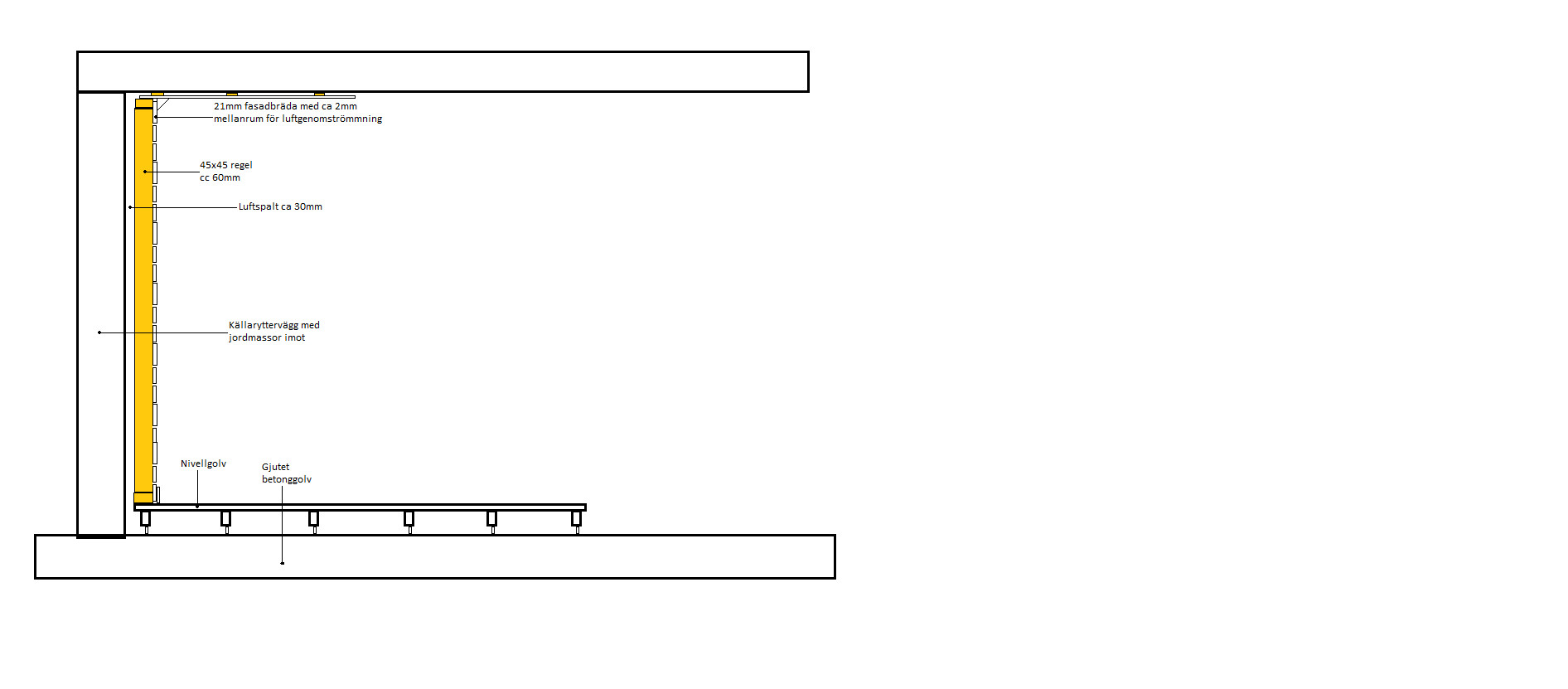
Hi! I am renovating the recreation room in the basement. The idea is to put up an installation wall where I can run electrical conduits and install outlets. I have sketched a bit in paint about how I am thinking and am wondering if this could be a good method? I initially thought of placing insulation between the studs with a ventilated baseboard and cornice, but then I thought it might be too tight and the savings minimal, so I think I'll skip that?!
Where the wall will go, there was previously a wooden wall. There was tar paper between the stud (45x45) and the masonry wall. Then insulation (30mm) and on that, there was paneling. So no ventilation or anything like that. However, no mold or moisture, but some lime deposition.
Hello Kalle in Liköping!
As your old wall was constructed, with insulating paper (sill or underlayment paper) between wood and masonry and diffusion open towards the basement, it always works. What you have drawn should also work, as long as it is not diffusion-tight against the room. Air gaps between the panel boards do not have much significance. The benefit of insulation in the installation wall depends on the material that is in the outer wall.
Hi Kalle in Liköping!
As your old wall was constructed, with insulating paper (syll- or unerlagspapp) between wood and brick and diffusion open inwards towards the basement it always works. What you have drawn up will probably also work as long as it is not diffusion-tight towards the room. Air gaps between the panel boards are not of great significance. The benefit of insulation in the installation wall depends on what material is in the outer wall.
Hi! Okay, so you're not surprised that there hasn't been any moisture or mold damage in the old wall. I can also add that the insulation was rock wool. I thought it was important for air to be able to circulate behind the wall to carry the moist air out from the foundation wall. The basement wall is built of 20 cm concrete block.
So it would work if I pushed foam plastic between the studs?
No, I am not surprised. Additionally, it is no disadvantage that air can circulate. Concrete block has about four times the thermal conductivity of mineral wool, so that wall is equivalent to 50 mm of mineral wool. Comfort will not noticeably improve by doubling the insulation capacity, but if you have the opportunity, it's not a disadvantage.
No, I am not surprised. Moreover, it's no disadvantage that the air can circulate. Concrete blocks have about four times the thermal conductivity of mineral wool, so that wall is equivalent to 50 mm of mineral wool. The comfort won't noticeably improve by doubling the insulation capacity, but if you have the opportunity, it's no disadvantage.
Okay, but I could fit a wider stud if I don't need to have air between the masonry basement wall and the one to be studded. Then it would be basement wall, sill strip, wooden stud 95x45, stone wool insulation 95mm, facade panel nailed tight. But should there be spacers between the horizontal studs at the floor and ceiling?
Now I'm not quite sure how to proceed since there seem to be several ways to solve it.
Wood must be separated from concrete and similar materials using syllpapp or equivalent, regardless of where it is. You gain no benefit from such little extra insulation.
Click here to reply
Vi vill skicka notiser för ämnen du bevakar och händelser som berör dig.