
123,343 views ·
61 replies
123k views
61 replies
inside corner on drywall
First, you apply the plaster - then you pull the latex in conjunction with smoothing/painting. The corners should be as rigid against each other as possible. Exactly as you describe in the first paragraph is how we always do it.
The first house I did this way I built 9 years ago, and my sister lives there today - no cracked corners anywhere.. BUT - we also had LP50 behind - not sure if ACME does that or not but the corners become very rigid..
You can buy corner beads at the nearest building supply store that sells plasterboard.!
The first house I did this way I built 9 years ago, and my sister lives there today - no cracked corners anywhere.. BUT - we also had LP50 behind - not sure if ACME does that or not but the corners become very rigid..
You can buy corner beads at the nearest building supply store that sells plasterboard.!

Go with latex. After almost ten years as a painter, I've never seen anything else. Just bump the sheets into the corner. The latex hides if you get the sheets a bit uneven. Just don't forget to cut the drywall in the corners.
how do you mean by cutting the plasterboard in the corners?
do you mean cutting off the bevel so it becomes straight?
then I will buy these metal corners and use latex.
thank you so much for all the advice.
by the way, do you have any tips on how to cut the plasterboards?
I guess the table saw is a bit much
do you mean cutting off the bevel so it becomes straight?
then I will buy these metal corners and use latex.
thank you so much for all the advice.
by the way, do you have any tips on how to cut the plasterboards?
I guess the table saw is a bit much
Cutting the plasterboard = cut edges - so the chamfer should be removed. Either cut with the drywall knife or with a special edge cutter (although it might be a bit overkill if you're not going to drywall a lot.)


With a Talmeter, you measure and scribe at the same time. Very convenient. The smaller the pieces you have, the more time you save. Once you've scribed, flip the board and snap it. Finish by cutting off the paper that is still intact.jens.nilsson@live.se said:
Otherwise, you use some type of ruler and a regular knife. There are also knives specifically designed for the purpose, but it can hardly get more convenient than a Talmeter.

Just keep track of where the studs are so you can attach the board there. If you have OSB or similar behind, you don't need to worry about that.Styx said:
I've always used latex caulk in internal corners, and it turns out very well. My tip is to fill and sand first (fill broadly). When you see professional painters finish, you see very little plasterboard after their filling. Check with a bit of light. Sand off with a so-called giraffe.

If you apply latex first and it's still wet when you're filling, it will stick to the filling knife, which will annoy you.
For smaller pieces, a folding rule and a knife work well. For large ones, use the long straightedge and the knife. Try to do it on a table or something similar, so you're not doing it directly on the ground. Once you've "scored" it, you can just move the board's scoring over the edge, and the board will fold (hold onto it). You don't cut it all the way through. Then you cut the paper on the back in the middle. A sharp blade is preferred.MathiasS said:With a Talmeter, you measure and mark at the same time. Very efficient. The smaller the pieces you have, the more time you save. After marking, you turn the board over and snap it. Finish by cutting off the paper that is still intact.
Otherwise, you use some type of ruler and a regular knife. There are probably also knives specifically intended for the purpose, but it can hardly be more efficient than a Talmeter.
OldSchool
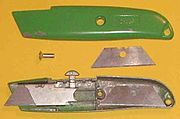
Folding rule, knife, and long level are like copper pipes. It belongs to the 20th century.zupermac said:For smaller pieces, the folding rule and a knife work well. For larger ones, take the long level and the knife. Try to do it on a table or something similar so you don't do it directly on the ground. When you have "scored," you can just move the board's scoring over the edge so that the board folds (be sure to hold it). So you don't cut it completely. Then cut the paper on the back in the middle. A sharp blade is preferable.
OldSchool
[bild]

A picture is worth a thousand words. There's nothing better than describing something with an image.
Spackling
Install joint tape correctly
Now, I'm not a painter, but I do enjoy drinking coffee and watching them sometimes.
When it comes to paper tape or that other fiberglass tape, it doesn't seem to matter much which one you use. For new construction, the paper tape might be preferable since it's a bit stronger (tension) in all joints and that might be needed in new builds. If you're putting up a little drywall on an already existing wall (stable), you can use the other one. It's also self-adhesive and a bit easier to handle. Painters almost exclusively use the paper tape, of course.
Spackling
Install joint tape correctly
Now, I'm not a painter, but I do enjoy drinking coffee and watching them sometimes
.When it comes to paper tape or that other fiberglass tape, it doesn't seem to matter much which one you use. For new construction, the paper tape might be preferable since it's a bit stronger (tension) in all joints and that might be needed in new builds. If you're putting up a little drywall on an already existing wall (stable), you can use the other one. It's also self-adhesive and a bit easier to handle. Painters almost exclusively use the paper tape, of course.
Last edited:
Still works.MathiasS said:
The same knife works for the roofing felt too, but then I have to change the blade a bit more often.
Exactly, you just end up cutting yourself. Plus, this model lasts better than those plastic things. There are also luxury versions, but I find it hard to justify the price.akhagen said:


How do you turn the sheet? Just sliding it out over the edge and snapping straight down should work, right?MathiasS said:
Yes, of course it does, that's probably the normal way. However, I usually flip it first while it's still intact and therefore easier to handle, then snap it "upwards" instead. That way it is ready to be split with the knife and I don't have to turn the disc when it's snapped and wobbly to handle.Daniel_N said:
Aha. I usually slide out, crack down, and then cut from the underside, the knife runs automatically right in with the angle where it's been cracked.MathiasS said: