We have bought a 50s wooden house that we have renovated.
One thing we have done is remove the crawl spaces to make "bigger rooms."
BUT
When you walk on the upper floor, it "thuds" a lot. (it didn't do that before)
The closer you get to the removed crawl space wall, the more it thuds.
(it thuds when my 4-year-old walks upstairs and we sit downstairs, so it's very sensitive)
The beams are very sturdy, I tried adding even more joists in between, but it didn't work.
Now I'm starting to believe that the walls of the crawl spaces had a function of pressing down the beam that runs along the house's side, making it "stiff."
In the places where we still have crawl spaces, the floor is excellent.
Has anyone experienced the same?
My idea is to put up a couple of hefty joists that "press down" this beam at the wall sides.
Or does anyone have a tip?
I would be very grateful for it.
Here is a picture when the floor is open, and the green line is where the crawl space was previously.
If you have kept the sawdust as insulation, it does very little to dampen sound and is not very good for insulation either.
I know how it works. But there are civil engineers employed by the municipal building permit department and that's what the question was about, right?
No, as I wrote before, the municipality required you to have an engineer calculate the structure and come up with a solution before you got a building permit.
Now you've cobbled something together yourself that no one is aware of. Maybe the next owner of your house will write about what you've done here on Byggahus.
No, as I wrote earlier, the municipality would have required you to have a structural engineer calculate the framework and come up with a solution before you received a building permit.
Now you've cobbled something together yourself that no one has checked. Maybe the next owner of your house will write about what you've done here on Byggahus.
I doubt it. But regardless, it's totally OK with me. By the way, I had a civil engineer here who took a look at it and gave it a thumbs up. He was a friend, but fully qualified, even though he now works on bigger things than houses.
Funny that people don't realize it's a troll. Just look at his "house plan" that was Googled.
Either it's a troll, or the original poster isn't doing so well with the house renovation. If you look at the original poster's account, they also have another popular thread here about a bathroom renovation that went to h*ll.
I have something that seems quite substantial in basically the middle of the house's upper floor. But unclear if those who removed one of our knee walls 50 years ago did it wrong.
Does this look like a beam that supports the roof?
That is probably some kind of pipe. The kitchen fan, maybe? Or bathroom ventilation?
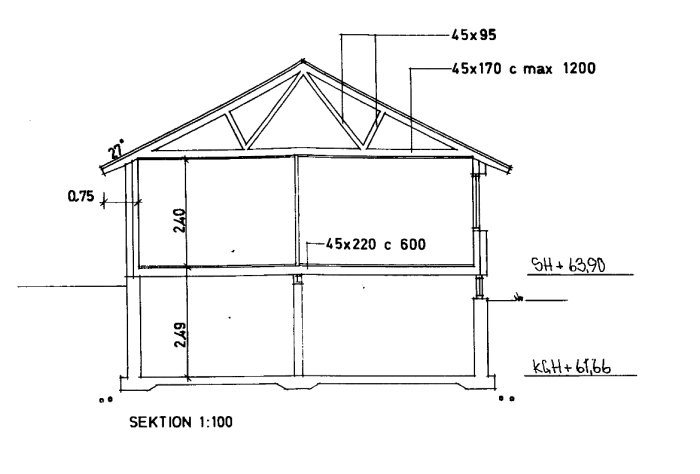
Many say that walls drawn on sectional drawings are always load-bearing, but is that really true? I can show my own house as an example.
Free-spanning truss rafters.
Sectional drawing.
If the walls on the drawing are always load-bearing, then the wall drawn on the ground floor would also have to be. Which I don't believe it is.
It is also built with 40x40 studs at 120 cc in "cross-sections."
In the TS case, it's quite obvious that the construction is load-bearing, but is it really entirely true concerning all sectional drawings?
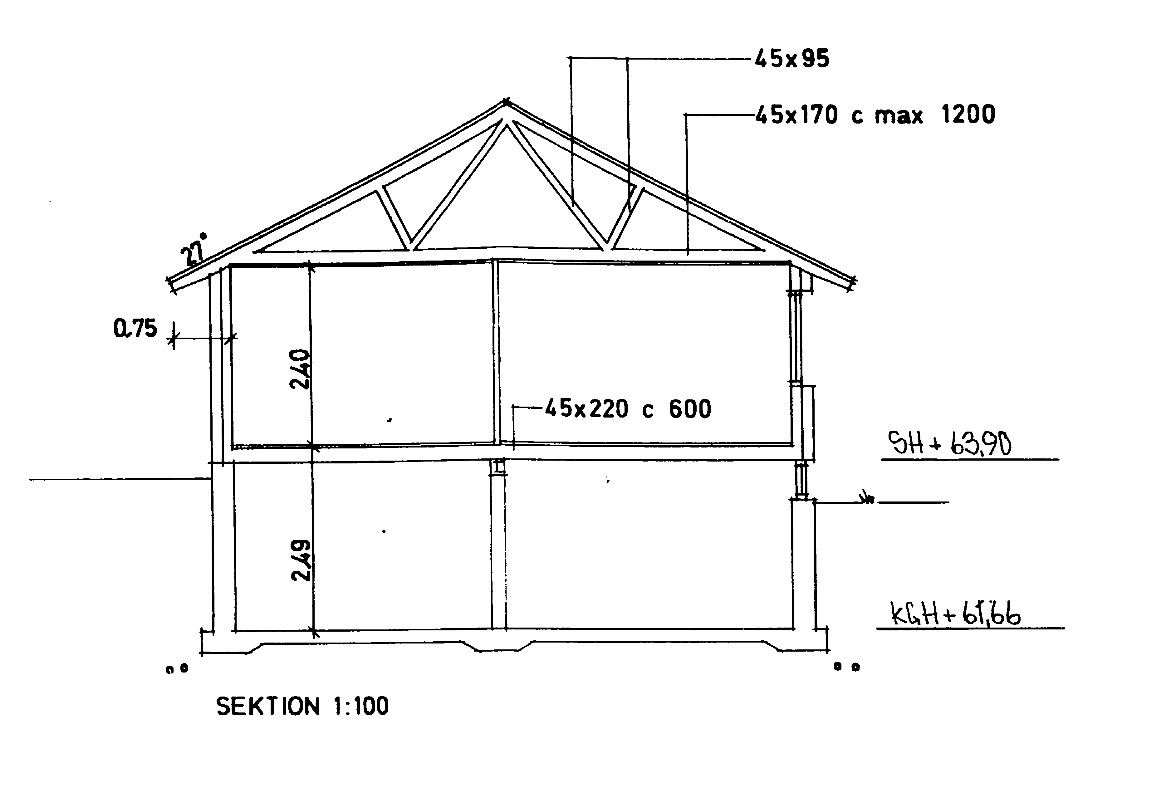
Many say that walls drawn on section drawings are always load-bearing, but is that really true? I can show my own house as an example.
Truss roof trusses.
[image]
[image]
Section drawing.
[image]
If the walls in the drawing are always load-bearing, then the wall drawn on the ground floor would also be so. Which I don't believe it is.
It is also built with 40x40 studs cc 120 in "cross-sections."
In TS's case, it is quite obvious that the structure is load-bearing, but is it truly the case for all section drawings?
No, it is obviously not the same as, for example, in your case with truss roof trusses.
We bought a 50s wooden house that we have renovated.
One thing we did was remove the knee walls to get "bigger rooms"
BUT
When you walk upstairs, it "thuds" a lot. (didn't do that before)
The closer you get to the torn-down knee wall, the more it thuds.
(it thuds when my 4-year-old walks upstairs and we're sitting downstairs, so it's very sensitive)
The beams going across are very sturdy, I tried adding even more joists in between, but that didn't work.
I'm starting to think that the knee wall had a function of pressing down on the beam running along the house's long side, making it "rigid."
In the areas where we still have the knee walls, the floor is fine.
Has anyone experienced the same?
My thought is to put up a couple of hefty joists to "press down" this beam at the wall sides.
Or does anyone have a tip?
I would be very grateful for it.
Here's a picture when the floor is open, and the green line is where the knee wall used to be.
Ddegi said:
Hello!
We bought a 50s wooden house that we have renovated.
One thing we did was remove the knee walls to get "bigger rooms"
BUT
When you walk upstairs, it "thuds" a lot. (didn't do that before)
The closer you get to the torn-down knee wall, the more it thuds.
(it thuds when my 4-year-old walks upstairs and we're sitting downstairs, so it's very sensitive)
The beams going across are very sturdy, I tried adding even more joists in between, but that didn't work.
I'm starting to think that the knee wall had a function of pressing down on the beam running along the house's long side, making it "rigid."
In the areas where we still have the knee walls, the floor is fine.
Has anyone experienced the same?
My thought is to put up a couple of hefty joists to "press down" this beam at the wall sides.
Or does anyone have a tip?
I would be very grateful for it.
Here's a picture when the floor is open, and the green line is where the knee wall used to be.
You can be completely calm! Nothing will happen other than it sounding a bit more. You can of course reinforce by making an open storage where the knee wall was with appropriate framing lumber. You can figure that out by yourself. There are surely more old houses with the knee wall removed than preserved. I live in a house from 1931 with the knee walls removed.
I work as a designer and can only confirm what many have written that the studs in the wall were part of the roof construction. Often in villas, the roof and the first floor are the same construction. By dimensioning it as a truss, where the knee wall is included, you can reduce the dimensions of both the floor beam and the roof beam. When you removed the knee wall, you also removed the intended interaction, so the roof beam and floor beam have too long spans. This means that the construction has lower stiffness, and as a consequence, you get problems with impact sound. Contact a designer to calculate it to ensure the roof holds the intended snow load. The floor can be reinforced if the roof is okay. Good luck!
Isn't it important as a designer to then get more information? What are the cc measurements between the trusses? Have the impact sounds always been there but are more noticeable due to the change of material/volume in the room? Have any subfloors been replaced, etc., etc.? What did the knee walls actually look like and what dimensions did the "support legs" have? Have I missed something?
I tore everything out on my upper floor. All the way out to the support legs, and the knee walls could hardly have played a role in the construction. Shabby studs and chipboard. Nevertheless, I put up new walls later. I experience a lot of thumping and impact sound on the ground floor, but that depends on how the house was originally built. 1940s
Isn't it important as a designer to gather more info in that case? What is the cc distance between the rafters? Have the impact sounds always been there but are perceived more due to change of material/volume of the room? Have any subfloors been replaced, etc, etc? What did the knee walls actually look like and what dimensions did the "support legs" have? Did I miss anything?
I tore everything on my upper floor. All the way out to the support legs and the knee walls could not have played a role in the construction. Shabby studs and chipboard. Although, I did put up new walls then. I experience a lot of thumping and impact noise on the lower floor but that's due to how the house was built in the beginning. 1940s
But you left the support legs =) Did the same thing, built with sticks and masonite I recall.
If you cut a piece of timber that takes tensile forces, the saw doesn't pinch, but it can still go completely wrong.
Isn't it quite unusual for vertical studs on a knee wall to have tensile force? Do you have any examples of this? I'm always interested in learning more!
Vi vill skicka notiser för ämnen du bevakar och händelser som berör dig.


Nissens said:
No, as I wrote earlier, the municipality would have required you to have a structural engineer calculate the framework and come up with a solution before you received a building permit.




Acora said:
Isn't it important as a designer to gather more info in that case? What is the cc distance between the rafters? Have the impact sounds always been there but are perceived more due to change of material/volume of the room? Have any subfloors been replaced, etc, etc? What did the knee walls actually look like and what dimensions did the "support legs" have? Did I miss anything?