The first two clamps didn't bottom the studs; the picture shows when I couldn't press them together anymore. And I don't doubt that each clamp can press 270 kg based on previous experience. But as I said, it wasn't a completely scientific experiment.
your results are perhaps 50-75% from reality depending on the quality of the timber that window/door manufacturers have
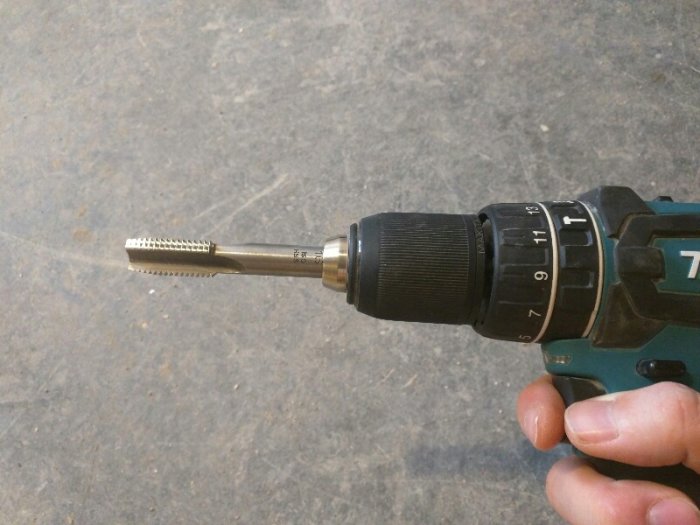
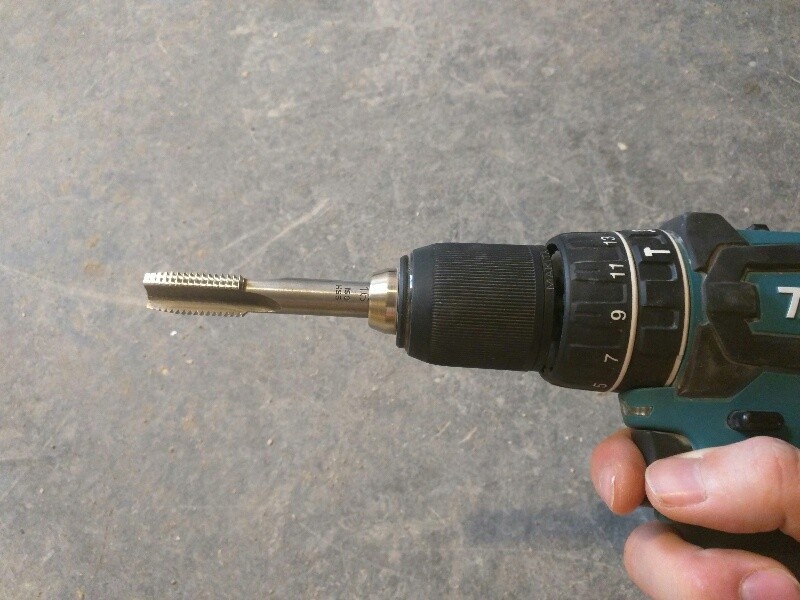
The experiment continues! I wanted to see if/what difference it would make if I threaded the wood before screwing in the frame sleeve. So I brought out an M16 tap, which incidentally fits perfectly in a 13 mm chuck:
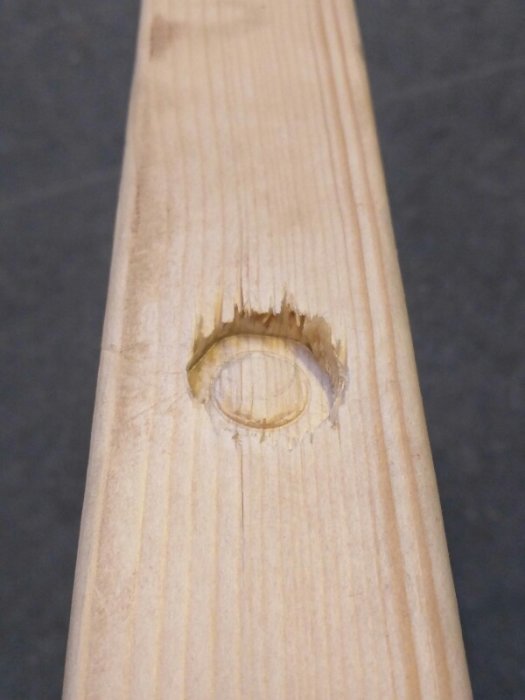
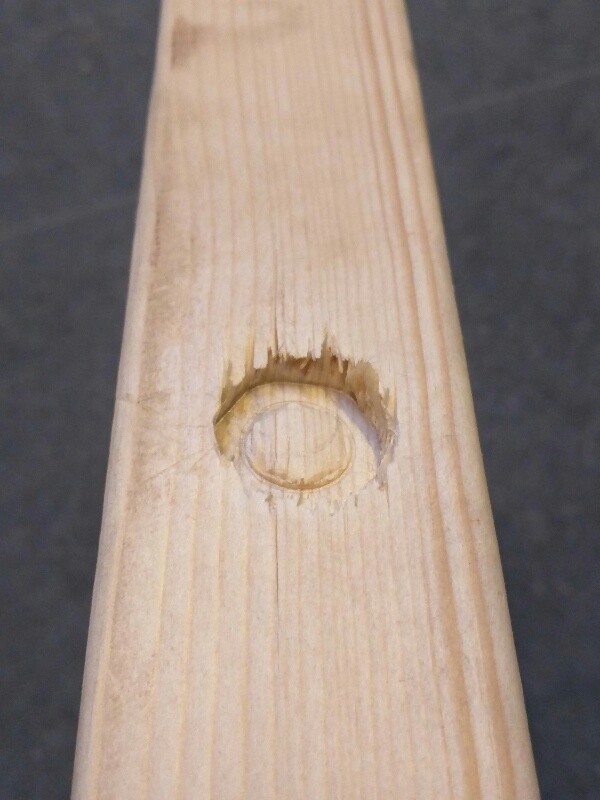
I threaded straight through the beam. My theory was that this would likely reduce the force required to press the sleeve into the beam, as the tap cuts out some material and makes threads that fit looser than those the sleeve cuts itself. But I was proven wrong, as I couldn't press the sleeve in even with 5 clamps. Instead, it was pushed about a centimeter into the opposite beam:
How fun it is when your theories are completely disproven! My new theory is now that a tap has sharp cutters that create perfectly neat threads in the wood, while a frame sleeve has blunter cutters which instead press the threads into the wood, leading to them being easier to compress. You live and learn!
Comparative single tests, on the other hand, are of slightly questionable value in determining differences. The worn-out part may have occurred in a piece of wood with better quality wood, even just in one spot on the same piece of wood with better quality.
However, with many tests and a well-developed testing methodology, one could draw far-reaching conclusions.
But regardless, even these simple tests provide a good deal of valuable information. At least we know the approximate strength range of the wood/frame sleeve, as long as a relatively substantial margin of uncertainty is taken into account...
I understand it as that the OP is not going to use the frame screw in a door/window but for something else, hence the tests.
A customer used a frame screw to adjust his roof and it seemed convenient
Exactly right! I have torn out the floor at home that consisted of wooden joists lying in sand on top of a very uneven concrete slab (think lunar landscape). Over the past 70 years, these have worked their way down into the sand, which has resulted in the floor becoming uneven and creaky.
So the plan now is to replace the floor joists and instead use frame sleeves to adjust the new joists against the uneven concrete slab (similar to a Nivell floor). This is in an apartment on the 3rd floor, so moisture is not a problem.
Is leveling compound not an option then? Like leveling flat and then laying joists directly on the level?
That would have been the simplest (to outsource), but an estimated 1000 liters of leveling compound+truck+labor didn't seem economically justifiable to get rid of a bit of squeaky floor. But just over 3000 SEK for 400 door frame sleeves+concrete screws is worth it (and with a 14 mm knot drill in the hand router, making holes in the joists is a breeze).
Correct! I have ripped out the floor at home that consisted of wooden joists lying in sand on top of a very uneven concrete slab (think lunar landscape). Over the past 70 years, they have worked their way down into the sand, which has resulted in the floor becoming uneven and creaking quite a bit.
So the idea now is to replace the floor joists and instead use frame sleeves to adjust the new joists against the uneven concrete slab (kind of like in a Nivell-floor). This is in an apartment on the 3rd floor, so moisture is not a problem.
then I can directly answer that it will not hold.
combined with stationary weights. with both downward-directed weights and side forces that occur when you walk, it will not hold
then I can answer directly that it won't hold.
combined with stationary weights. to both the downward-directed weights and side forces that occur when walking, it won't hold
I believe you, but please elaborate a little...
When everything is tied together with floor chipboard, it does feel like it should hold, right?
Nivell holds, doesn't it? I should probably add that I've never worked with the Nivell system.
What type of flooring are you considering ?? Parquet, for example, can be laid directly on sand.
I have torn up some sand floors, but have not encountered any with a combination of joists.
I believe you, but please elaborate a bit... When you tie everything together with floor chipboard, it feels like it should hold, in my opinion? Nivell does hold, right? I should add that I've never worked with the Nivell system
I agree with the question; can you elaborate on what you base it on?
I will be mounting the jamb sleeves with CC 30 in each stud, which can be compared to a Nivell floor where the nylon screws are mounted with CC 45. The studs will then be placed with CC 60 and with CC 30 along "furnishable walls," which is the same as for a Nivell floor. I will also be using 45x95 C24 studs, but "lying down" (i.e., 45 mm high), compared to Nivell studs which (most commonly) are 45x45.
According to my tests above, the studs bent long before a single jamb sleeve gave way, but the studs will be stronger than in my tests above.
An even cheaper solution is to use threaded rod. Cut it to the right length and make a t-slot in the top with the angle grinder. Threaded rod comes in slightly sturdier dimensions so bending/lateral forces won't be an issue. That's what I did when leveling a wooden patio built on concrete slabs.
All the data presented in the thread suggests that it will hold up excellently if lateral loads are disregarded. I'm not quite sure about the numbers, but the pullout strength of a slightly larger model wood screw should be well above the distributed load/number of screws. It's not uncommon to break the screw if using a crowbar.
I agree with the question; can you elaborate on what you base it on?
I will install the frame sleeves with CC 30 in each stud, which can be compared to a Nivell floor where the nylon screws are mounted with CC 45. The studs will then be at CC 60 and with CC 30 along "furnishable walls," which is the same as for a Nivell floor.
I will also use 45x95 C24 studs, but "lying down" (thus 45 mm high), compared to Nivell studs which (most commonly) are 45x45.
According to my tests above, the studs bent long before just a single frame sleeve gave way, but the studs will be stronger than in my tests above.
different threads. and different materials would help if the pin in the wood was equally hard.