
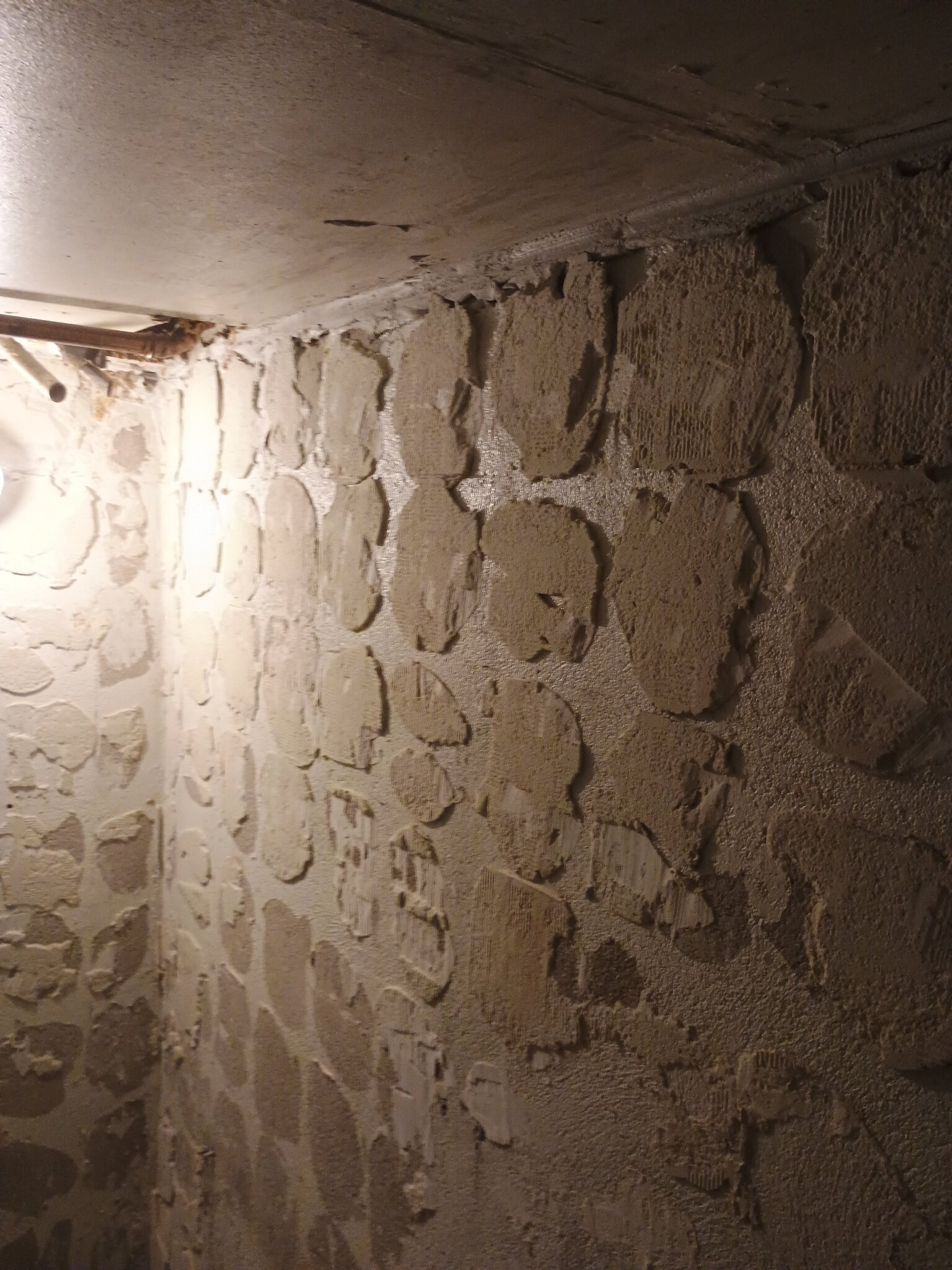


I'm wondering 🤔 why would you use self-leveling compound on a wall? And how would that work?J jonaserik said:
If it needs to be removed, I would chisel it down with a wide chisel and grind the surface with a concrete grinder, like a flex machine.
If it needs to stay, I would render the wall.
P.S., I just want to mention that the adhesive might contain asbestos if it's from the "asbestos period."
Saw it as if the floor was meant, the photo is a bit sideways. Maybe plaster up between the adhesive clumps, otherwise just chisel down. If it’s concrete it works reasonably well, but if it’s leca-lightweight concrete-brick, large bits come off. Possibly resulting in large holes.H HSP said:I'm wondering 🤔 why would one use self-leveling compound on a wall? And how should it be done?
If it needs to be removed, I would chisel it down with a wide chisel and sand the surface with a concrete grinder like a flex machine.
If it should remain, I would plaster the wall.
Ps, just want to mention that the adhesive might contain asbestos if it's from the "asbestos period"
Don't really know what kind of old adhesive it is, but it's at least 30+ years old.
Chiseling is completely hopeless, there's no good "edge" to press against. I've sanded with 40-grit paper now, but it takes forever and wears out the paper and creates dust (despite vacuuming...). 2x2m room, and at the pace I'm sanding now, it's at least 2 full days of work.
Plastering the wall might be an option, but the lower 1/3 of the wall follows the adhesive with the tiles.
Even that is a heck of a job, so it looks like I'll just continue sanding...
Chiseling is completely hopeless, there's no good "edge" to press against. I've sanded with 40-grit paper now, but it takes forever and wears out the paper and creates dust (despite vacuuming...). 2x2m room, and at the pace I'm sanding now, it's at least 2 full days of work.
Plastering the wall might be an option, but the lower 1/3 of the wall follows the adhesive with the tiles.
Even that is a heck of a job, so it looks like I'll just continue sanding...
The next problem is what to do with the walls. It's partly hard plaster that's stuck like rock and old paint in some places, and completely smooth where the fix was sanded. Three interior walls are 110% dry, one exterior wall definitely has some moisture in it, after all, it's an old basement. The easiest would be if there were some putty-like material so I could skim coat everything.
BUT I can't figure out which putty/mortar works. If it needs to breathe, it apparently has to be some kind of kalkbruk, but I can't plaster all the walls again, that seems overkill, and it likely won't adhere to the smooth areas.
I was considering Casco Väggspackel Wallcraft for a while but read that it was dense and "plastic-like" and didn't work well with breathable mineral paint...
I don't care what kind of finish it ends up with, rough or smooth, but it would be nice if it were uniform.
Any tips??
BUT I can't figure out which putty/mortar works. If it needs to breathe, it apparently has to be some kind of kalkbruk, but I can't plaster all the walls again, that seems overkill, and it likely won't adhere to the smooth areas.
I was considering Casco Väggspackel Wallcraft for a while but read that it was dense and "plastic-like" and didn't work well with breathable mineral paint...
I don't care what kind of finish it ends up with, rough or smooth, but it would be nice if it were uniform.
Any tips??
Click here to reply
Similar threads
-
Hur får jag bort denna strömbrytare av märken Elko?
Belysning -
Ta bort färg från bjälkar
Färg, Måla & Tapetsera -
Har jag gjort bort mig? Lagt parkett, hur får jag till list mot trappa
Golv -
Få bort färgstänk på lackad möbel
Möbelsnickeri -
husannonstext syns vid min gatuadress googlesökn - hur får jag bort ?
Juridik