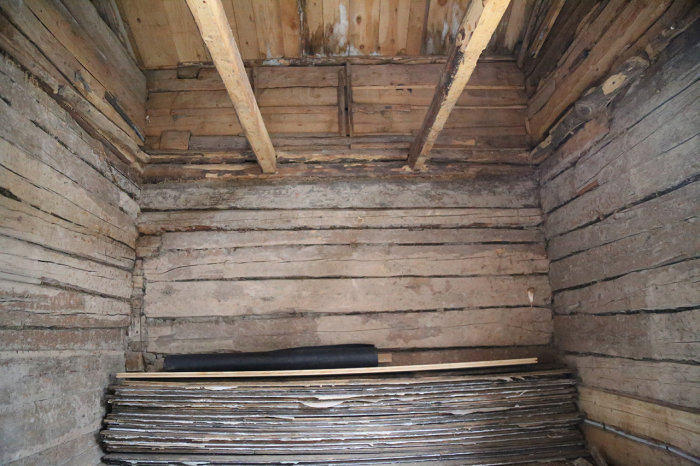
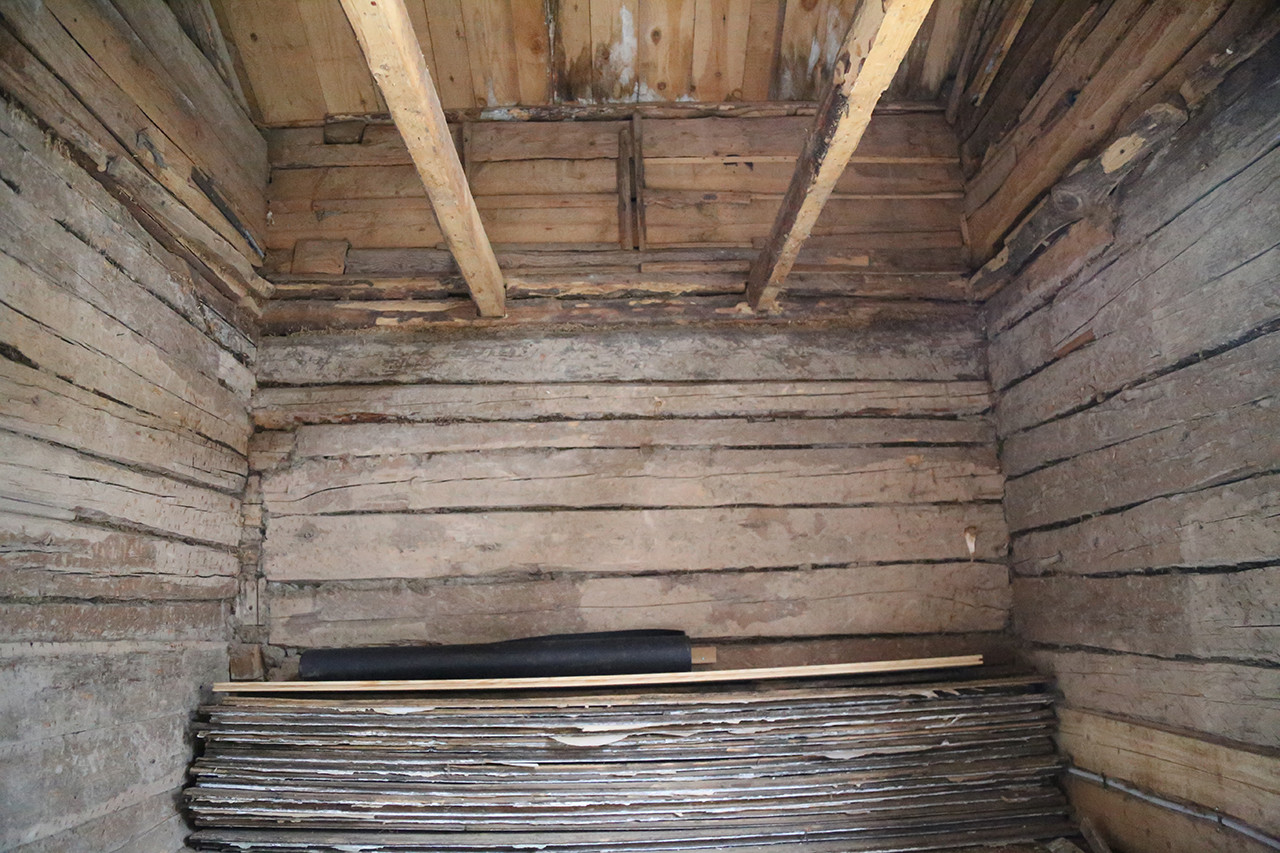
I am in the process of fixing an attic floor in an old cottage. In a room with a low ceiling and poor insulation in the attic floor, I have removed the attic floor, cleaned out the insulation (mainly leaves and oats as well as mouse droppings - the insulation was done in the autumn of 1890), and then removed the ceiling boards in the room (hand-sawn boards, about 30-25 cm wide, probably 200+ years old, warped but perfectly fine for another 100 years).
Boundary conditions: the room is 270 cm x 470 cm. Two longitudinal ceiling joists, about cc 90. Both the ceiling in the room and the attic floor are somewhat shaky. The framing is undersized. See the picture (taken from the room upwards toward the attic, with ceiling and attic floorboards removed):
I plan to make a couple of improvements:
1. Increase insulation height. The existing joists are 5 inches high and spaced approximately cc 90 cm. I plan to add 2 inches, making it 170 mm. Instead of oats, leaves, and mouse droppings, I intend to insulate with flax insulation.
2. Increase the standing height in the room by a couple of centimeters, to just over 180 cm.
3. Increase the stability of the attic floor.
I plan to do this by simply screwing (and possibly gluing) new joists parallel to the old ones. This is a very old house; the room is probably from the early 1700s (and originally likely a grain storage/pantry before becoming a room in the 1800s), and I therefore do not want to alter the room's character or replace more than necessary. Therefore, I want to retain the low ceiling height and the old joists; otherwise, the easiest, quickest, and structurally best solution would have been to just replace the joists with three new ones and raise them by a couple of decimeters.
I plan to use a jack to lift the existing joists in the middle by 2-4 cm (as much as possible) and screw the new joists in place, creating a pre-tensioned structure where the old beams are lifted by the new, screwed-in ones. There are now two options:
1) 2x7 joists are screwed to the side of each existing 5-inch joist, so the new joists stick up 2 inches above the existing joist. This increases the insulation space by 2 inches. The attic floorboards then have a smaller bearing surface. This solution is recommended by the carpenters/joiners I have hired for other work on the house.
2) A 2x7 is placed on top of each existing joist on the flat side and screwed down from above. It's a bit more tricky to install and perhaps a bit more complicated with the insulation. But it provides a larger bearing surface for the ceiling boards. This solution is recommended by the county's building conservation expert I consulted.
Questions:
1) Which of the above solutions provides the greatest stability?
2) Which solution best maintains the pre-tension and increase in ceiling height?
3) There will be some form of twisting moment on the existing beams with solution 1 above. The higher the load on the attic floor, the higher the twisting moment. But is the moment significant at all? The attic floorboards rest and are attached at each end.
4) Is there another, better solution to achieve what I want (without removing existing joists)?
Turning the Platten on top doesn't do much. So the span is 4.70? In reality, even 2x9" doesn't suffice with such a long span. But if you can live with a slightly rattling floor, go with option 1. Insert an extra 2x7" between the existing ones as well. This way, you get only a 45cm span on the floorboards in the attic!
If the attic isn't going to be used, a sturdy beam, like 6x8", could be placed across the existing beams and screwed together. The crossbeam rests/is attached to the long walls.
That's the case in my own and my neighbor's Skånelänga/cottage, where the attics were used as grain storage. (Which might explain why the "insulation" consisted of oats.)
Click here to reply
Vi vill skicka notiser för ämnen du bevakar och händelser som berör dig.