
7,007 views ·
64 replies
7k views
64 replies
How to insulate fluted joists?

Dalmas: You don't seem to understand at all how moisture is transported in a building. Your advice is not suitable to follow.
There is a lot in Daniel 109's comment. If you do not have very good knowledge of how moisture mechanics works, you should not give advice in cases that do not belong to the standard solutions.
In this case, I would be concerned that the concrete has such a high vapor resistance that the floor joists become "too enclosed."
We actually see this all too often here on the forum; if the advice contains words like breathe and cellulosaisolering, you should be extra critical. Cellulosaisolering is not bad at all and you can gladly use it because it makes better use of natural resources, but its moisture buffering capacity is too small to have any significant impact in practice, this has been shown by SP.
In this case, I would be concerned that the concrete has such a high vapor resistance that the floor joists become "too enclosed."
We actually see this all too often here on the forum; if the advice contains words like breathe and cellulosaisolering, you should be extra critical. Cellulosaisolering is not bad at all and you can gladly use it because it makes better use of natural resources, but its moisture buffering capacity is too small to have any significant impact in practice, this has been shown by SP.
I hear you.W witten said:There is a lot of truth in Daniel 109’s comment. If you don't have very good knowledge of how moisture mechanics work, you should not advise in cases that aren't standard solutions.
In this case, I would be concerned that the concrete has such high vapor resistance that the floor beams become "too trapped."
We actually see this all too often here on the forum, if the advice includes words like breathing and cellulose insulation, you should be extra critical. Cellulose insulation is not bad at all and you can certainly use it as it makes better use of natural resources, but the moisture buffering capacity is too small to make much of a difference in practice, as SP has shown.
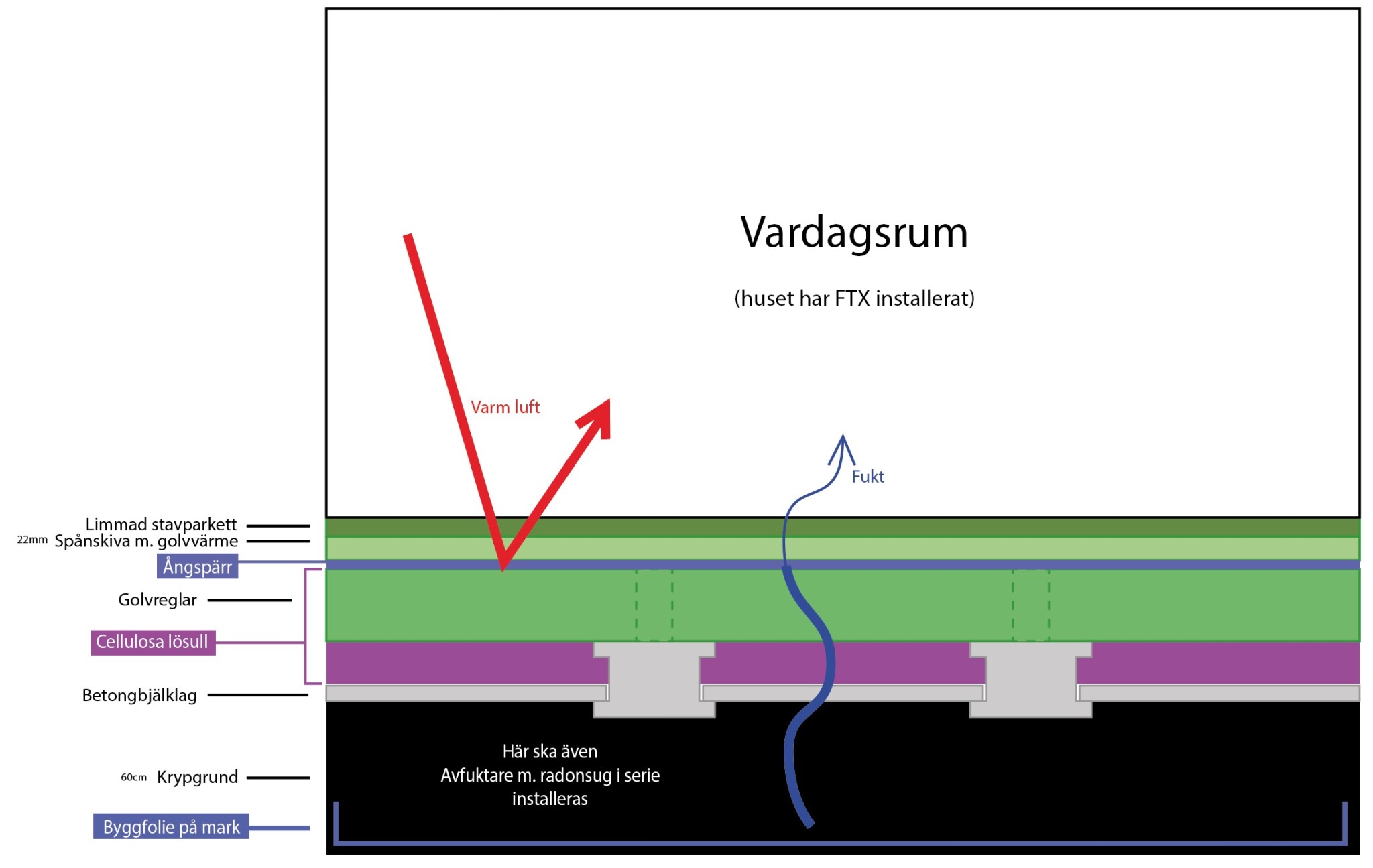
Do you think my latest sketch in post 16 seems reasonable and something I should go with?
Totally okay if you think so.. But how big of a loser are you if you don't provide a correct solution to the problem yourself when criticizing others' opinions.. You can have your views, but don't throw dirt at others if you don't provide a concrete solution or guide the user on how to proceed... You have many posts, much of it is just junk and not very helpful... You might as well just write "ask a constructor" instead of going after other users... That was totally lousy of you...D Daniel 109 said:
I want to help the OP by warning against completely incorrect advice. There are others who have given sensible advice in the thread. But I can repeat if you want.
A moisture barrier should always be on the warm side of a building component. Or more accurately, the side with the highest absolute humidity, but that is basically the same thing. So to the extent that a moisture barrier is needed, it should be high up in the floor. The underside should be more vapor-open than the top side. Cellulose insulation clearly has advantages. But some seem to think it solves all moisture problems, so you can build however you want. That's not true. A dehumidifier in the foundation is good if there's a risk of high humidity there. Better floor insulation results in a lower temperature and thus higher relative humidity in the foundation.
Does that answer work for you?
A moisture barrier should always be on the warm side of a building component. Or more accurately, the side with the highest absolute humidity, but that is basically the same thing. So to the extent that a moisture barrier is needed, it should be high up in the floor. The underside should be more vapor-open than the top side. Cellulose insulation clearly has advantages. But some seem to think it solves all moisture problems, so you can build however you want. That's not true. A dehumidifier in the foundation is good if there's a risk of high humidity there. Better floor insulation results in a lower temperature and thus higher relative humidity in the foundation.
Does that answer work for you?

Know-It-All
· Västra Götaland
· 12 305 posts
It just so happens that Daniel 109 is right.
Know-It-All
· Västra Götaland
· 12 305 posts
When it comes to flooring, it is indeed more complicated. You have warm indoor air that wants to transport moisture down into the floor, while you have ground moisture that wants to come up. Hence, a moisture barrier against the ground, a moisture barrier against living spaces, and something ventilated in the space in between.
Now the user writes that his sheet metal is his moisture barrier as it should be sealed... Why should he then add another moisture barrier above the insulation if it later turned out not to be completely sealed?... Where does the moisture stop then?.. In certain seasons, the metal sheet will be cooler on the inside, and moisture will form there... Where will it go?When it comes to flooring, it is more complicated, yes. You have warm indoor air that wants to transport moisture down into the floor while you have ground moisture that wants to come up. Hence the moisture barrier against the ground, moisture barrier against the living space, and something ventilated in the space in between.
Where does TS mention a sheet at all?
The same laws of nature apply to floors. As in other parts of the climate envelope.
The same laws of nature apply to floors. As in other parts of the climate envelope.
Know-It-All
· Västra Götaland
· 12 305 posts
If it is a diffusion-tight sheet, only diffusion-tight insulation should be used there. But now TS has placed cellulose, and in this case, the least bad option is a vapor barrier that still allows some drying out and limits moisture penetration from the living area.
I don't see any sheet metal either in TS sketches or posts. Where did you get it from?