
60,122 views ·
41 replies
60k views
41 replies
How to hang kitchen cabinets on a lightweight concrete wall?


I used nylon plugs from Essve.
Builder, I have the utmost respect for your experience and exceptionally knowledgeable and well-articulated advice here on the forum, but in this case, I hope you are completely wrong....
Builder, I have the utmost respect for your experience and exceptionally knowledgeable and well-articulated advice here on the forum, but in this case, I hope you are completely wrong....
I can add that all kitchen cabinets were previously hung with regular galvanized nails that were nailed in at an angle, which has been the case in all apartments. Radiators, on the other hand, were hung with threaded rods and mortar.
Best regards
Best regards
Unfortunately not. As a builder, property owner, and manager, you get some insights into how things are not always as safe as appearances and especially advertisements suggest. My experience is based on numerous collapsed kitchen cabinets with costly compensation claims for the contents.MathiasS said:
Once, a carpenter tried to prove me wrong with the 'crowbar test' in a light BTG wall, claiming I was wrong, and foolishly, I fell for the trick. 80 apartments and two years later, over 20 upper cabinets had fallen down. One as soon as the tenants moved in. Then we took down all the upper cabinets and installed them with threaded rods. At the time, Fischer's nylon plugs or extended plugs were not available, and the carpenters, against my orders, had used screws that were too long for the plugs. (What protrudes on the backside is of no use if they aren't in wood, and there's none in light BTG.)
During the renovation of my daughter's house purchase, I noticed an upper cabinet that looked a bit suspicious. It was hanging on a load-bearing, 15 cm thick wall of light BTG. Fortunately, the cabinet was empty after the previous owner moved out. When I was about to detach the doors, the cabinet fell on me. The remnants of the plastic plugs remained in the wall but were also found in the screw threads = cold drawing in the plastic. (It has been shown even in BTG that under pure tensile force, the plastic doesn't hold in the long term. The friction in the hole between the plastic and surrounding material then becomes irrelevant, regardless of how great the friction is.)
An earlier and significantly safer method for cabinet installation was to hang them with clip nails dipped in saltwater (causing them to rust fast to the light BTG). The tip was bent 10-15 degrees, and the nail was hammered in. However, this method had the disadvantage that the rail in the upper cabinets would often come loose since it wasn't level with the back edge, but 3-5 mm in. Therefore, they switched to plugs and screws and faced new problems instead.
__________________
The Builder

Self-builder
· Stockholm
· 8 592 posts
The Builder: So what are your experiences with nail plugs then?
There, at least, the screw/nail and plug are matched for each other, so "cold drawing" should not occur?!
/K
There, at least, the screw/nail and plug are matched for each other, so "cold drawing" should not occur?!
/K
klaskarlsson said:
I only have experience with nail plugs on a smaller scale, like nailing up cable. And it works excellently there
How it is to use nail plugs for mounting overhead cabinets in kitchen furnishings I have therefore avoided being confronted with Some experiences you'll have to get on your own If it holds, it holds. If the cabinets fall down, then you know that it's not nail plugs you should use next time, etc.One final clarification. Strain only occurs in plastic plugs, not in nylon plugs.
_______________
The Builder
Self-builder
· Stockholm
· 8 592 posts
Nail plug for cable :S
It must be a small variant of plug, or a really big cable
My nail plugs are between 80 - 120 mm in length with a 4 - 6 mm diameter
/K
It must be a small variant of plug, or a really big cable
My nail plugs are between 80 - 120 mm in length with a 4 - 6 mm diameter
/K

With the right plug, the right screw, and the right drill hole, the cabinets will probably stay put. The criticized magazine Gör Det Själv features in its latest issue an overview of plugs and what different plugs (with the right screw) can handle in the different materials they are intended for.

Now I just need to step in.
The builder is referring to these kinds of nail plugs, which are white or yellow. Perfect for when you're securing, for example, electrical cables with staples. Draw a straight line, a 5 mm hole in the middle of the line, insert the APK plug, and staple the cable straight and neatly.
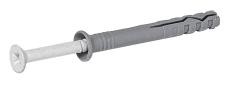
klaskarlson is referring to the other, larger type of plug, often close to or around a decimeter long. Great for attaching really heavy things with, in concrete at least. In light concrete, I wouldn't think any of the plugs are particularly suitable. OK, a cable doesn't weigh much...
That's what you mean, isn't it...
The builder is referring to these kinds of nail plugs, which are white or yellow. Perfect for when you're securing, for example, electrical cables with staples. Draw a straight line, a 5 mm hole in the middle of the line, insert the APK plug, and staple the cable straight and neatly.
klaskarlson is referring to the other, larger type of plug, often close to or around a decimeter long. Great for attaching really heavy things with, in concrete at least. In light concrete, I wouldn't think any of the plugs are particularly suitable. OK, a cable doesn't weigh much...
That's what you mean, isn't it...
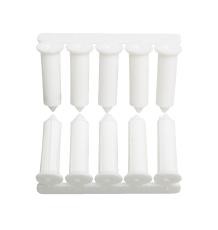
Yep! That's what I meanMikael_L said:Now I just have to step in. The builder means these kinds of nail plugs, which are white or yellow. Perfect when you need to nail-clip, for example, an electric cable. Draw a straight line, a 5 mm hole in the middle of the line, insert an APK plug and clip the cable neatly and straight.
klaskarlson means the other, larger type of plug, often close to or around a decimeter long. Great for securing quite heavy things, at least in concrete. In light concrete, I wouldn't think either of the plugs is particularly suitable. OK a cable doesn't weigh much...
That's what you mean, right...?
And I also completely understand what klaskarlssons' nail plugs look like, but I haven't used them myself. They kind of came around a bit later than when I finished my career on the construction site.
And I've had the magazine Do It Yourself on trial for a year, but I've abandoned it. For me, it falls into the same category as Martin Timell's 'professionalism', and that's amateur level for me
They hit the jackpot when they tried to show how to do a load-bearing frame with a block in a floor for a staircase and titled the article Shift into a new gear. That's something SJ might deal with, but not a builder.
____________________
The Builder
Self-builder
· Stockholm
· 8 592 posts
Yes, it's that larger variant I mean
They sit "gö bra" - even in light concrete.
Probably depends on several factors, but the length and that the plug and screw/bolt are perfectly adapted are probably the most important. As mentioned, the drill holes should ideally be made a few mm smaller than the diameter of the plug in light concrete so it sits even better
/K
They sit "gö bra" - even in light concrete.
Probably depends on several factors, but the length and that the plug and screw/bolt are perfectly adapted are probably the most important. As mentioned, the drill holes should ideally be made a few mm smaller than the diameter of the plug in light concrete so it sits even better
/K

Sorry for the thread hijacking. Builder, is there a magazine one can subscribe to/read to enrich oneself in the art of building? Personally, I have received some help from my craftsman to 'get started' with certain things, but you can't run to him all the time. Besides, his interest now that my biggest jobs are completed is considerably less nowadays...imported_Byggaren said:And the magazine Gör det själv I have had on trial for a year, but abandoned it. For me, it falls into the same category as Martin Timell's 'professionalism' and that's amateur level for me
The price they took when they showed how to make a beam exchange with a nogging in a floor framework for a staircase and titled the article Shift into gear. Such things might possibly be handled by SJ, but not by a builder.
____________________
Byggaren
I have read Gör Det Själv for a few years now, but I haven't seen any better publication. Sometimes I imagine that I am learning things, even though I naturally don't have enough knowledge to evaluate or grade whether what they show in their articles is done the right way or not. At the same time, you want to get better and learn new things, so any tips on periodicals or the like are gratefully received!
I agree that it can sometimes get silly. However, one must not forget that it's a Danish magazine being translated into Swedish by a translator who is not familiar with the construction industry.