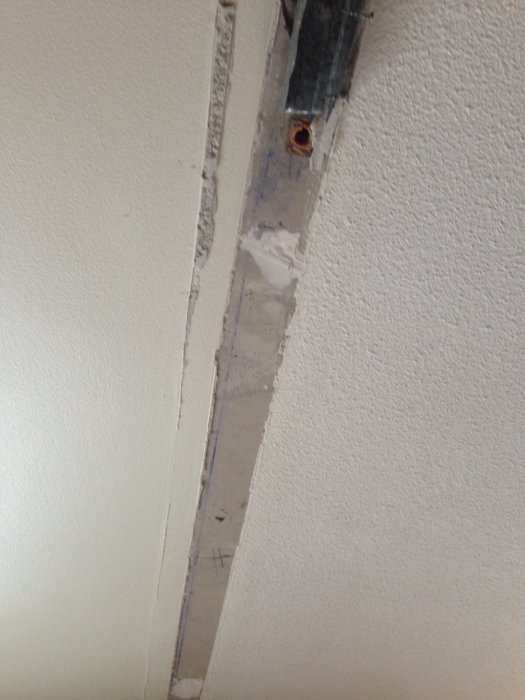
We have removed an interior wall in our condominium (80s building). As the picture shows, there were steel studs in the ceiling to support the wall we took down.
How can we fix this so the ceiling feels unified for both rooms with the least visible seam possible?
The ceiling in the room on one side of the seam (left) has a smoother surface than the room on the other side of the seam (right). We want to paint the entire ceiling with textured paint just like the right side and thus minimize seam visibility.
We have demolished an interior wall in our condominium (80s building). As the picture shows, there were steel studs in the ceiling to support the wall we took down.
How can we arrange this so that the ceiling feels unified for both rooms with the least possible visible seam?
The ceiling in the room on one side of the seam (left) has a smoother surface than the room on the other side of the seam (right). We want to paint the entire ceiling with textured paint just like the right side and thus minimize seam visibility.
Grateful for answers
/tsop
]
start by removing all rough edges, e.g., with a scraper/sander, then fill, sand, prime, and then apply the textured paint twice, preferably using a thick roller...
It will never be completely identical unless you now put in a huge amount of work and make both sides equally smooth and then repaint everything. So you will probably have to count on some deviations, but on the other hand, it is only now that you also see them. Once it is painted and fixed up and a few months have passed, you won't even think about it. (even if they end up different)
Then I'll need to purchase a coarse roller and find something good to scrape with.
Do I only need to prime the joint area, or should I do the entire ceiling?
Should I texture paint the entire ceiling, or just the left room where textured paint hasn't been used? I guess the former.
hard to say, what does it look like? many damages? are there any discolorations or the like, if not, then just work on the spot, and apply the topcoat twice then
Much depends on the lighting in the room; with the right lighting, you can magically conceal quite large differences...
As for the wall, it's probably about fitting a suitable wooden rule in between and cutting according to it, otherwise, it will likely take quite a lot of filler...
Some suitable corner protection and filler. Or planed wood with trim on the sides.