Can't they be cut at a 45-degree angle with an angle grinder and stone disc, and then put in a couple of irons as extra reinforcement between the layers, which go half a meter into the next stone?
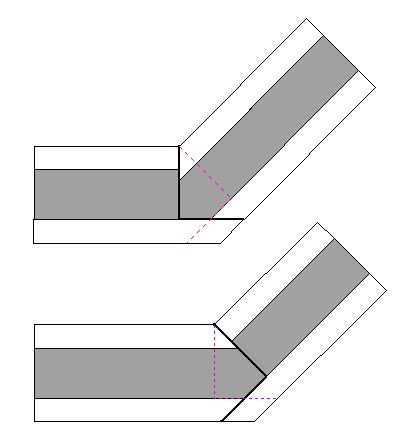
Yes, it would be simple if it were something like this that was meant:
And then switch by flipping it over. But how can I solve the problem that the insulation is exposed on the sides? And also in the joint, the insulation is against the wall edge, is that a problem?
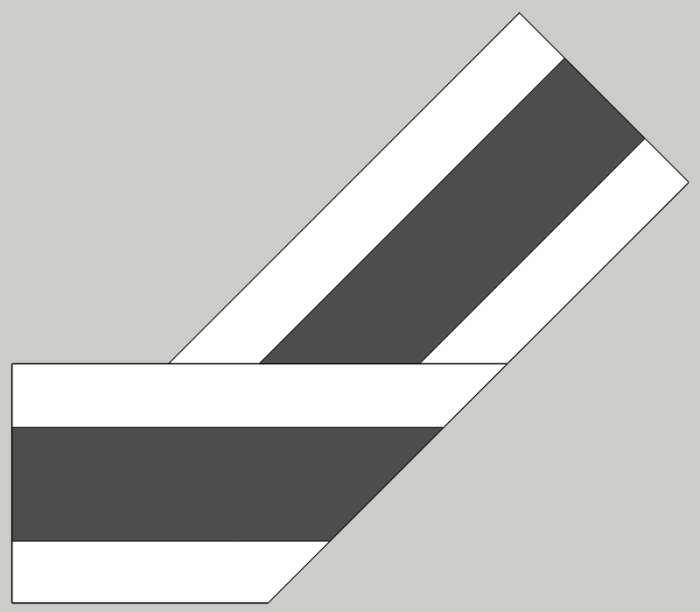
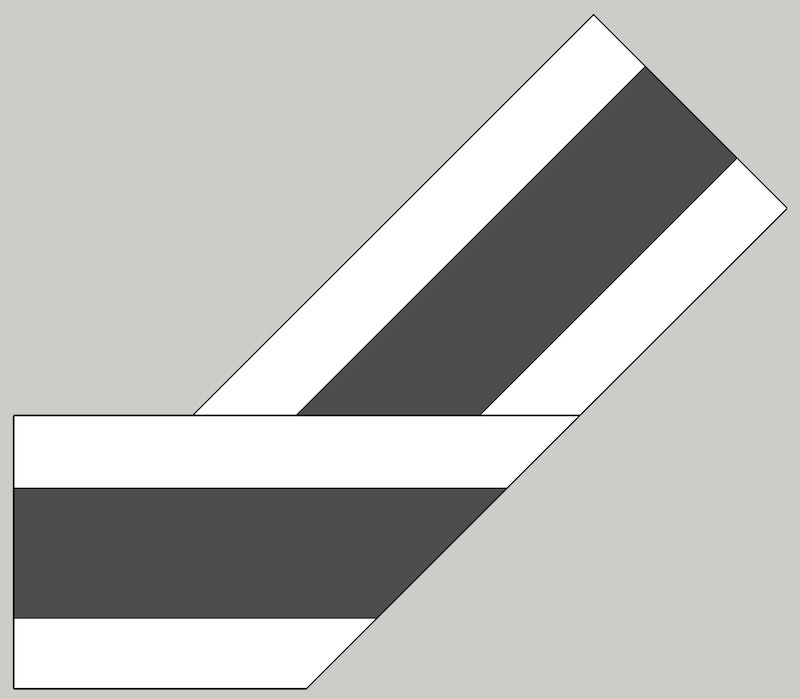
Thanks for the answers. Ideally, I want to avoid a joint in the outer corner, and a general joint is probably not an option at all. The best I've come up with myself so far is something like this:
Are there any cardinal mistakes with this solution? I've asked the supplier for suggestions.
If I were you, I would have done the joining according to post three. Much more stable. That the insulation won't be complete, I wouldn't give a damn about!
Yes, you got it right! I'm thinking though that the overlap might be a bit too weak. But if you could glue the joint strongly enough for it to function as a homogeneous block, maybe... But for me, it's probably still the suggestion in post #3 that applies, if one is being a bit rational too.
How much fiddling and spilling can you imagine? If you follow #3 and in addition cut some blocks lengthwise, you can use these as covers on the open edge (after the corresponding piece on the short end has been removed).
If you want to be really material-efficient, only cut the inside and the core of the block that has the core inward towards the joint. Then you'll probably get four covers per slaughtered block (otherwise, it'll probably only be two).