I have no idea if I've ended up in the right subforum, but if not, feel free to move the thread to a more suitable place. I barely know how to formulate my question correctly...
But it's like this: we are considering trying to make a "cold room" (equivalent to an old-fashioned root cellar) in our barn/loft where we can store our crops (as well as jars, drinks, etc.).. and we're wondering a bit about how one can/should do it and what to consider... if it's even possible?
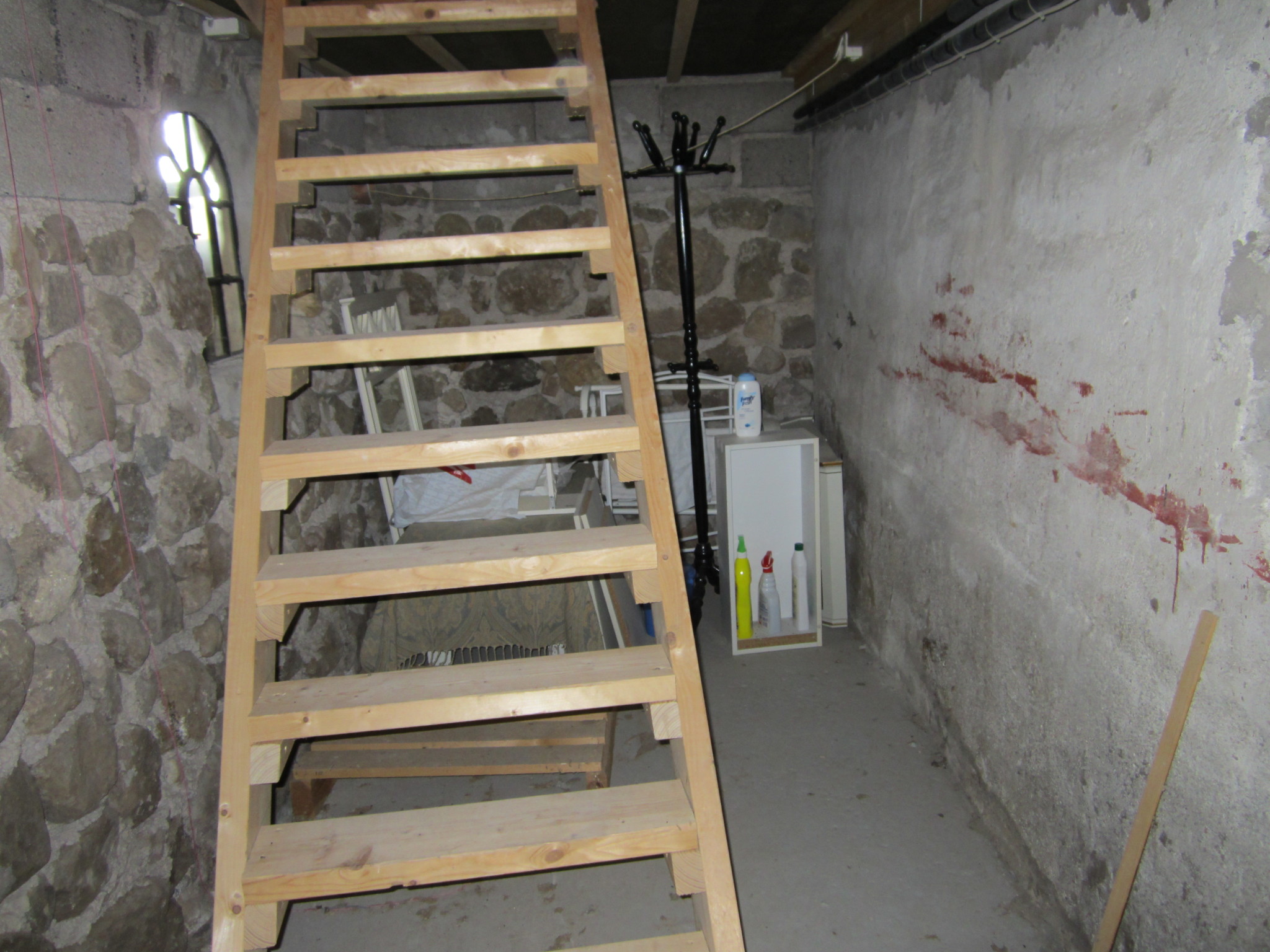
We have a suitable space today, so to speak, in the middle of the house, where there are partly natural stone walls (mixed with some cinder blocks) and a cast concrete floor. The ceiling consists of that black board (which I've forgotten the name of)
Attaching a picture here of the space, minus the stairs that have been removed (where the stairs end, towards the camera, there are a couple of boulders on the ground, the plan is to build a wall there and put a door).
How should one think?
- Humidity? How humid should it be in a root cellar (or rather for the food to keep) and can that humidity affect the apartment above? (and if so, how should one seal/fix the ceiling so that the humidity doesn't disturb the apartment above).
- Cold? General temperature? (currently, the space gets residual heat from the laundry room which is next to it).
- Insulation? Should one insulate or let it be as it is? (we plan to heat on the other side in a few years, i.e., not just the laundry room).
- Ventilation? how should one think here? Inlet and outlet...
What temperature do you have today? During wintertime, it seems like there is a window there, and an exterior wall, does it get ice or frost on them during the winter? Is there any indication that there might be some growth on the walls that can be seen, a bit like fuzz or something else?
The window you glimpse opens out to the barn, which is currently unheated (though there are plans to keep it at least 'maintenance warm' year-round soon). None of the walls in the space shown in the picture are exterior walls, but it can reach around -2 degrees in the barn on the coldest winter days (Skåne).
In the laundry room, which is currently connected/open between them, we've had the floor heating at about 14 degrees (plus, there's a storage tank in the laundry room and the washer/dryer run quite often), and it's the waste heat from there that has warmed the space in the picture. I haven't unfortunately placed a thermometer in there to check.
I believe if we had put up a wall and door, it would be significantly cooler in THAT room.
the question about temp was a bit important, if you are going to have potatoes there, the temperature should be max about +2-+3C otherwise they may start sprouting in mid-January, otherwise the temperature seems pretty good and there's no risk of freezing. what can cause problems is if you start putting up walls and possibly insulation, the moisture that is present in some form should go out into the room. You mentioned LGH above, is there a problem with the ceiling there now? if not, don't worry, what can be good is to have some pipe going out into the air and a pipe coming in from the shed, but not too warm, earth cellars naturally ventilate themselves through natural draft, it's warmer there than outside.
We have no ventilation today in any of the rooms and that needs to be fixed, therefore we're trying to figure out what to do in "that" room before we fix the one next to it
As far as we know and can see, there are no moisture (or mold) problems in the space, neither on the walls nor the ceiling! However, there is extremely poor ventilation which periodically causes a bad smell throughout the laundry room. But as mentioned, this will be fixed.. There will be both supply and exhaust air (in both rooms).
I thought two degrees was too cold for potatoes? That they should be around 5-6 instead. I've never stored potatoes long-term myself, so I don't know how it's supposed to be Do root vegetables like roughly the same temp?
Not too worried about the walls directly, they are Leca and stone. But I don't want too humid air in the floor structure under the apartment (above the intended "food storage") in the insulation and so on.. hard to keep track if something gets moldy etc. That apartment is fully heated and people live in it.
At the same time, it shouldn't be dripping wet in a "root cellar" either, so it SHOULDN'T be a problem.. (?)
If we're going to add some air, can we run a pipe a few meters out.. (To/through an exterior wall) and have it draw in air on its own.. kind of like natural ventilation.. or do we need to help the air along?
Sensible to have it from the outside coming in at floor level, with some form of damper so that not too much cold air comes in. With the damper, it is then possible to regulate it, then a pipe out through the ceiling, preferably a 75 mm drainpipe, regular earth cellars have one in that size on the earth roof and nothing in (not airtight in the doors) and natural ventilation, (remember my grandmother's) it is probably inappropriate with a fan, as it might create too much ventilation.
About the temperature for potatoes, it was a potato farmer who said it, but it might vary a bit depending on how the cellar is, you can try one year with about +4C, but no potatoes near the pipe that comes in, as they might freeze, it shouldn’t blow in the pipes, just barely perceptible.
To insulate against the apartment above, something can be placed on the ceiling of the cellar. I don't think moisture will be a problem when you say that it is dry. This will probably turn out well, I have a root cellar one floor down, with a bit of chill in it.
Dampers for regulating incoming air levels shouldn't be a problem to achieve (in my opinion) but what about the temperature then? Several times, for example, we've had 12 degrees outside.. a few days before Christmas (not so unusual). How should one think regarding food storage then?
Hope it doesn't get as warm in the space or should there be some form of cooling unit? (as opposed to a real root cellar, this space is above ground.. and will probably get a bit warmer with the surroundings)?
Just out of curiosity, what should good humidity levels be in a good "root cellar"? if one should have some benchmark..
The high temperature might be a problem for you, since you live at that latitude, you're aware of this, I have a house there myself. Perhaps a portable cooling unit could solve it; there are several available at a somewhat reasonable price. The problem with them is that they also reduce the humidity, creating condensation when the air is cooled, and depleting the air of moisture. You might need a unit that sits outside and brings in the cold air, but then it will cost significantly more. To get it right, it's probably best to talk to someone who specializes in AC, not someone at a department store, but a professional. I can't help any further, it's important to get the right temperature and humidity, which can be somewhat tricky at times. I cool my food cellar with the brine fluid from my heat pump at about +6 C. I hope you end up with a good food cellar!
Click here to reply
Vi vill skicka notiser för ämnen du bevakar och händelser som berör dig.