Haha oh my god no I can't be bothered to redo it. It took ages to build the frame. Doubtful if it can be used again. First, I need to see how the top side turns out. If there are no tracks or lots of cracks and it can be sanded nicely, I'll keep this one. I don't care what the underside looks like.
And exactly why couldn't you use the mold again? Such a mold should easily be used more than 10 times. And I agree with the previous speaker, by the third attempt you probably have something usable. Go for expansion compound on attempt 2.
Mainly thinking about how it will lose stability if I keep screwing screws in and out. It took me two days to get the sargerna to lie just right. But in theory, it is possible. However, quite bothersome.
How many days should I keep watering? Is there any point in continuing after a week?
Mainly thinking about the fact that it loses stability if I keep screwing in and out screws. It took me two days to get the frames to lay just right. But in theory, yes, it's possible. But quite troublesome.
How many days should I keep watering? Is there any point in continuing after a week?
Four days is recommended by Finja, now we want to see the result!
When the concrete begins to whiten, you can consider removing the formwork, water it for another week; as long as you water it, it will not whiten.
After that, you can remove the plastic and let it dry out; concrete cures for 100 years, after which its strength starts to reverse.
When the concrete starts to whiten, you can consider removing the formwork, water for another week, as long as you water it will not whiten,
Then you can remove the plastic and let it dry out, concrete cures for 100 years after which it goes backwards in strength
This guy recently posted a video about a countertop similar to yours. That is, with a large hole. I believe it was some concrete mix specifically for countertops they have in America, but it might still be of some help?
Looked like he mixed it very dry to me, then mixes a slurry to fill in the cavities.
The longer you wait, the better. Water for another week, and then let it dry out until it whitens, it will continue to harden for a long time afterward. Cracks occur when the water exits too quickly, for example, a house slab is almost impossible not to get cracks, then it should be vacuum sealed.
The longer you wait the better, water for another week, and then let it dry out until it whitens, it will continue to burn for a long time
Cracks occur when the water leaves too quickly, for example, a house slab is almost impossible not to get cracks, then it should be vacuum-sucked
Hahaha it would be fun to vacuum-suck a concrete countertop. I was actually on a job a few weeks ago where we vacuum-sucked the floors. You don't see that very often nowadays, say those who were around in the 80s.
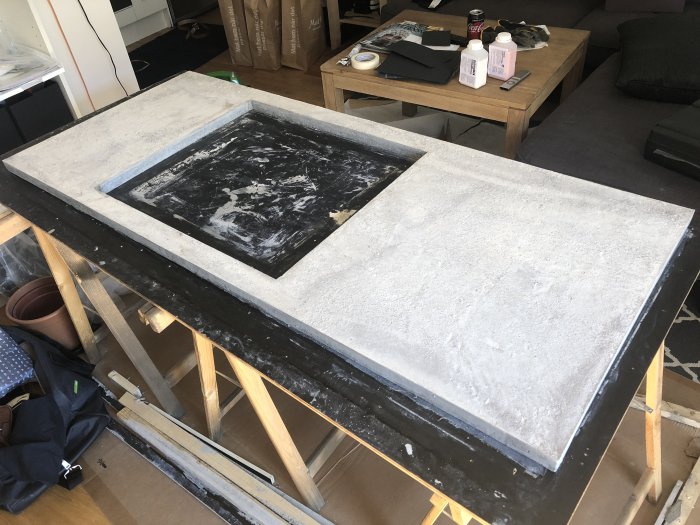
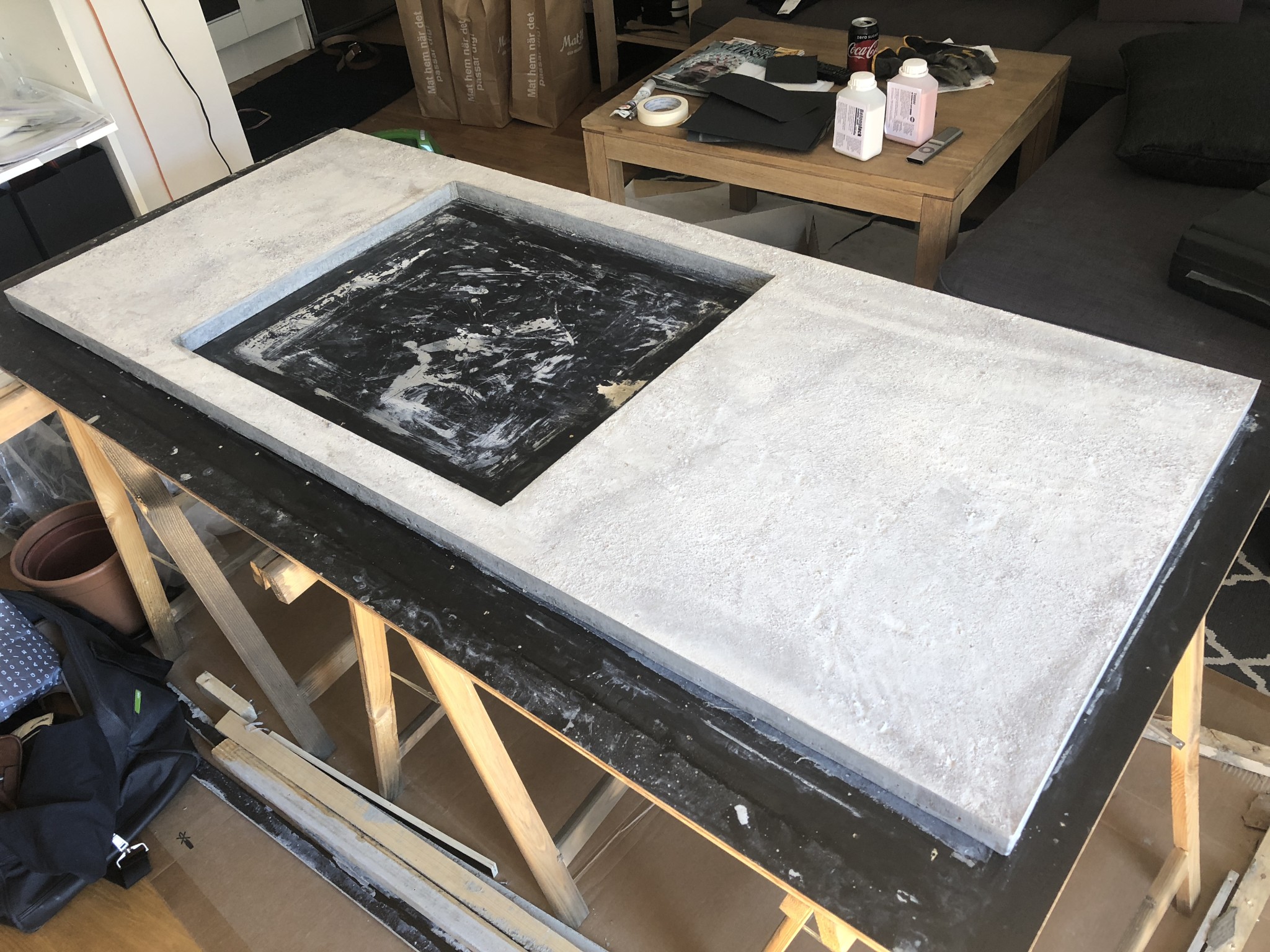
Now the countertop has hardened enough and I have removed the frame. However, I haven't flipped it yet. Now I have a few questions:
1. Is it common to sand the underside as well?
2. Does the underside need to be treated?
3. How do I turn it over in the best way based on what you see in the picture?
Now the countertop has cured enough and I have removed the frame. However, I haven't turned it over yet. Now I have a few questions:
1. Is it common to sand down the underside as well?
2. Does the underside need treatment?
3. How do I flip it over in the best way based on what you see in the picture?
[image]
3: place two studs across and screw through the "ho-hole", and clamps on the outer edges, that's my suggestion... You should be able to flip it without it breaking...
3: put two beams across and screw through the "ho-hole", and force on the outer edges, that is my suggestion ... You should be able to flip it without it breaking....

peterwesterlund said: