
I am going to remove the old railing for the basement stairs.
I will make a new railing and gate out of wood.
My problem is how to make it strong and stable.
I need to have a standing post/beam for the frame that I will attach panels to.
The post must be attached on top of the "basement stair wall", and I would guess the material is some form of lightweight concrete/leca block & plaster. You can distinguish patterns of something that is definitely masonry.
I don't think just screwing two brackets and attaching the post to them will be stable.
I will try to take a photo so I can show you, planning to start the work this weekend so I need quick help
I will make a new railing and gate out of wood.
My problem is how to make it strong and stable.
I need to have a standing post/beam for the frame that I will attach panels to.
The post must be attached on top of the "basement stair wall", and I would guess the material is some form of lightweight concrete/leca block & plaster. You can distinguish patterns of something that is definitely masonry.
I don't think just screwing two brackets and attaching the post to them will be stable.
I will try to take a photo so I can show you, planning to start the work this weekend so I need quick help

Post shoes are really ugly in my opinion. Instead, use an expansion bolt (or glue in a galvanized rod) and drill a suitable center hole in the post. Use cardboard or some plastic spacer underneath to prevent the post from absorbing water.
Thanks for the quick responses
I have taken a photo that I am attaching.
The post and mount won't be visible as there will be paneling on both sides.
I've considered using a post shoe, but how should I attach it? Making larger holes and cramming in adhesive doesn't seem to work well?
The fact that the "wall" is curved doesn't make things easier.
I'm also considering attaching a beam along the entire wall and then extending a post from it, but perhaps it's better to attach the post directly to the wall?
The frame will resemble the existing railing, but I will have panels on both sides, and I plan to make a gate at the stairs.
The old one will be cut with an angle grinder right at the "root".
I need it to be stable sideways; along the length won't be a problem as I will attach it to the facade (not visible in the picture) since we have an extension there.
And one more question.
The panels will be painted, but what kind of wood should I use for the frame?
Is it most suitable to use treated wood since I don't plan on painting the frame as it won't be visible at all?
I have taken a photo that I am attaching.
The post and mount won't be visible as there will be paneling on both sides.
I've considered using a post shoe, but how should I attach it? Making larger holes and cramming in adhesive doesn't seem to work well?
The fact that the "wall" is curved doesn't make things easier.
I'm also considering attaching a beam along the entire wall and then extending a post from it, but perhaps it's better to attach the post directly to the wall?
The frame will resemble the existing railing, but I will have panels on both sides, and I plan to make a gate at the stairs.
The old one will be cut with an angle grinder right at the "root".
I need it to be stable sideways; along the length won't be a problem as I will attach it to the facade (not visible in the picture) since we have an extension there.
And one more question.
The panels will be painted, but what kind of wood should I use for the frame?
Is it most suitable to use treated wood since I don't plan on painting the frame as it won't be visible at all?
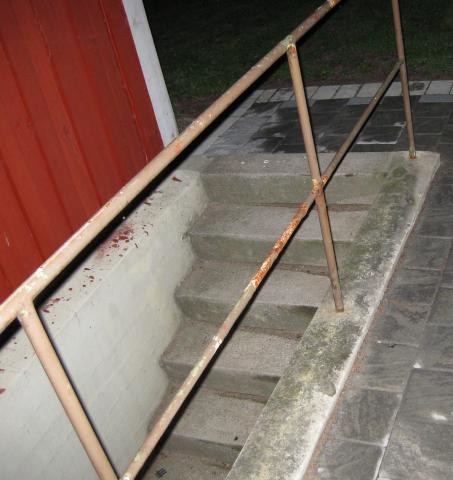
It looks like you have started to get rust growing down into the concrete along the posts. The rust expands and over the years will burst the concrete. I have an exterior staircase myself, a basement staircase just like yours, and a terrace with severe rust explosions (60-year-old house). Just cutting down flush is not good. It's best to chip away a bit around the iron and cut 3-4 cm down and then cast again so that the oxygen can't reach. Then drill new holes and securely cast new galvanized or stainless steel fittings.
Click here to reply