
5,952 views ·
12 replies
6k views
12 replies
How to attach gypsum to a masonry wall that can become warm.
Hello.
I'm renovating an old house in Småland.
I've torn out the old kitchen and the old kitchen boiler.
I've bricked up the leftover hole in the brick wall.
Instead, I'm going to open up a hole for a stove in the next room.
On the brick wall in the kitchen, I'm thinking of putting up drywall.
Do any of you smart people here have a good method for installing the drywall?
When I fire up the stove in the living room, the wall might get a bit warm.
So maybe it's not a good idea to glue the wall? With the risk of it coming off?
Alternative 2: Screw and anchor into the wall?
A third option I've been considering is to frame out with metal studs (it's probably not a good idea to use wooden studs against the wall?) and perhaps use plywood instead?
This option would allow me to have recessed outlets, so maybe this is the way to go or what do you think?
Very grateful for suggestions and thoughts.
I'm renovating an old house in Småland.
I've torn out the old kitchen and the old kitchen boiler.
I've bricked up the leftover hole in the brick wall.
Instead, I'm going to open up a hole for a stove in the next room.
On the brick wall in the kitchen, I'm thinking of putting up drywall.
Do any of you smart people here have a good method for installing the drywall?
When I fire up the stove in the living room, the wall might get a bit warm.
So maybe it's not a good idea to glue the wall? With the risk of it coming off?
Alternative 2: Screw and anchor into the wall?
A third option I've been considering is to frame out with metal studs (it's probably not a good idea to use wooden studs against the wall?) and perhaps use plywood instead?
This option would allow me to have recessed outlets, so maybe this is the way to go or what do you think?
Very grateful for suggestions and thoughts.
Or just plaster/spackle the wall. We did that in a bedroom where we tore off surface material, plastered and then painted.
https://www.weber.se/fasad-puts-och...-putssystem/invandig-puts/gypsum-gipsputs.htm
Easy to apply and also sandable.
https://www.weber.se/fasad-puts-och...-putssystem/invandig-puts/gypsum-gipsputs.htm
Easy to apply and also sandable.

Thanks for the answers.
I imagine that smoothing the wall would take too long.
Gypsum adhesive sounds interesting. I'll look into this further.
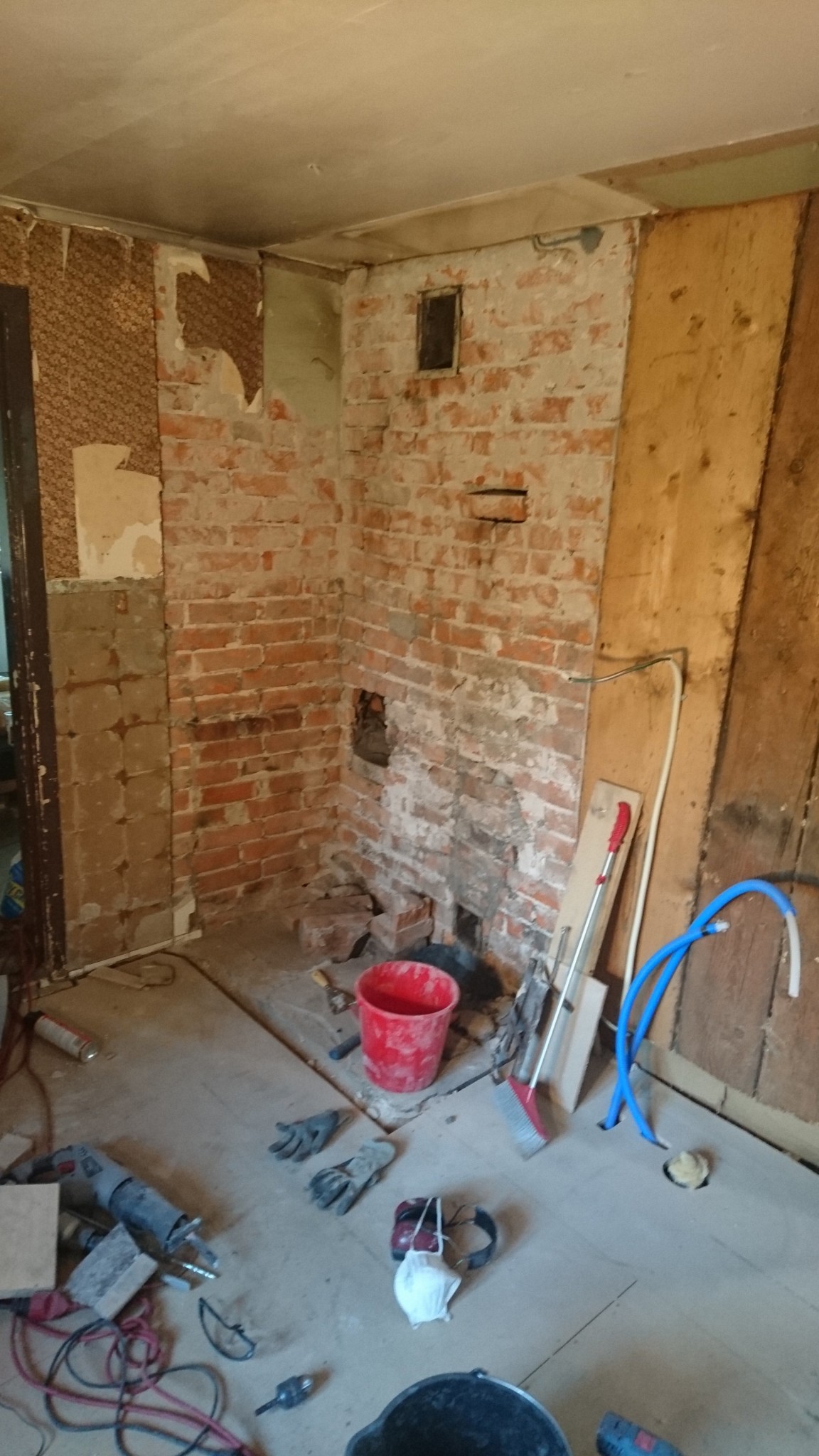
It's probably going to be this or that I extend the wall a few cm with a metal stud and put up plywood instead; it feels like this option could facilitate the installation of kitchen cabinets, etc.
I'm attaching a picture of how it looks.
I imagine that smoothing the wall would take too long.
Gypsum adhesive sounds interesting. I'll look into this further.
It's probably going to be this or that I extend the wall a few cm with a metal stud and put up plywood instead; it feels like this option could facilitate the installation of kitchen cabinets, etc.
I'm attaching a picture of how it looks.

I did the same project in the previous house with steel studs and minerit as the first board that ends up behind the stove, then regular drywall on the rest. Then you can use wooden studs and frame for the kitchen on the rest.
No, it is probably the fastest in terms of work time, the simplest, and definitely the neatest and absolutely the best technical solution. Clay plaster or lime plaster or whatever is original or approved by the chimney sweep. I would choose clay plaster (or lime plaster) and then limewash, i.e., white.rayab said:
It would look really nice plastered
Sorry if I'm nagging, it's up to you. I'm just very convinced about how I would do it myself and what I would appreciate seeing when visiting or living in a house.
Hmm would it really be faster...Stenolofanders said:
No, it's probably the fastest in terms of work time, the simplest and definitely the most stylish and absolutely technically best solution. Clay plaster or lime plaster or whatever is original or okay according to the chimney sweep. I would choose clay plaster (or lime plaster) and then lime wash, i.e. white..
Isn't it difficult to get it even and smooth?
Feels like it would be more stable to attach kitchen cabinets to plywood or similar if I frame it out.
Just good to hear opinions
It has already been brought up but must be emphasized. Do not build around an older chimney that is being used with studs and plasterboard. The chimney will not be inspectable at the next fire safety inspection, and there is a risk that inspection holes will need to be drilled.
Plastering is, as mentioned, the most sensible option - it seals the chimney, the chimney sweep/property owner can inspect it, and it is the original construction.
Plastering is, as mentioned, the most sensible option - it seals the chimney, the chimney sweep/property owner can inspect it, and it is the original construction.
It can't really be a requirement for the chimney to be open all around?Claes Sörmland said:
It has come up already but must be emphasized. Do not build around an older chimney using studs and drywall. The chimney will then not be possible to inspect at the next fire safety inspection, and there's a risk that inspection holes will need to be drilled.
Plastering is, as stated, the most sensible option - it seals the chimney, allowing the chimney sweep/property owner to inspect it, and it maintains the original construction.
Previously, there were masonite boards on the wall there.
There are no retroactive requirements of that type, but in older houses, the fire safety regulations that applied at the time of construction are followed. For long periods, it was required that chimney flues were not built behind wooden walls - wood needed to have a certain distance from the inside of the flue. In practice, it is the assessment during the fire safety inspection that matters; the chimney sweep must be able to see if the flue is sealed.
Click here to reply
Similar threads
-
Fästa blandare för dusch, 13 mm gips och 10 mm osb.
Badrum -
Fästa WC-fixtur endast i kakel och enkelgips?
Badrum -
Fastening in wall construction of gypsum+plywood+steel bracket
Building Materials and Construction Technology -
Fästa armstöd badrum, tjockare en trippelgips
Badrum -
Mount TV on simple drywall with metal studs
Building Materials and Construction Technology