
4,337 views ·
32 replies
4k views
32 replies
How should I prevent the newly constructed house from molding?

I guess it should be insulated 45 mm horizontally outside the posts.Centano said:
If you have damp wood, you should be careful with too much heat as it promotes growth. A dehumidifier is probably good to use initially and gradually increase the heat. However, this assumes that it is relatively airtight. Then you should try to sand/plane the wood clean from growth once it has dried.
How is the wind barrier really attached, is there an air gap inside the wind barrier and outside?
[image]
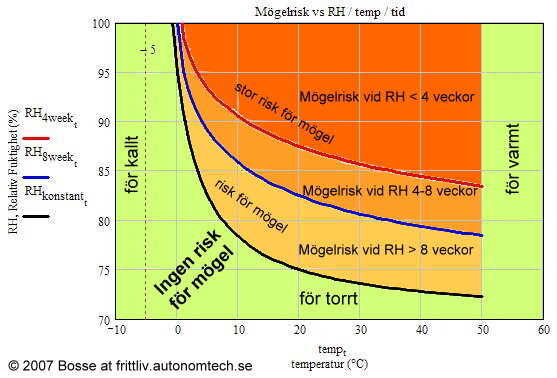
Warming does not mean it needs to be room temperature, but perhaps just 5 degrees warmer than outdoors as the relative humidity (Rh) drops quickly with the first few degrees that the air is warmed up and this is important to get below 75% Rh in as much of the building area and its walls as possible, and preferably a little lower.
Warmer air also tends to rise, and one should ensure that its outlet is controlled so that there is no condensation and running water from cold parts if the path out for the air is in plastic material – or that it is kept warmer by the passing warm air with sufficient flow without cooling too much to avoid becoming too humid if it is constructed in wood material.
Warmer air also tends to rise, and one should ensure that its outlet is controlled so that there is no condensation and running water from cold parts if the path out for the air is in plastic material – or that it is kept warmer by the passing warm air with sufficient flow without cooling too much to avoid becoming too humid if it is constructed in wood material.

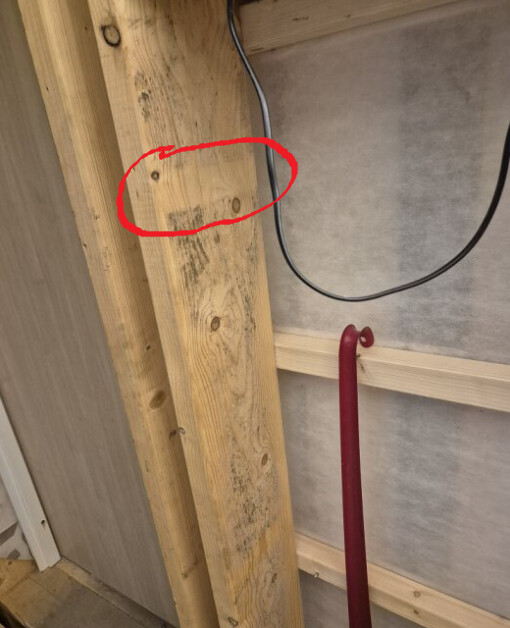
You can see in the first photo that the bluing was there even before the stud was placed. You can see traces from the spacer pins when the wood was stacked, probably under a tarp or something where it was damp.M Martin Lj said:I'm in the process of building a new 1.5-story house. We are very afraid of mold and growth on the wood. Therefore, we proceeded with the framing during the late summer at a brisk pace with help from carpenters. This went quickly and it didn't rain on the frame before the roof was on and the house was wrapped. When I measured the moisture content of the frame, it was around 11-13%. This made me very happy and I thought we had done well.
Autumn came and the window delivery had issues and was delayed, which extended the time for the siding and windows. The house was completely done on the exterior about 3 weeks ago so we didn't have time to insulate and heat the house before winter.
Now to the big concerns, we live on the west coast and the past month it has basically rained constantly and been around 5-10 degrees with extremely high humidity. This seems to have caused the frame to absorb moisture from the air? I don't understand what else could have happened for now the moisture content of the frame is around 16-18% and growth has started to form everywhere inside the house. This makes both me and my wife stressed and depressed.
What can we do now? Should I just accept the situation and wait until spring so the house can dry? Should I start sanding/planing away growth? It's a bit difficult to heat the house since it's not insulated and the entire floor is open down towards the crawl space. Will dehumidifiers do any good in this situation when it's so open?
These are some examples of how it looks now, there are similar growths in ~20 more places and it seems to increase every day.
[image]
[image]
[image]
The bare rafters in my garage have had quite a bit of bluing for almost 25 years but it hasn't increased.

Good observationCruzze said:
You can see from the bluing in the first photo that it was there even before the rule was set up. You can see traces from the spacer pins when the wood was stacked, probably under a tarp or something where it was damp.
[image]
The bare roof trusses in my garage have had quite a bit of bluing for almost 25 years, but it hasn't increased.
What exactly causes the studs to turn blue or possibly get mold on them? They are protected from precipitation inside behind the wind barrier.
Boards and studs at the lumberyard are often stored under the same conditions and they manage just fine.
And in the finished house, the studs will end up outside the vapor barrier and somewhere in the insulation the same conditions could arise as now, meaning it could get damp there? Or am I thinking wrong?
Boards and studs at the lumberyard are often stored under the same conditions and they manage just fine.
And in the finished house, the studs will end up outside the vapor barrier and somewhere in the insulation the same conditions could arise as now, meaning it could get damp there? Or am I thinking wrong?
Very simply, we can say this: Wood that gets wet is not a problem if it is allowed to dry. Wood that gets wet repeatedly and does not have the opportunity to dry becomes a problem.
I am an enthusiastic hobbyist who builds everything myself. My structures stand in all weathers. Once they are under a roof and have the chance to dry out, it's no longer a problem.
All houses built today are designed to be able to dry out. Regardless of whether insulation or plastic is in place. So nothing you show is a problem. As long as the house is built according to the specifications and requirements that apply.
If you are worried, conduct continuous moisture measurements in the wood. You will see that it dries out quickly.
I am an enthusiastic hobbyist who builds everything myself. My structures stand in all weathers. Once they are under a roof and have the chance to dry out, it's no longer a problem.
All houses built today are designed to be able to dry out. Regardless of whether insulation or plastic is in place. So nothing you show is a problem. As long as the house is built according to the specifications and requirements that apply.
If you are worried, conduct continuous moisture measurements in the wood. You will see that it dries out quickly.
The problem, as seen in the pictures, is that the timber has become soiled with small particles, often from the ground, which, under the right conditions, start to mold. Therefore, as shown in one of the pictures, where the supports were, there is no mold.

Take it easy, as soon as you have insulating material and have turned on the heat, it will dry up, and discolorations will no longer build up. It doesn't matter if it grows a little now as long as you keep it dry later, which you intend to do.
I have been measuring the timber continuously since the roof was put on, and what bothers me is that the moisture content has gone up over the last 2 months.Bart said:
I was convinced that as soon as the house was weather-tight, we could relax, but now I realize that the frame apparently gets wet just from the outside air being wet 🥲. Maybe logical, but not something I accounted for.
If I understood the advice correctly, I need to ensure that the air inside the house becomes less than 75% RH. This is achieved by sealing against new air coming in and running a desiccant dehumidifier during the winter. Before I apply plastic and insulation, the moisture content in the frame must be less than 16%.
You have several factors working against you:
The solution with external cross-layered insulation that hasn't been installed also seems a bit backward? Are you supposed to try to fit all the insulation boards afterward?
How is the work contracted? This is largely a planning issue that should have been discussed with the designer. If building at a slow pace with uncertainty, I would say external insulation on the weatherproofing in the form of, for example, a “västkustskiva” is a very good solution. Then the house will at least be somewhat insulated and weather-protected.
As noted earlier, the moisture likely originates from when the lumber was on the ground, and since the air has been so humid, it hasn't had a chance to dry out. Was it properly elevated from the ground so that the ground moisture could air out?
There are still no extreme amounts, so if action is taken quickly and a dehumidifier is brought in, it probably won't be a problem. I would prioritize making it airtight and sealing it against the foundation.
- The West Coast is extremely humid
- Open access to crawl space with soil contamination entering the house without airing out
- Unfinished building envelope
The solution with external cross-layered insulation that hasn't been installed also seems a bit backward? Are you supposed to try to fit all the insulation boards afterward?
How is the work contracted? This is largely a planning issue that should have been discussed with the designer. If building at a slow pace with uncertainty, I would say external insulation on the weatherproofing in the form of, for example, a “västkustskiva” is a very good solution. Then the house will at least be somewhat insulated and weather-protected.
As noted earlier, the moisture likely originates from when the lumber was on the ground, and since the air has been so humid, it hasn't had a chance to dry out. Was it properly elevated from the ground so that the ground moisture could air out?
There are still no extreme amounts, so if action is taken quickly and a dehumidifier is brought in, it probably won't be a problem. I would prioritize making it airtight and sealing it against the foundation.
Here's the thing with wooden houses. There are no wooden houses, especially on the west coast, that don't have mold. The key is to keep it within reasonable levels.