
7,435 views ·
16 replies
7k views
16 replies
How should I dry tongue-and-groove 28*120 for flooring
Hello
I have bought 90 sqm of tongue and groove 28*128 at Ekesiöö lumberyard. I have it drying at home and have spread it out on the floor. What should I consider, can I spread it out so that the planks are two and two on top of each other, or should I have more to use the weight of each other to keep it straight? If it twists, is it a problem to get it tight when I finally screw it onto the 60CC floor joist? How long should I let it dry before I screw it down to avoid big gaps after I've screwed it down?
Thanks
/Per
I have bought 90 sqm of tongue and groove 28*128 at Ekesiöö lumberyard. I have it drying at home and have spread it out on the floor. What should I consider, can I spread it out so that the planks are two and two on top of each other, or should I have more to use the weight of each other to keep it straight? If it twists, is it a problem to get it tight when I finally screw it onto the 60CC floor joist? How long should I let it dry before I screw it down to avoid big gaps after I've screwed it down?
Thanks
/Per

You should stack the timber with spacers in between. If the boards are made of pine, the spacers should be made of spruce. If you purchase a moisture meter (available at all hardware stores), you can determine when the timber is dry enough. 8% moisture content is desirable.
Thanks for the answer, I'm a bit curious about why you have to mix pine and spruce spacers and can't use the same?J justusandersson said:
I think it has to do with mold growth, but I could be wrong there. If I'm right, the choice of material for the ströläkt doesn’t matter unless the floor is soaking wet (moisture content > 20%).
How damp is the floor now (or when you bought it)? I assume it has already dried?
Air circulation is also very important and significantly reduces the time it takes to dry. A small table fan (without heat) that can stand and blow would shorten the time considerably.
How damp is the floor now (or when you bought it)? I assume it has already dried?
Air circulation is also very important and significantly reduces the time it takes to dry. A small table fan (without heat) that can stand and blow would shorten the time considerably.
Thanks for the tip about the borsfläkten, I will definitely do that. It was already somewhat dried when I bought it. Another question: The joist spacing is cc 100, do you know what the thickness of pine tongue and groove should be to prevent flexing (teen room). I have bought 28*20 pine timber, is that sufficient or do I need to make the joists closer together or take other measures?
It is to avoid discoloration.P perra4 said:
I assume you mean 28x200? Yes, 28 mm is too thin to lay alone on such a large c/c distance. Since you have already bought the timber, the simplest measure is to lay a 12 mm K-plywood sheet under the boards. (Place the sheets so that the surface veneer lies across the floor joists) A 22 mm floor particle board also works, but then it will be higher. Otherwise, an old rule of thumb is to go up to what was formerly called 1 1/2 inch boards, i.e., 36-38 mm thick. If you want to keep the floor height down, you need to place new floor joists between the old ones.P perra4 said:
28*120mm, it was clumsy of me to choose the wrong dimension. I guess I'll have to add joists between the old ones. I'm assuming the joists should be parallel to the existing floor structure? The existing floor structure is 17cm*5cm. What is a good dimension for the additional parallel floor joists? I want as much insulation as possible in the floor structure to reduce noise between the floors.
The existing joists are probably 50x175 mm, which corresponds to 2x7 inches, as it surely said on the drawing.
What is an appropriate dimension for new beams depends on the span of the existing ones, and if you possibly want to compensate for old deficiencies. Measure the span (length of the beams) and I will give you some options.
What is an appropriate dimension for new beams depends on the span of the existing ones, and if you possibly want to compensate for old deficiencies. Measure the span (length of the beams) and I will give you some options.
Very kind of you, thank you so much for your help. Your measurements (2*7 inches) are correct, but unfortunately, I don't have any drawings left as the house is from 1926. The span is 590cm, and there is a complementary framework of 3*10cm (perhaps 2*4 inches) parallel to the joisting in between, which made me think it was 50CC and therefore I bought 28*120, (I saw the nails at that distance in the decking). The old floor (the decking is 23*110) has sagged here and there, though I'm unsure if it's the joisting or the complementary framework that has given way (I haven't had the chance to tear up that part yet). Attached is a picture of how it looks today.
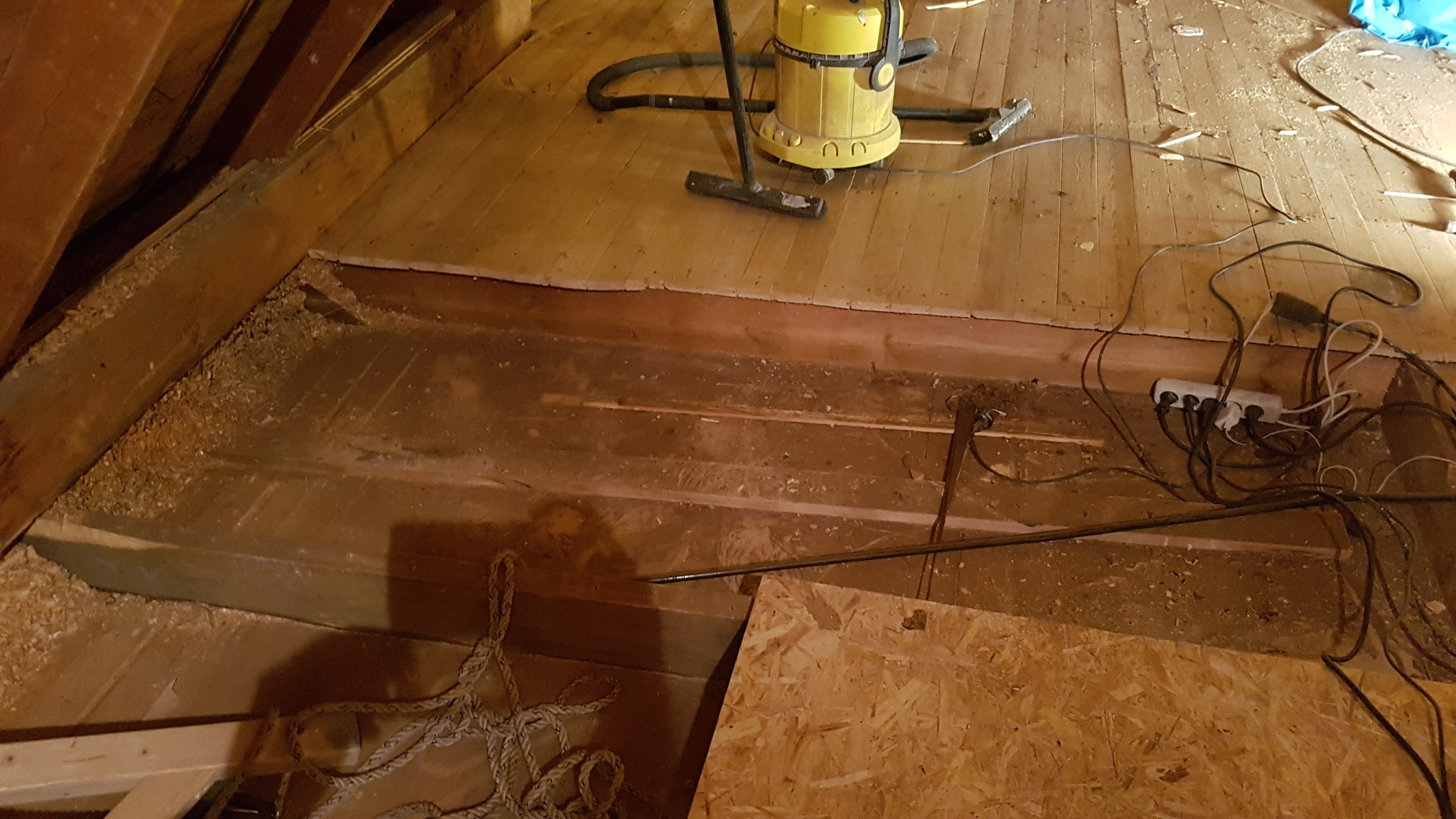
Are you sure there is no supporting wall on the floor below? A 5.9-meter span is extremely much for your floor joists.
Yes, there is a load-bearing wall on the floor below, at a distance of 2m and 3.9m from the outer walls, but there is no visible indication that the floor frame would rest on it, though it should sit correctly on the load-bearing wall. The beam itself is a single piece measuring 5.9m.
It is good that the beam is in one piece, but it still must feel a bit unsteady. Then I think the absolute best solution is that you insert new 45x170 (C 24) joists between the old ones. Place a thin insulation strip under the new joists to cover the missing 5 mm, which slightly reduces the risk of impact sound disturbances. Then you can use your purchased flooring timber. With c/c 500 mm, it will feel very solid and good.
Yes, it's a bit shaky and has settled in places, when I dug into the wood chip insulation it turned out that the 3*10 extra joist was just lying directly on the wood chips (see image). I was a bit tempted to just have 45*100 extra joists so that I could fit a ground board under the extra joist, which should be good for sound insulation. Not sure if 45*100 is enough but it's probably a trade-off between sound insulation and stable floors.
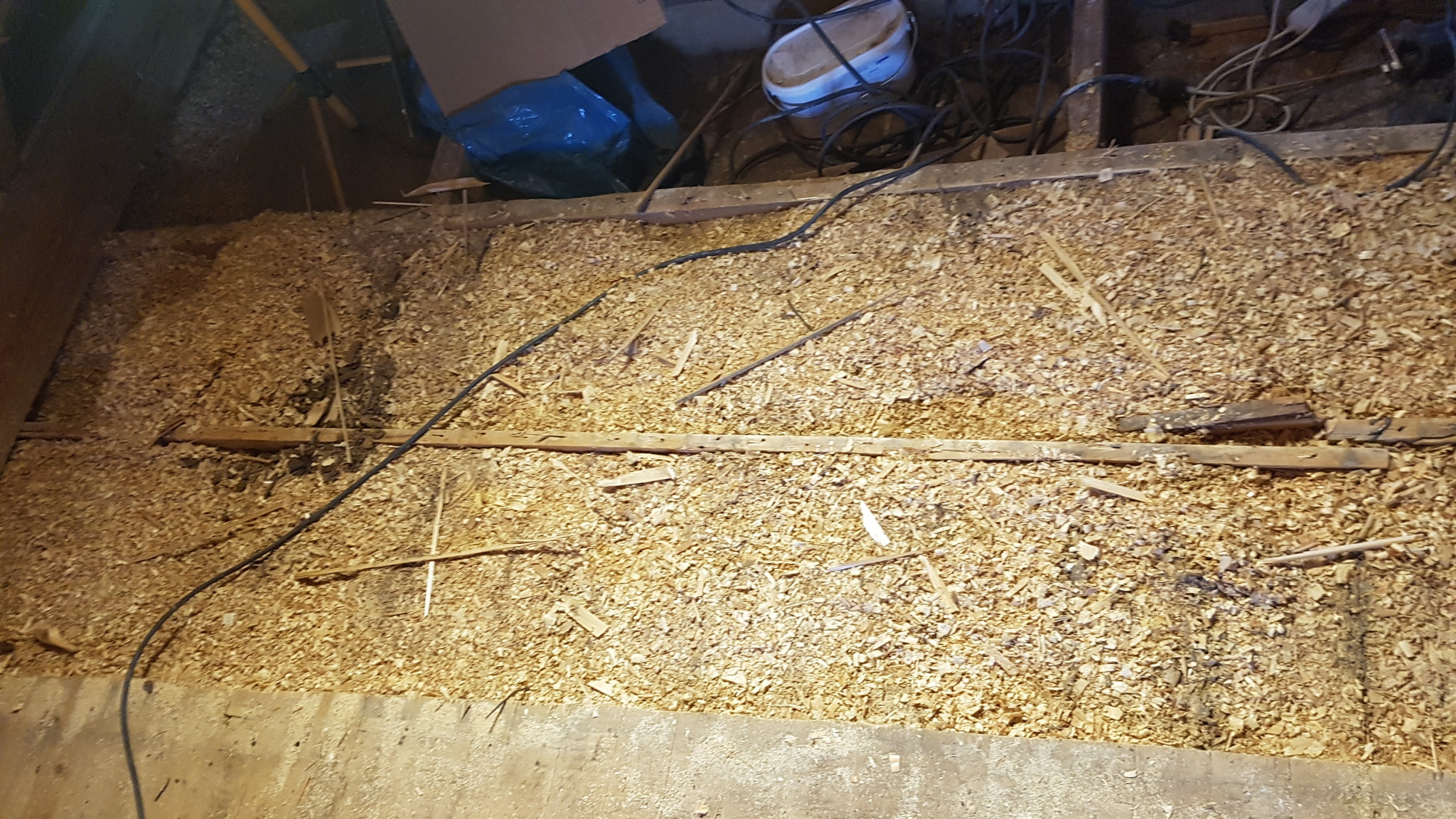
You absolutely must prioritize stable flooring. Otherwise, it can be very tricky with every other joist stable and the other swaying. Furthermore, there is actually no contradiction with sound reduction. The impact sound from the old ones is difficult to address. You fix the airborne noise by filling the cavities halfway with mineral wool.
If you want to make a really good solution regarding impact sound, new joists are required at a slightly higher height of glulam and then the problem with the floorboards recurs. Everything becomes a few centimeters higher and more expensive, but good.
If you want to make a really good solution regarding impact sound, new joists are required at a slightly higher height of glulam and then the problem with the floorboards recurs. Everything becomes a few centimeters higher and more expensive, but good.