
2,862 views ·
20 replies
3k views
20 replies
How should I do?
actually thought about whether you can do that. ThanksOldboy said:
Lifting this thread again. When I removed a panel board, I saw this construction.N Nygge72 said:
Stud - Board opposite direction stud - Stud - Board opposite direction stud etc.
Why this construction method? Is it because houses were previously built with the boards available to reduce costs, as this small house looks like a patchwork quilt with the paneling, and there could be 30cm splices to have something to attach them to. Or does it have another function?
If it's for the sake of splicing, it significantly eases it for me as I can remove them and stick solely to the studs then.
Now I'm not quite sure what the current construction looks like... Do you have any pictures? That would significantly help to understand what it actually looks like.
Considering it's a small simple shed with thin (?) walls, I assume it doesn't mean the wall consists of many layers of paneling and studs on top of each other?
For simpler buildings, it usually works to use what you have lying around. That's what I do with our old outbuildings. As long as you keep track of your building physics, there are no issues. If the appearance isn't so critical, or it ends up being a hidden construction, it doesn't matter. It's also perfectly fine to splice, for example, panel boards. They are not load-bearing, and if the splice is cut at an angle so snow and water don't settle/penetrate behind the panel, it works excellently. If you make neat precision cuts and assemblies, the splice becomes almost invisible. If you want to ensure against the panel ends twisting or cupping differently from each other, attach a board behind to lock them together.
You save a lot on labor and materials (boards, nails, dismantling, trim, weather protection, paint, and painting) by just removing what's damaged on a facade and splicing in with new. Normally, it's just the bottom end that's damaged.
Considering it's a small simple shed with thin (?) walls, I assume it doesn't mean the wall consists of many layers of paneling and studs on top of each other?
For simpler buildings, it usually works to use what you have lying around. That's what I do with our old outbuildings. As long as you keep track of your building physics, there are no issues. If the appearance isn't so critical, or it ends up being a hidden construction, it doesn't matter. It's also perfectly fine to splice, for example, panel boards. They are not load-bearing, and if the splice is cut at an angle so snow and water don't settle/penetrate behind the panel, it works excellently. If you make neat precision cuts and assemblies, the splice becomes almost invisible. If you want to ensure against the panel ends twisting or cupping differently from each other, attach a board behind to lock them together.
You save a lot on labor and materials (boards, nails, dismantling, trim, weather protection, paint, and painting) by just removing what's damaged on a facade and splicing in with new. Normally, it's just the bottom end that's damaged.
It's built like a regular construction, with studs about 37-43 cc apart. But in between, he has placed a board (which sits at the outer edge against the panel) that feels like a "splice board" for the paneling.Now I'm not quite sure how the current construction looks... Do you have any pictures? That would significantly help in understanding how it actually looks.
Considering that it's a small simple shed with thin (?) walls, I assume that it doesn't mean the wall consists of many layers with paneling and studs on top of each other?
For simpler buildings, it usually works to use what you have lying around. That's what I do on our old farm buildings. As long as you're aware of your building physics, there are no problems. If the appearance isn't so critical, or if it ends up being a hidden construction, then it doesn't matter. It's also quite possible to splice, for example, panel boards. They are not load-bearing, and as long as the splice is bevel-cut so snow and water don't end up lying behind the panel, it works excellently. If you make neat precision cuts and assemblies, the splice becomes almost invisible. If you want to fully ensure against the panel ends twisting or bending differently from each other, you can attach a small piece of wood behind to lock them together.
You save a lot on labor and materials (boards, nails, demolition, trim, weatherproofing, paint, and painting) by only removing what is bad on a facade and splicing in with new. Normally it's just the bottom end that's bad.
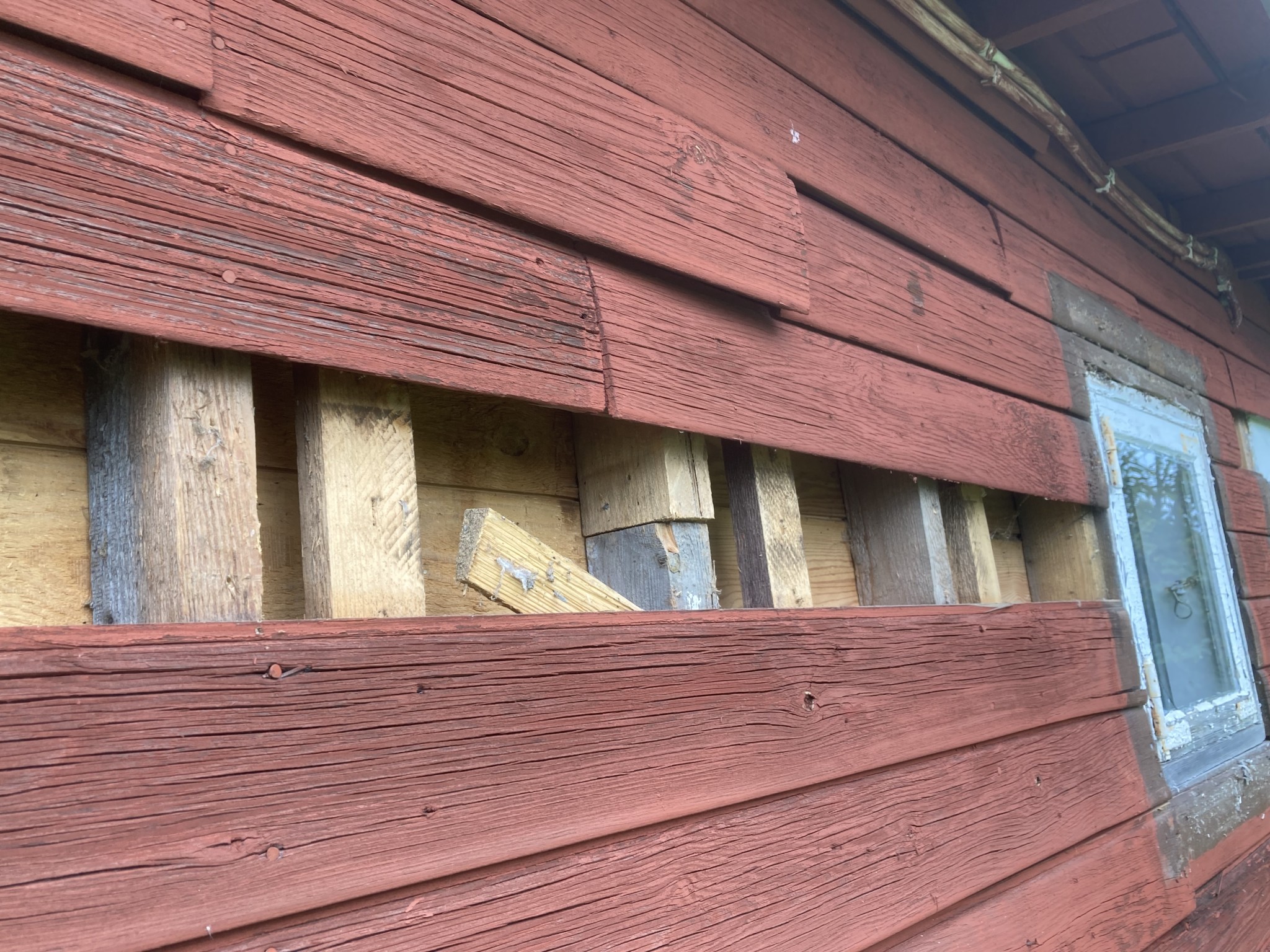
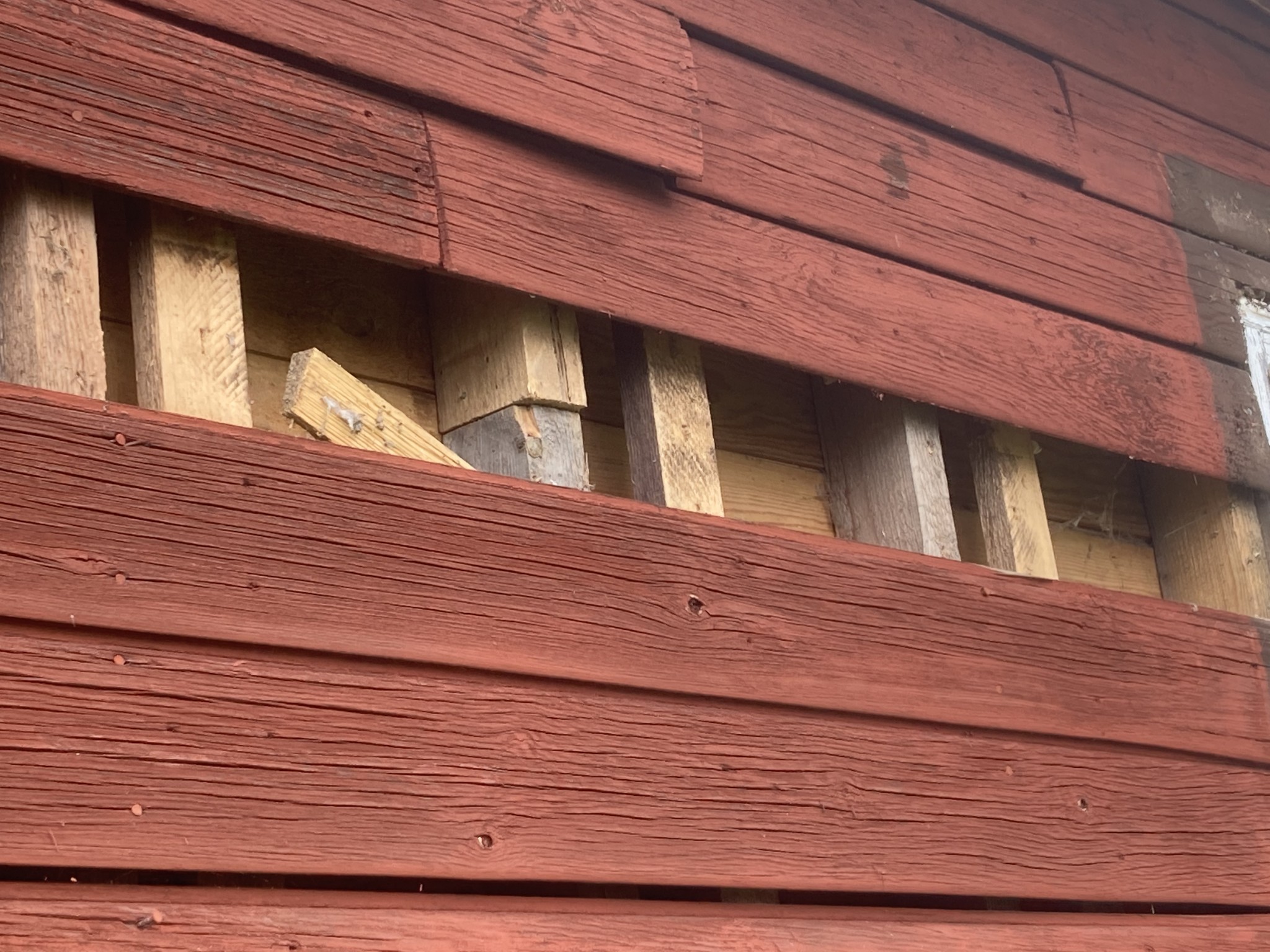
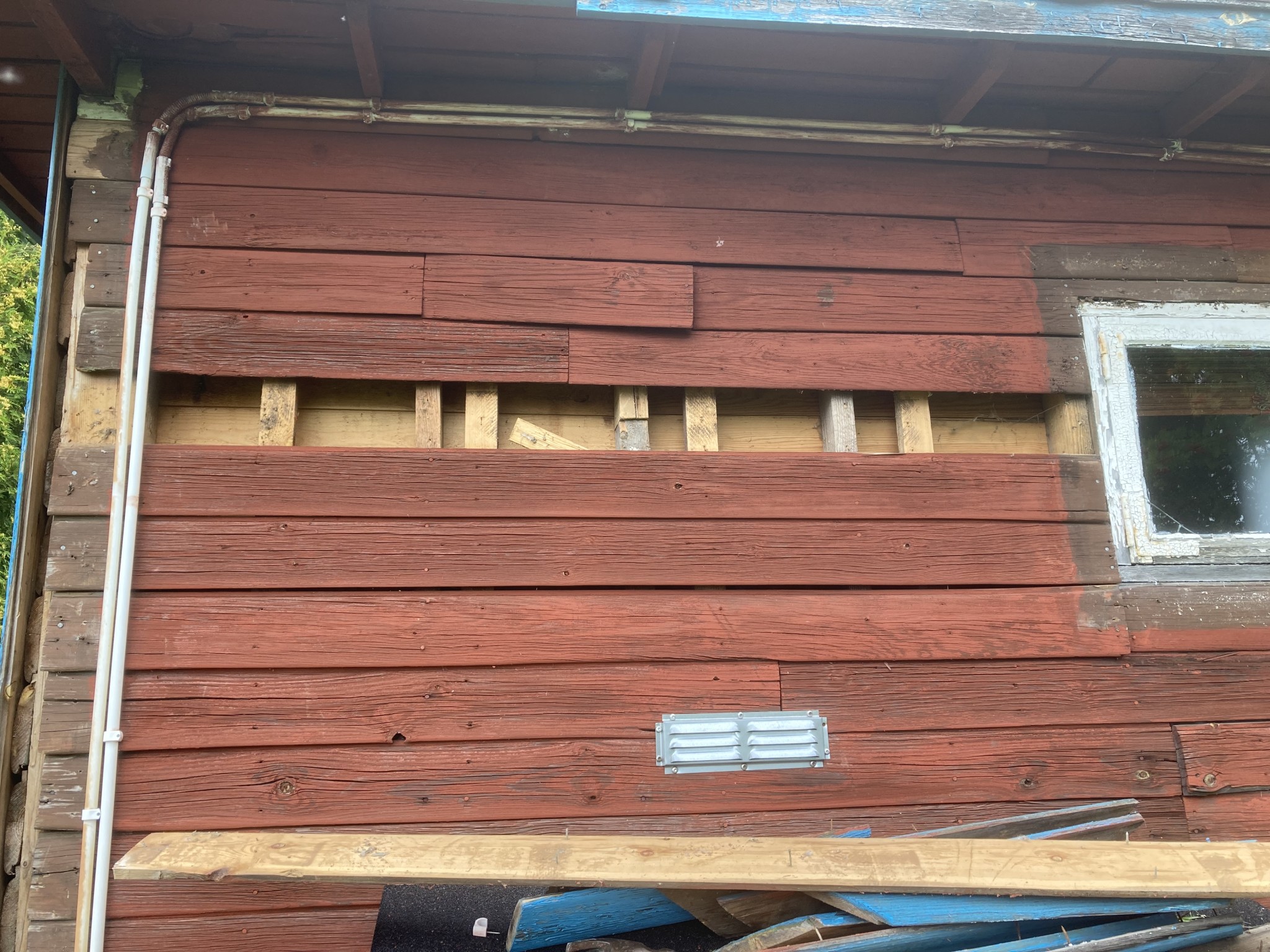
Yes, it could be a splice plate for the panel. Short panel pieces need to be attached to something. It could also be if the tongue/groove is damaged and you need/want to make sure the panel stays in place.
The board that sticks up and is placed diagonally could be intended as bracing. It is admittedly short and weak, but still. Ideally, there should be bracings in all corners, and they should run from the roof/binder to the floor/sill. (This is clearly visible in timber frame houses.)
The board that sticks up and is placed diagonally could be intended as bracing. It is admittedly short and weak, but still. Ideally, there should be bracings in all corners, and they should run from the roof/binder to the floor/sill. (This is clearly visible in timber frame houses.)
ThanksYes, it could be a scarf board for the panel. Short panel pieces need to be attached to something. It can also be if the tongue/groove is damaged and one needs/wants to ensure that the panel stays in place.
The board that protrudes and sits diagonally could be intended as bracing. It is admittedly short and slender, but nevertheless. Ideally, there should be bracing in all corners, and they should extend from the roof/roof beam to the floor/sill. (Clearly visible on half-timbered houses.)
Click here to reply