

I have plans for a countertop in the kitchen to serve as a workbench in a combined office/sewing room. The plan is to attach it to the walls, and the length would be about 1.5m. The board is 38mm thick but will it manage this without support underneath from base cabinets as intended? It will rest on beams on three out of four sides...
What do you think, will it be stable enough?
Attached is a picture of the hole where the board will be placed...
What do you think, will it be stable enough?
Attached is a picture of the hole where the board will be placed...
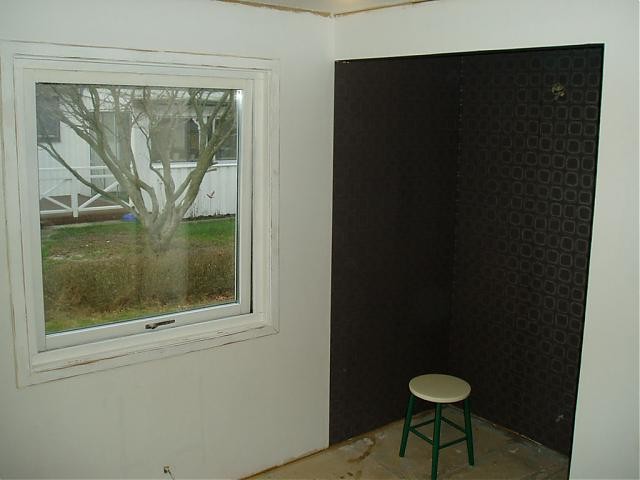

Probably, but I would have also put something under the front edge, why not an L-profile in steel or aluminum so that you can keep the dimension of the profile down, a regel looks so bulky.
/Kent
/Kent

We have a 30mm thick wood panel of glued walnut strips, 170cm long and 60cm deep, supported on three sides. It's been there for almost a year now. Used as an "office desk" with a computer etc.
Snickarboden; do you mean there is a risk of the panel sagging if it's not stabilized under the front edge?
Snickarboden; do you mean there is a risk of the panel sagging if it's not stabilized under the front edge?
Yes, if it is in chips, there is a _small_ risk if you apply pressure on it.
/Kent
/Kent
Just as I wanted to convey it. Spånskiva is form-stable but not as stiff as stavlimmat etc., there are no fibers for that. Now it's 38 mm thick but I don't think you'll find any manufacturer who dares to say it holds its shape without reinforcement at that length.
/Kent
/Kent
A small follow-up question (just to learn and understand). If you have laminate with particle board inside and discover after a while that it has bent down a few millimeters, can you then put a reinforcement on the underside and make the board straight again? And also without the laminate cracking?
Yep, those boards are quite "flexible," so it would take a lot more before the surface layer cracks. Then there are different qualities of these boards, the better ones have a denser and finer layer closest to the surfaces and are usually significantly stiffer than those with the same density of chipboard throughout.
/Kent
/Kent
Click here to reply