
2,824 views ·
6 replies
3k views
6 replies
How is the clear span of a truss with braces calculated?
I have a question regarding the free span of a truss roof with support legs. We want to remove a wall in our 1 1/2-story house and can't fully understand whether it is load-bearing or not.
Facts:
- Truss roof resting on brick outer wall, free span ~5.8 meters
- Support legs about 1 meter in on each side, span between support legs ~ 4 meters.
- Framework consists of 45x200 mm, c/c 900-1000 mm with 45x200 beam between each truss, overall c/c 500 in the intermediate floor.
- Floor construction consisting of 22 mm chipboard, 28 mm battens for underfloor heating pipes (though _along_ the joists), and finally 22 mm oak parquet.
The wall we wish to remove is located in the middle of the house and is made of 70 steel frame with double layer plasterboard on both sides. The steel frame seems to come from Knauf / Danogips but does not appear to be constructed with reinforcement posts intended for load-bearing structures, but rather their system for lightweight ones (MR70). The frame of the steel frame rests on the ceiling panel and not on the floor joist. The frame also has a ~4 mm layer of polyethylene, and I can easily stick a knife through it. The steel frame is therefore not under tension against the ceiling, nor when someone is upstairs. The floor up there feels completely solid everywhere.
The problem is that from what I can read in span tables, 45x200, c/c 500 mm is not sufficient for nearly a 6-meter span and should cause significant deflection. However, this is without considering support legs and other interactions from the truss (which I'm not going to pretend to understand) and also not what the floor construction might add to the stability. The wall might therefore possibly be load-bearing, but nothing I see indicates that it actually is. Do I dare to take it down? What is the worst that can happen? The floor starts to sag? The house collapses?
Facts:
- Truss roof resting on brick outer wall, free span ~5.8 meters
- Support legs about 1 meter in on each side, span between support legs ~ 4 meters.
- Framework consists of 45x200 mm, c/c 900-1000 mm with 45x200 beam between each truss, overall c/c 500 in the intermediate floor.
- Floor construction consisting of 22 mm chipboard, 28 mm battens for underfloor heating pipes (though _along_ the joists), and finally 22 mm oak parquet.
The wall we wish to remove is located in the middle of the house and is made of 70 steel frame with double layer plasterboard on both sides. The steel frame seems to come from Knauf / Danogips but does not appear to be constructed with reinforcement posts intended for load-bearing structures, but rather their system for lightweight ones (MR70). The frame of the steel frame rests on the ceiling panel and not on the floor joist. The frame also has a ~4 mm layer of polyethylene, and I can easily stick a knife through it. The steel frame is therefore not under tension against the ceiling, nor when someone is upstairs. The floor up there feels completely solid everywhere.
The problem is that from what I can read in span tables, 45x200, c/c 500 mm is not sufficient for nearly a 6-meter span and should cause significant deflection. However, this is without considering support legs and other interactions from the truss (which I'm not going to pretend to understand) and also not what the floor construction might add to the stability. The wall might therefore possibly be load-bearing, but nothing I see indicates that it actually is. Do I dare to take it down? What is the worst that can happen? The floor starts to sag? The house collapses?
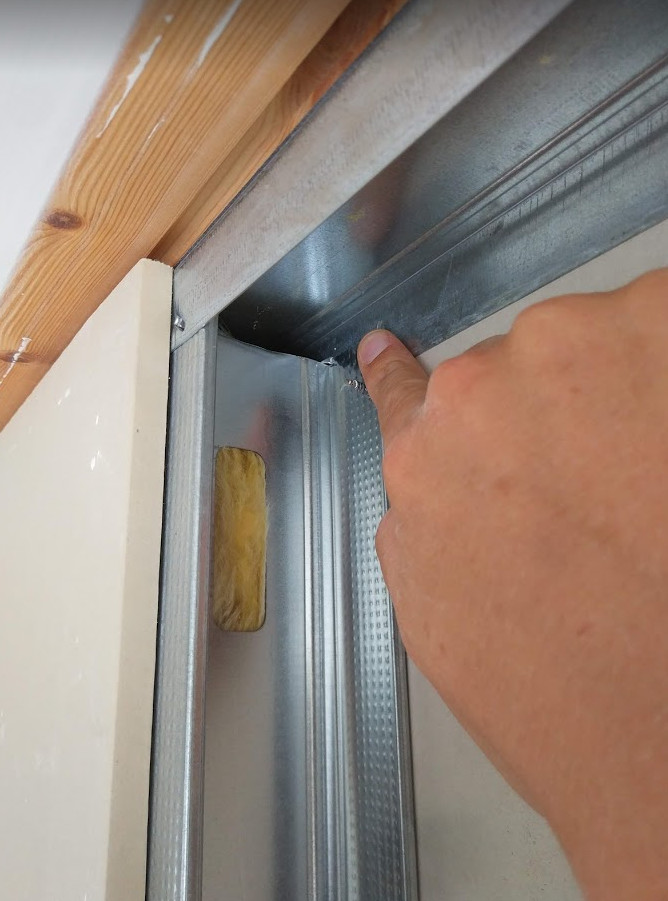
Have now opened up a bit more to see how it is built, and discovered that the posts do not go all the way up from floor to ceiling but are clipped and just stapled together with the "frame." I have also attached a photo of the polyethylene strip that sits between the frame and the ceiling. This can hardly be a load-bearing construction? 


One needs to see a complete section through the house with details on dimensions to understand the load-bearing system. Additionally, it is always interesting to know when the house was built. The deflection in the middle of the floor on the upper level is an indicator. If the outer wall consists of solid brick or equivalent material, it doesn't align well with steel studs timewise.
The house is from the late 1800s but was completely renovated in the early 2000s. Only the brick and stone foundation are original; everything else (including rafters and joists) is new. Unfortunately, I live in a country where the documentation requirements are not as strict as in Sweden (Denmark), so there are no construction sketches apart from some quite rudimentary drawings that look like they were done in Paint. I've had to measure the dimensions of the joists myself. I've tried to contact the seller but haven’t been able to get a response.J justusandersson said:You need to see a whole section through the house with details on dimensions to understand the load-bearing system. It's always interesting to know when the house was built. The sagging in the middle of the upstairs floor is an indicator. If the outer wall consists of solid brick or comparable material, it doesn't match well with steel studs in terms of time.
At the other end of the house, it's entirely open on the ground floor without any supporting wall, but according to the rudimentary drawings, there is supposed to be an HEB140 beam embedded in the floor structure. Therefore, I was quite certain that the wall we now want to demolish was load-bearing until I saw how it was constructed... Despite not being a structural engineer, I find it very difficult to see how it could support anything other than a dollhouse. My wife is not thrilled with the idea of starting to tear down the ceiling to examine the construction further.
I've tried investigating with a stud finder, but underfloor heating and steel framework everywhere make it difficult to get any clarity.We can probably agree that the wall with the steel studs is not load-bearing. Invisible steel beams make it almost impossible to calculate it.
It is not that the competence of those who build is lower in Denmark than in Sweden. Quite the opposite. They just have a different system. I don't think such an extensive reconstruction has occurred without the involvement of an architectural firm that also handled construction management. I believe the documentation exists there.
Click here to reply