
26,388 views ·
13 replies
26k views
13 replies
How do you attach a glulam beam to a wooden post in the nicest way?
How to best attach a glulam beam to a wooden post?
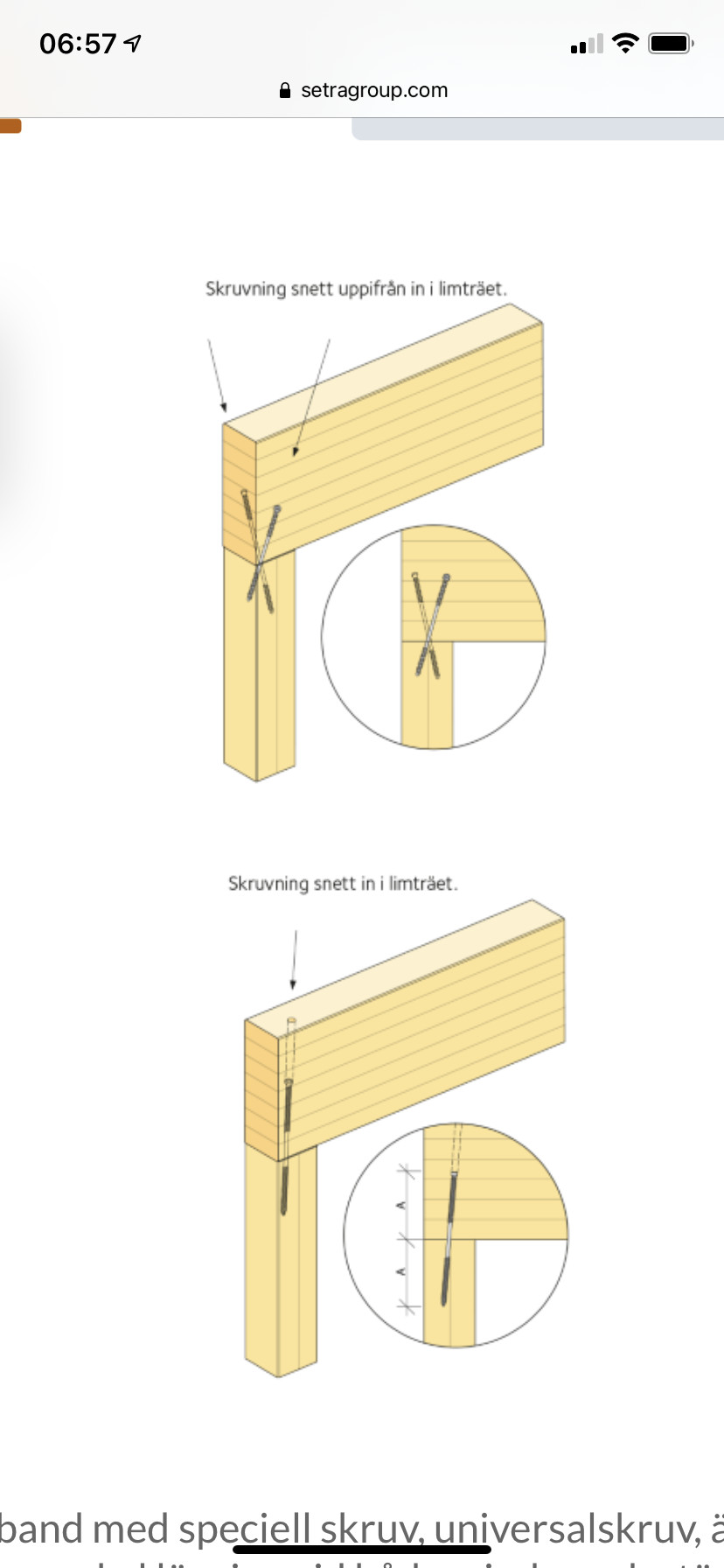
Is it possible to pre-drill at an angle from the post and then attach the post-beam with long screws?
Of course, using a nail plate with a concealed attachment would be the most aesthetically pleasing.
The same goes for between the glulam beam and the roof joist - what attachment is required there?
I've tried searching for some sort of installation guide for supporting a load-bearing wall in a house with a glulam beam but can't find anything good. There are solutions, but one would like to see the options to get the best solution.
I would gladly receive tips and solutions that could be useful for the work.
The house is a 1 1/2 story, with a load-bearing wall between the chimney and the outer wall which will be demolished and replaced with glulam.
There will be a wooden post against the outer wall, but I don't have a clear solution for the post against the chimney, whether it should be a steel post or wood.
Is it possible to pre-drill at an angle from the post and then attach the post-beam with long screws?
Of course, using a nail plate with a concealed attachment would be the most aesthetically pleasing.
The same goes for between the glulam beam and the roof joist - what attachment is required there?
I've tried searching for some sort of installation guide for supporting a load-bearing wall in a house with a glulam beam but can't find anything good. There are solutions, but one would like to see the options to get the best solution.
I would gladly receive tips and solutions that could be useful for the work.
The house is a 1 1/2 story, with a load-bearing wall between the chimney and the outer wall which will be demolished and replaced with glulam.
There will be a wooden post against the outer wall, but I don't have a clear solution for the post against the chimney, whether it should be a steel post or wood.
I'm going to do the same thing. How do you calculate the size of the beam?
Your idea of screwing obliquely from the post sounds like a good idea, you can plug the hole afterward if you want.
In the roof joist, it is possible to place angles on top of the beam, they should be concealed by the roof on the sides.
Your idea of screwing obliquely from the post sounds like a good idea, you can plug the hole afterward if you want.
In the roof joist, it is possible to place angles on top of the beam, they should be concealed by the roof on the sides.

Threaded rod with washer and nut all the way through. Or a French screw if you can't access the back. Countersink the holes and plug the holes. Maybe one of these will work for you!?
Will the joint be visible?
In many public spaces with visible glulam beams, there is usually a thick metal plate type 5-6 mm at least, which sits on the outside of the beams. Holes have been drilled through the beams, threaded rods inserted, and everything is pulled together with large nuts. This is then painted in a nice and matching color.
In many public spaces with visible glulam beams, there is usually a thick metal plate type 5-6 mm at least, which sits on the outside of the beams. Holes have been drilled through the beams, threaded rods inserted, and everything is pulled together with large nuts. This is then painted in a nice and matching color.
The joint will be visible.
I'm on board with trying to screw and then plug the post, but not between the post and beam.
The link above shows an example and mentions something about special screws. But it should work with a couple of long screws that are screwed in at 45° through the post and beam.
More suggestions are welcome, and also on attachment between beam and roof.
I'm on board with trying to screw and then plug the post, but not between the post and beam.
The link above shows an example and mentions something about special screws. But it should work with a couple of long screws that are screwed in at 45° through the post and beam.
More suggestions are welcome, and also on attachment between beam and roof.
There are infinitely long screws, so in theory, you could screw from one end if possible? glue with epoxy? drill into a large plug model and glue?
Many years since the post was written, though a relevant question for me, how did you end up doing it?
Between the beam and the ceiling, I'm considering reinforced angle irons.
If perforated metal sheets are used, you'd want to enclose the beam and the columns afterward, but if you'd rather not enclose them, it would be desirable to fasten them together in a neater way.
Between the beam and the ceiling, I'm considering reinforced angle irons.
If perforated metal sheets are used, you'd want to enclose the beam and the columns afterward, but if you'd rather not enclose them, it would be desirable to fasten them together in a neater way.
Perhaps try with a piece of square tubing that slides on, on top of the post, with a welded-on cap and plates on either side of the beam as side support. Should be able to work. It will act like a U-profile that the beam fits into.H hebbe said:How do you most elegantly attach a glulam beam to a wooden post?
Is it possible to pre-drill diagonally from the post and then use long screws to attach post-beam?
Of course, you can use nail plates, but a hidden fastening would be the most aesthetically pleasing.
The same goes for between the glulam beam and the roof joist - what attachment is required there?
I have tried to find some form of installation instructions for supporting a load-bearing wall in a house with a glulam beam but can't find anything suitable. There are solutions, but one would like to see the alternatives to ensure the best solution.
I would gladly receive tips and solutions that could be useful for the work.
The house is 1 1/2 stories, the load-bearing wall between the chimney and the outer wall is to be demolished and replaced with glulam.
Against the outer wall, there will be a wooden post, but against the chimney, I haven't got a clear solution for the post, steel post, or wood.
Click here to reply