Hello!
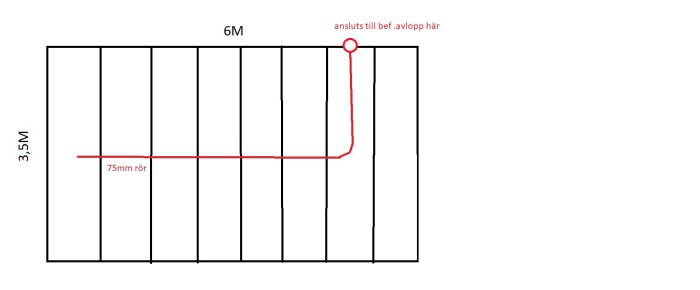
I know this has been discussed before, but I thought I'd ask the question here anyway. We are going to move the kitchen about 5m sideways and will therefore need to run the drainage through the joists (see sketch).
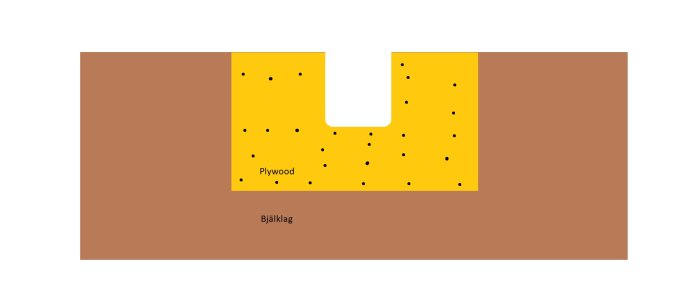
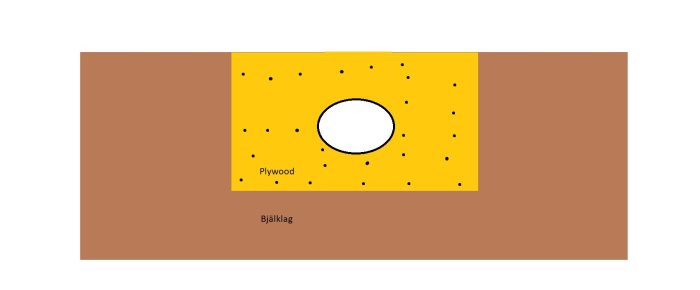
The joists are 45x195, and according to current recommendations, I was planning to run a 75mm drain to the new kitchen. Therefore, I would need to "notch" one or two joists to avoid a lot of small pieces of drainpipe with many joints. I was then planning to place the hole in the middle of the joist and reinforce with plywood as per the sketch.
Notching:
Drilling:
What does the expertise in here think about this? The alternative is to go down to a 50mm drain, but I have read that it's not recommended for kitchen drainage!
Hmm how long will the drain be? Since you need a slope on the drain, the notching on the first beams closest to the stem will be very deep, doubtful that a little plywood "replaces" them, so this is what I did in my bathroom, reasoning that it was better to have an extra drain joint than a sagging beam structure. Now the picture was bad but it continues the same out of the picture,
Do you have to notch in the middle of the joist? It's definitely the worst part to weaken!
Can't you go along the outer wall? There, the notching doesn't impact as much by far!
Kest: The picture is mainly to show how many beams I have to drill through, the pole will be placed about 50cm in from the top of both pictures.
Patzie: The notching will only be in the first two beams closest to the new sink, that is where the slope just begins, then there will be holes in the rest.
Worth mentioning is that I have the possibility to add extra floor joists to reduce from cc30 to cc60. However, I would prefer to avoid doing this if it's not necessary.
It is a clearly inappropriate (to use a cautious word) solution you are planning. Here are some principles: Never notching, only drilling holes. Holes should be made in the center of the beam (vertically). Holes should never be made near the ends and preferably not in the middle (horizontally). The size of the hole should be adjusted to where in the beam's length the drilling is done.
75 mm pipe is far too large considering the dimensions of the beams and the long span. The pipe should have a slope between 1:100 and 1:50, i.e., 1-2 cm per meter. In addition, the floor joists, 45x195, are already too slender for a span of 3.5 meters. Either you choose a 50 mm pipe and place the holes about 1/4 length out from the wall or you find another solution (which always exists).
Thanks for all the answers, and as justus says there is always another way, which is my plan B. That is to drill it down to the laundry room and from there build it into a "culvert" on the wall. This then removes all the holes in the joists except through the last joist before the wall as the basement room is a bit shorter than the room above.
The question then is, can I drill a 75mm hole in a joist or must it be 50?
If not, does it make sense to run 75mm up to the last 1.5m from the sink and then switch to 50mm?
You can drill a 75 mm hole if it is centered in the beam. When you plan to drill holes and consider the offsets required by the case, you will get too close to the edges of the beams with 75 mm. I do not see that a change in diameter as you describe it provides anything.
Thanks for all the answers. But then it should work well if I place the hole centrally in the beam and about 50cm in from the support. Because if I only need to make a hole in one beam as my plan B suggests, then there will be no problem!
Hi, I tried to find a good picture but didn't have one. I ended up taking a 75mm hole in the center (horizontally and vertically) of the beams and minimized the number of beams I put a hole in (it was 2) by diving down and running the external in the basement and enclosing it in a box.