267,379 views ·
153 replies
267k views
153 replies
Help regarding drywall on basement walls!!!

Yes, I think so too. But is it really that expensive?JohannesP said:
The Fermacell boards are so rigid and the strength is so good that you only need one board and you can mount almost anything on this with a regular screw.
With gypsum board/OSB, you need double boards for stiffness and you also have an organic material that increases the risk of mold.

Hello again Now I have to chime in😜 Fermacell is not a good idea at all against basement walls; it works in wet rooms with non-backfilled exterior walls with a waterproof membrane.roland53 said:Yes, I believe that too. But will it be that expensive? The Fermacell boards are so rigid and their strength is so good that you only need one board, and you can pretty much attach anything to it with regular screws. With plasterboard/OSB, you have to have double boards for the sake of rigidity, and then you also have an organic material that increases the risk of mold.
Fermacell is 80% gypsum and 20% ground paper pulp, so the gypsum would disintegrate over time, and the paper pulp would mold. Quote: FERMACELL Fiber Gypsum Board is approved by SITAC for walls in wet rooms. FERMACELL Fiber Gypsum Board consists of 80% gypsum and 20% paper fibers. The fibers are distributed throughout the board material and run in all directions, thus combining the tensile strength of the fibers with the compressive strength of the gypsum. Therefore, the boards have a strength that far exceeds the well-known plasterboards and can be compared to the strength of wood panels.
Kind regards, The Inspector
👍🏼 so are there also paper fibers in minerit then?Besiktningsmannen said:Hello again Now I have to weigh in😜 Fermacell is not a good idea at all against basement walls, it works in wet rooms with non-backfilled exterior walls with a waterproof layer.
Fermacell is 80% gypsum and 20% ground paper pulp, so the gypsum would break down over time, and the paper pulp would mold, Quote: FERMACELL Fiber gypsum is approved by SITAC for walls in wet rooms. FERMACELL Fiber gypsum consists of 80% gypsum and 20% paper fibers. The fibers are distributed throughout the board material and are oriented in all directions, thereby combining the tensile strength of the fibers with the compressive strength of the gypsum. Therefore, the boards have a strength that far exceeds the well-known gypsum boards and can be compared to the strength of wood boards.
Best regards, Besiktningsmannen
Now, it wasn't that the boards were supposed to be mounted directly against the basement wall if I understood correctly. The discussion was whether it could be an alternative to regular gypsum boards (with paper on the outside) and OSB boards mounted on steel studs. !!Besiktningsmannen said:
And in that choice, I would undoubtedly choose Fermacell boards.
.There are certainly even more suitable boards. Looking forward to the panel's suggestions....
Paper-covered drywall on steel studs doesn't work risk-free either, even if you have an air gap next to the basement wall, the moisture in vapor form will destroy the drywall and cause the paper on the drywall to mold.roland53 said:Now, it wasn't that the boards would be mounted directly against the basement wall, if I understood correctly. The discussion was about whether it could be an alternative to regular drywall (with paper on the outside) and OSB boards that were mounted on steel studs. !! And in that choice, I would undoubtedly choose Fermacell boards.
There are certainly more suitable boards available. Looking forward to the panel's suggestions....
No, and that is why I commented that if the choice was between gypsum with paper backing and Fermacell fiber gypsum, I would definitely choose Fermacell.Besiktningsmannen said:
I don't quite understand your comment in that situation
. Please feel free to suggest which boards are even better than Fermacell and explain why they are better.
Last edited:
Hello! I currently have a basement that needs renovation. The outside is insulated and drained with Isodrän. There is very little moisture in the walls and floor (not insulated). The house is from 1939 and there haven't been any moisture issues or odors before. What was in place were planks on a built-up foundation and wood panels on top, which seems to have allowed steam to pass through. The walls are 1.20 meters below ground level. My thought/question is if I install vertical metal studs (25 mm) in plaster to level the wall, then attach with nail plugs once it's dry, then stretch a building plastic over the studs with a 2 cm gap to the ceiling. I'll also leave OSB gypsum 2 cm from the ceiling, with a glued polystyrene strip with spacing that allows air to escape. Then a Platon mat on the floor, leaving 2 cm from the wall so the ventilation is behind the plastic on the wall. On top of the Platon, I’ll put building plastic with an upward turn towards the wall plastic and t-flex tape on this. This should result in having organic material inside the plastic, and everything against the slab and outer wall before the plastic being non-organic, with an air gap. Is it a construction that would work, or would I need to take ventilation out through the façade above ground for extra ventilation? I don't want any fans or plastered walls; I want OSB and gypsum. All tips are welcome, thanks in advance
The thing is that sooner or later you'll pierce holes in the building foil, either when you set it up or later, and then you'll have moisture there anyway..
Platon mats, on the other hand, are supposed to be a safe bet for floors.
Platon mats, on the other hand, are supposed to be a safe bet for floors.
Hello. Thought I'd share a bit about how I've planned to set up my basement.
There's something called luxelement and another product that's very similar is Jackon wet room board. Since I couldn't easily get the former, I chose the latter.
Anyway, I've planned to attach these boards with a "koblaja" render and then drill in a screw or a so-called "dowel". Since the koblaja adds a bit of height, I'm counting on having at least a few centimeters of air gap behind. Then I'll make two ventilation holes, one at the top and one at the bottom against each outer wall so that the moisture can at least escape somewhere. Then I'll tile the surface. The advantage of this solution is that there's no organic material anywhere that can mold!
And if you notice it gets extremely humid behind the wall, you have the option to install a mechanical fan to remove the moisture.
All of this is actually a shortcut because I find it difficult to render the walls and around the window. Board material is just a bit easier to make look nice!.....
There's something called luxelement and another product that's very similar is Jackon wet room board. Since I couldn't easily get the former, I chose the latter.
Anyway, I've planned to attach these boards with a "koblaja" render and then drill in a screw or a so-called "dowel". Since the koblaja adds a bit of height, I'm counting on having at least a few centimeters of air gap behind. Then I'll make two ventilation holes, one at the top and one at the bottom against each outer wall so that the moisture can at least escape somewhere. Then I'll tile the surface. The advantage of this solution is that there's no organic material anywhere that can mold!
And if you notice it gets extremely humid behind the wall, you have the option to install a mechanical fan to remove the moisture.
All of this is actually a shortcut because I find it difficult to render the walls and around the window. Board material is just a bit easier to make look nice!.....
Is "koblaja-puts" understood to mean "spot plaster with dung"?
I'm just curious, I don't have the answer on how it would functionally work in a basement - but what I know is that it's important for everything done with a house to be understandable, among other reasons, for future owners, and that overly unusual ideas should be avoided.
I'm just curious, I don't have the answer on how it would functionally work in a basement - but what I know is that it's important for everything done with a house to be understandable, among other reasons, for future owners, and that overly unusual ideas should be avoided.
@Blwrgrl: I have searched here on the byggahus-forum but haven't found anything particularly useful regarding these luxelements. However, they apparently have a website with many good practical tips on how to proceed to maximize the use of the product. That's why my tiler recommended this system because there was a lot of documentation available. If you look at picture 4a on the following link: http://www.int.luxelements.com/lux_sweden/praxis/wand/wand-innenbereich.htm
you can see the "ko-blajor" I was talking about. The reason is to be able to set the boards straight and evenly, even if the substrate is rough. He said it saves a lot of work by not having to plaster, and especially around the window, it becomes super easy to make it look nice. So I think it will turn out very well!
you can see the "ko-blajor" I was talking about. The reason is to be able to set the boards straight and evenly, even if the substrate is rough. He said it saves a lot of work by not having to plaster, and especially around the window, it becomes super easy to make it look nice. So I think it will turn out very well!
House with a basement from the 1970s.
The basement has previously been furnished as a rec room and bathroom/laundry. Raised pine floor with 45 joists resting on the slab. Upon breaking up and removing the floor, everything looked new underneath. The walls were also framed with timber, wood spacer blocks about 1-2 cm, mineral wool, tar paper, and wood paneling. Here too, everything looked new. I will go with a mechanically ventilated floor.
Initially, the plan was to insulate the exterior with isodrän, but some issues have arisen. On one long side and the short side, the rock is centimeters away from the basement wall when you get about 1-1.5 meters below ground.
My current thought is to use mechanically ventilated walls on the inside, like platon, and frame with insulation on top of that. What do you think of this solution?
Or would it be advantageous to only ventilate the part of the wall that cannot be insulated from the outside? That is, ventilate from the inside and insulate about 50-70 cm from the floor up and frame the wall all the way up to the ceiling. Can I insulate the part of the wall that is above ground on the inside? On the outside, I’m planning to lay a thickness of 10-20 cm isodrän about 15 cm below the ground and down 80-130 cm?
The basement has previously been furnished as a rec room and bathroom/laundry. Raised pine floor with 45 joists resting on the slab. Upon breaking up and removing the floor, everything looked new underneath. The walls were also framed with timber, wood spacer blocks about 1-2 cm, mineral wool, tar paper, and wood paneling. Here too, everything looked new. I will go with a mechanically ventilated floor.
Initially, the plan was to insulate the exterior with isodrän, but some issues have arisen. On one long side and the short side, the rock is centimeters away from the basement wall when you get about 1-1.5 meters below ground.
My current thought is to use mechanically ventilated walls on the inside, like platon, and frame with insulation on top of that. What do you think of this solution?
Or would it be advantageous to only ventilate the part of the wall that cannot be insulated from the outside? That is, ventilate from the inside and insulate about 50-70 cm from the floor up and frame the wall all the way up to the ceiling. Can I insulate the part of the wall that is above ground on the inside? On the outside, I’m planning to lay a thickness of 10-20 cm isodrän about 15 cm below the ground and down 80-130 cm?
Member
· Västernorrland
· 12 092 posts
If everything you tore down was dry and fine, you probably won't have any problems in the future either, no matter how you do it. Your house is likely situated quite favorably and water from surrounding materials is probably completely absent.
Hello!
I apologize if I should start my own thread, but I'm giving it a try here:
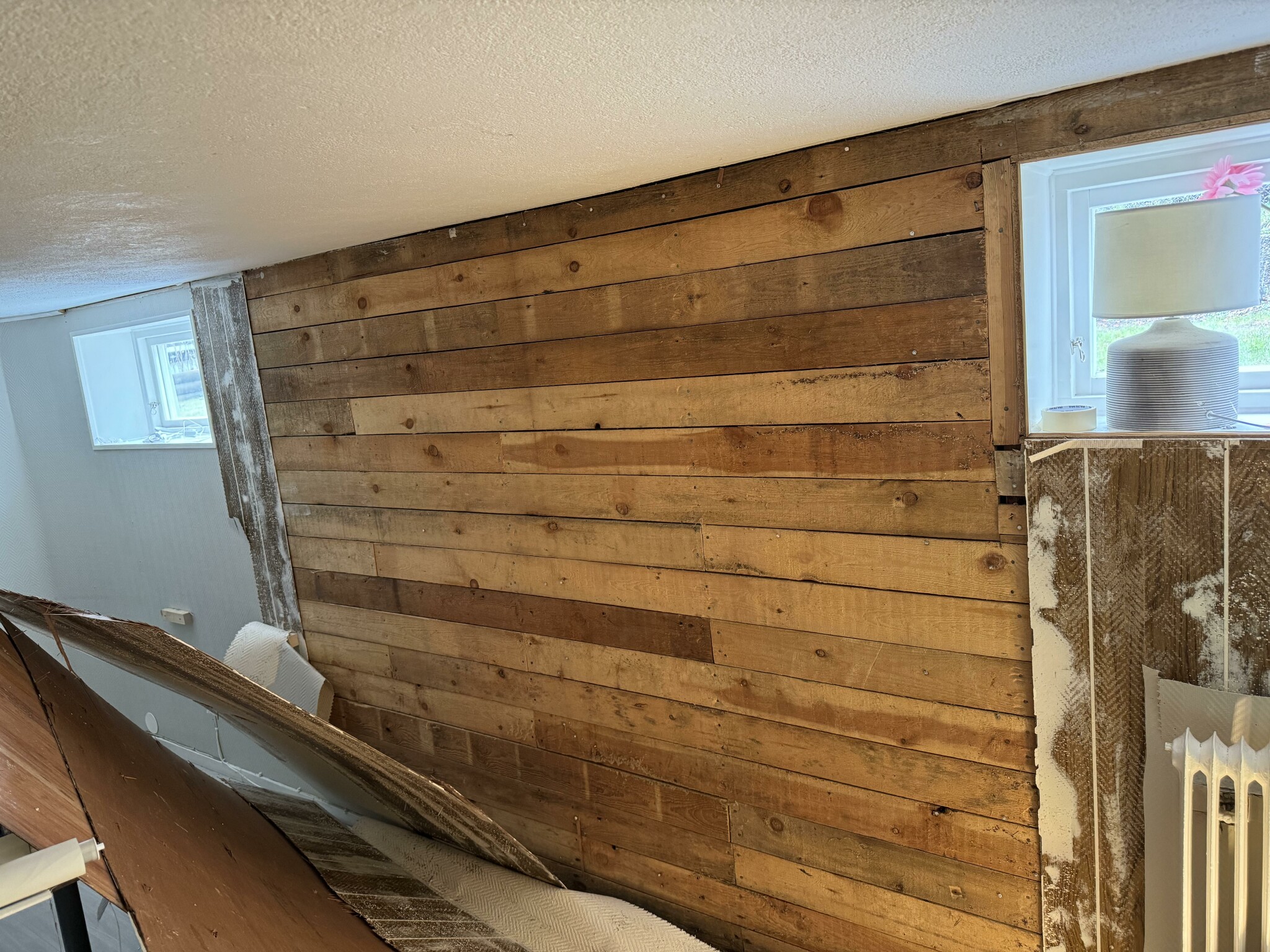
We are renovating a room in the basement (in a house that has been relatively recently drained) and have torn down paneling and wallpaper. The wall looks like the picture, a similar plank frame. Behind this, the basement wall is probably made of leca (with great likelihood). We aren't entirely sure how the wall should be constructed, whether we should plaster the leca and paint, or if we should frame with metal studs. BUT, what do we do with this "plank frame"? I don't dare to tear it down completely because I'm unsure if it has a load-bearing function. Is that idea completely unreasonable, or how should I think about it? Either way, I don't want organic material in the basement.
I apologize if I should start my own thread, but I'm giving it a try here:
We are renovating a room in the basement (in a house that has been relatively recently drained) and have torn down paneling and wallpaper. The wall looks like the picture, a similar plank frame. Behind this, the basement wall is probably made of leca (with great likelihood). We aren't entirely sure how the wall should be constructed, whether we should plaster the leca and paint, or if we should frame with metal studs. BUT, what do we do with this "plank frame"? I don't dare to tear it down completely because I'm unsure if it has a load-bearing function. Is that idea completely unreasonable, or how should I think about it? Either way, I don't want organic material in the basement.