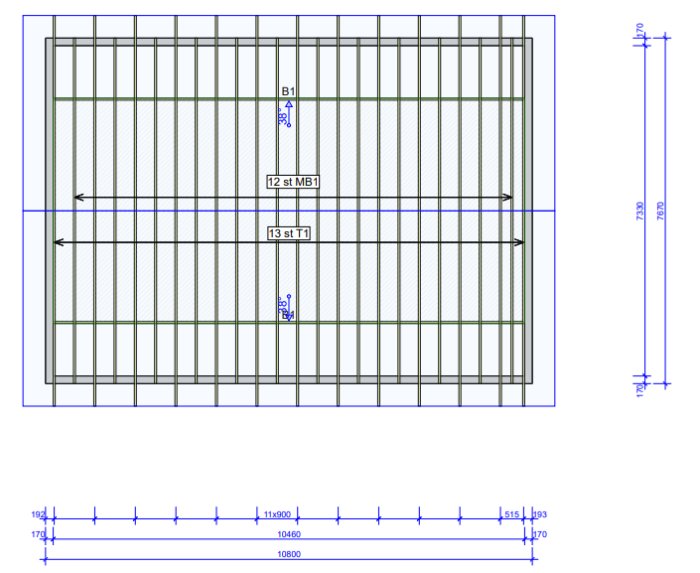
It is probably not glulam in the roof truss factory's drawing, but it should be fine anyway. You can rely on the calculation, and the production method allows the material to be used more efficiently. The measurement 7330 mm is between the outer wall studs. If you add horizontal studs on the inside and sheathing material on the walls, you will soon be down to 7200 mm. The beams that run across the trusses at the struts are meant to provide full interaction between the lower frames of the trusses and the floor beams that lie between the trusses.
I assumed that a dimension like 45x360 was glulam. I had no idea there was anything else in that dimension.
I initially got the impression that the span I want is "impossible." Only substantial, expensive glulam like 115x315 or a heart wall or beam underneath could solve this.
Now this solution came up and surprised me a bit. Have I missed anything negative with this proposal from the truss manufacturer?
One must know some structural analysis to analyze the truss drawing. Three things do the trick. The support legs function as "extra" supports for the floor joists, which help reduce deflection. On the portion of the joists that lie inside the support legs, only a storage load of 500 N/sqm is considered. The crosswise battens at the support legs make the intermediate joists also act in cohesion.
Really tricky solutions exist, thanks for the knowledge!
It feels like the suggestion is a hot candidate for this summer's project.
The catch, however, is the price, which was significantly higher than I expected. But that's probably the effects of the pandemic, of course. I might have to check with a few more manufacturers so I can compare a bit.
Yes, logically it should become cheaper. I've never bought roof trusses before and reading threads about what others paid before the pandemic doesn't seem very relevant.
You, who seem more than moderately knowledgeable, might also have insight into price developments? According to the drawing I attached, 13 roof trusses and 12 intermediate beams would cost me precisely 100k SEK.
25 glulam beams 115x315 and 7.3 m long would have cost about 80 kkr before the pandemic, so compared to that, 100 kkr is cheap. Otherwise, I usually refrain from commenting on costs. In the professional construction sector, there are people who calculate prices and they are incredibly skilled.
You shall have a big thank you! Invaluable for an amateur like myself to get such quick and professional help. I would like to mark all answers as the best, but it's not possible, so it'll be the first one.
I have now received a proposal from another truss manufacturer, let's call it option 2, and I would need help interpreting the drawing.
If I understand it correctly, the difference compared to option 1 is that the trusses are placed at 90 cm on center plus an intermediate beam, which should then give a total of 45 cm on center for the floor joist? Also, the loft is 20 cm narrower. General opinions on this option would be appreciated.
Yes, there will also be a beam between the roof trusses so the c/c will be 45 cm. The bottom frames are only 220 mm high, so the deflection will be somewhat higher in this option. This can be managed with glued and screwed chipboard on the large surface between the support legs. Preferably also sheet material on the underside.
I will continue this thread with a couple of new questions that have come up. Question 1 is best answered by the person who sent the quote, but he has taken Easter leave.
1. I assumed that the trusses with cross beams in alt. 1 would result in cc60 since that was what I wanted. However, it just occurred to me that they have calculated with 13 trusses and 12 cross beams so it should be less (cc45?) because the length is 10.8m but I can't read it exactly anywhere. Could it be cc45 and even a bit shorter at the last placement on the far right? I am attaching an image that came with the truss drawing.
2. If they don't end up at cc60, I still want the wall studs to be so. The trusses would then not be directly above a wall stud. Therefore, I need to embed a vertical stud under the wall plate, either inside or outside. What dimensions should this have in the area where there are no doors or windows but the wall studs are at cc60?
Last edited:
Click here to reply
Vi vill skicka notiser för ämnen du bevakar och händelser som berör dig.