
11,703 views ·
43 replies
12k views
43 replies
Have we accidentally demolished a load-bearing wall?
Hello,
We have widened a doorway by 40cm in width and height, which we assumed was not load-bearing after looking at the floor plan and tapping on the wall, which in hindsight was probably unwise.
The wall is about 15cm thick and to the left of the doorway, it is lightweight concrete/concrete where we have not demolished. To the right and above, it is timber framing and it's an apartment from the 1800s.
In hindsight, we now believe the wall might be partially load-bearing, i.e., to the left of the opening where we haven't demolished. What do you think, is it load-bearing? Who can we contact to get a certificate from an engineer confirming whether it is/isn't load-bearing? If it is load-bearing, how can we work around the issue?
Note: The board requires that we obtain a certificate from an engineer stating the demolition is approved and that the wall is not load-bearing.
See the floor plan image and where we believe it might be.
Thanks in advance!
We have widened a doorway by 40cm in width and height, which we assumed was not load-bearing after looking at the floor plan and tapping on the wall, which in hindsight was probably unwise.
The wall is about 15cm thick and to the left of the doorway, it is lightweight concrete/concrete where we have not demolished. To the right and above, it is timber framing and it's an apartment from the 1800s.
In hindsight, we now believe the wall might be partially load-bearing, i.e., to the left of the opening where we haven't demolished. What do you think, is it load-bearing? Who can we contact to get a certificate from an engineer confirming whether it is/isn't load-bearing? If it is load-bearing, how can we work around the issue?
Note: The board requires that we obtain a certificate from an engineer stating the demolition is approved and that the wall is not load-bearing.
See the floor plan image and where we believe it might be.
Thanks in advance!

A wall in a multi-family building from the 1800s (I guess the 1880s, mainly because there are relatively few examples left from earlier decades, at least in Stockholm) is either brick or plank with plaster on - partition wall). If you indeed have concrete or light concrete, it's a newer construction. You need to start by contacting the City Building Office to get blueprints and other information about the construction. Since renovations have definitely taken place (bathrooms have been added and the kitchen changed, possibly moved), blueprints and building permits can also be helpful. If after this you are sure that the wall is not load-bearing, you can consider whether you want to hire a structural engineer for an opinion on this or respond to the association that you believe they must prove that you have made changes to a load-bearing structure, not the other way around.
Thanks a lot for the answer. I have the following drawings! I think (with my lack of knowledge) that it is clearly NOT a load-bearing wall. Do you agree?1 16386 said:A wall in a multi-family house from the 1800s (guessing the 1880s, mostly because there are relatively few examples left from earlier decades, at least in Stockholm) is either brick or plank with plaster on - kloasongvägg. If you really have concrete or light concrete, it is a newer construction. You need to start by contacting the City Building Office to get drawings and other information about the construction. As renovations have definitely taken place (bathrooms have been added and the kitchen has been altered, perhaps moved), drawings and building permit documents may also be helpful. If after this you are sure that the wall is not load-bearing, you can consider whether you want to hire a structural engineer for an opinion on this or respond to the association that you believe they must prove that you have made changes to a load-bearing construction, not the other way around.
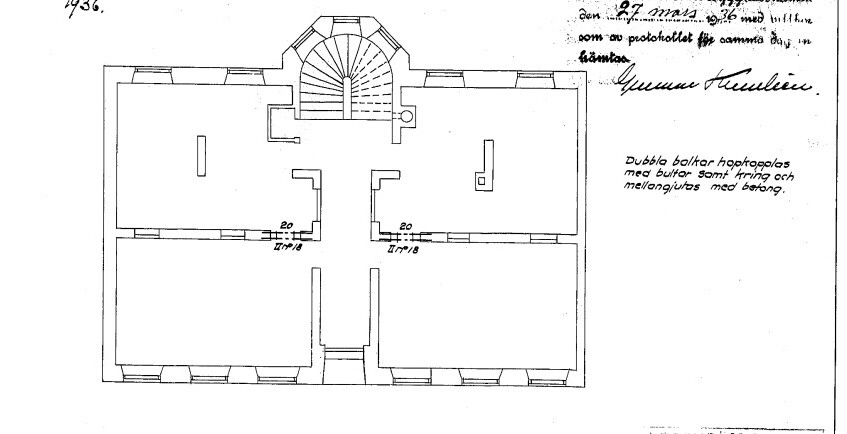
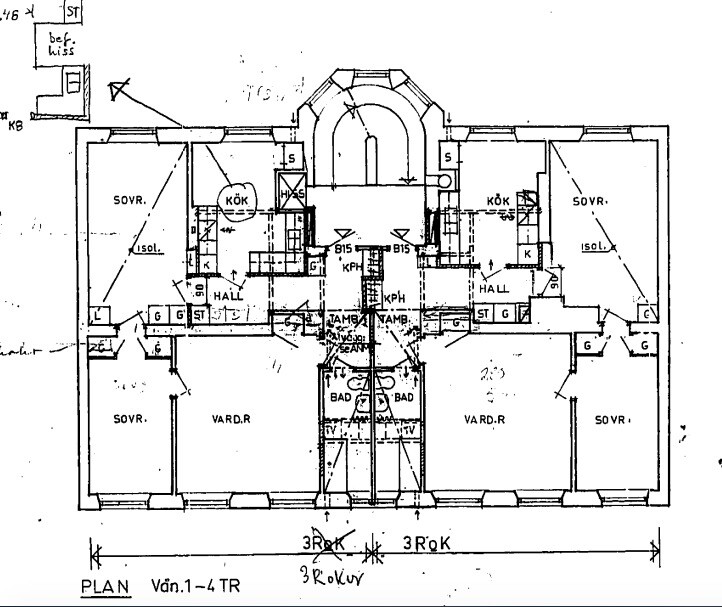


In this case, it is more likely that the wall running under the roof ridge (vertically in the first image) is load-bearing since it is drawn on the sectional drawing with a strong reinforcement in and under the basement level.Anna_H said:
No, I looked carelessly and thought it was 4 apartments. But as a basic principle, it still applies; this house is an exception, highlighting the importance of checking the sectional drawing. And it is indeed clear.BirgitS said:
It also clearly shows that the load-bearing walls are not something one would even want to attempt to touch; they seem quite substantial 😆
Agree with @Anna_H and @BirgitS. But I'm curious about what material you found in the wall. The apartments were significantly renovated during the modernization, but I would have expected the door between the rooms to be near the outer wall. I wonder if they moved that as well when they changed so much else.
Thank you @anna
1 16386 said:A wall in a multi-family home from the 1800s (guessing the 1880s, mainly because there are relatively few examples left from earlier decades, at least in Stockholm) is either brick or plank with plaster on - kloasongvägg). If you really have concrete or lightweight concrete, it is a newer construction. You need to start by contacting the City Planning Office to get drawings and other information about the construction. Since renovations have definitely taken place (bathrooms have been added and the kitchen has been changed, maybe moved), drawings and building permits may also be helpful. If after this you are sure that the wall is not load-bearing, you can consider whether you want to hire a structural engineer for an opinion on this or tell the association that you believe they must prove that you have made changes to the load-bearing structure, not the other way around.
See pictures!1 16386 said:I agree with @Anna_H and @BirgitS. But I'm curious about what material you found in the wall. The apartments have been heavily renovated in connection with modernization, but I would have expected the door between the rooms to be close to the outer wall. I wonder if they moved that too when they changed so much else.


In the last picture, it looks like a classic old kloasong wall.
https://sv.wikipedia.org/wiki/Kloasongvägg
https://sv.wikipedia.org/wiki/Kloasongvägg
A stud wall concerns its construction rather than how much load it can bear, so it can be either load-bearing or non-load-bearing. The dimensions of the studs are simply chosen based on the load they need to withstand.
The board still seems to think we must bring in a designer who either says it isn’t load-bearing or reinforces it.
Thinking that we can reinforce the sides and top with a steel stud. Don't know if this is an ok solution though.. 😅
https://www.k-rauta.se/produkt/stal...7Ak4we9CVWdV997m4huQG6TXqLwZ0K-waAq5aEALw_wcB
If the wall is load-bearing, you need to file a building notification with the municipality, which must be approved before the work begins. In the building notification, you often need to present calculations on how you decided the size of beams and thickness of pillars required to support the weight from above, and that’s something you need help with from a structural engineer.
I don't think such a metal stud can support any significant weight without bending. What is usually used as a beam is a glue-laminated beam: https://www.k-rauta.se/sok?query=limträbalk
which should rest on pillars: https://www.k-rauta.se/sok?query=limträpelare
There is text and some images regarding wall opening here: https://www.byggahus.se/kan-jag-oppna-upp-mellan-kok-och-vardagsrum-i-mitt-hus
This might make it easier to understand what it's all about.
Worth reading, even if it's about villas:
https://www.byggahus.se/ar-vaggen-barande-en-lathund
https://www.byggahus.se/plankhus-hus-med-stomme-av-plankor-1920-1950
I don't think such a metal stud can support any significant weight without bending. What is usually used as a beam is a glue-laminated beam: https://www.k-rauta.se/sok?query=limträbalk
which should rest on pillars: https://www.k-rauta.se/sok?query=limträpelare
There is text and some images regarding wall opening here: https://www.byggahus.se/kan-jag-oppna-upp-mellan-kok-och-vardagsrum-i-mitt-hus
This might make it easier to understand what it's all about.
Worth reading, even if it's about villas:
https://www.byggahus.se/ar-vaggen-barande-en-lathund
https://www.byggahus.se/plankhus-hus-med-stomme-av-plankor-1920-1950