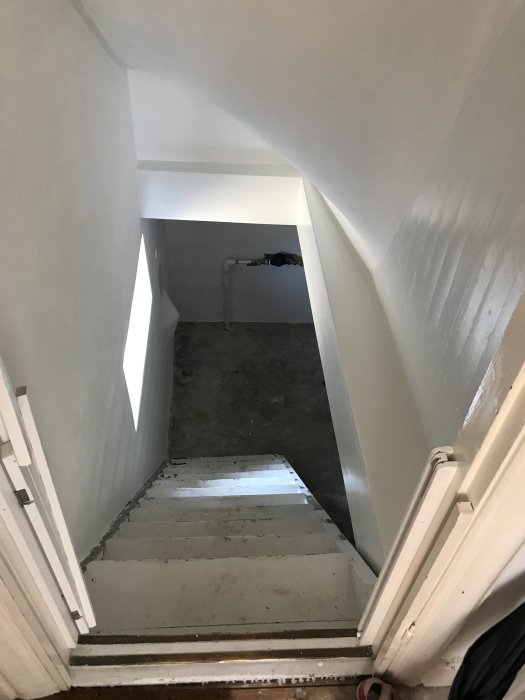
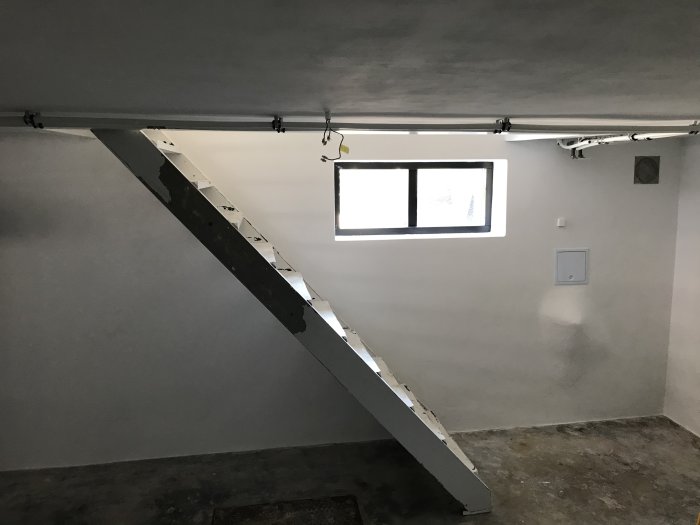
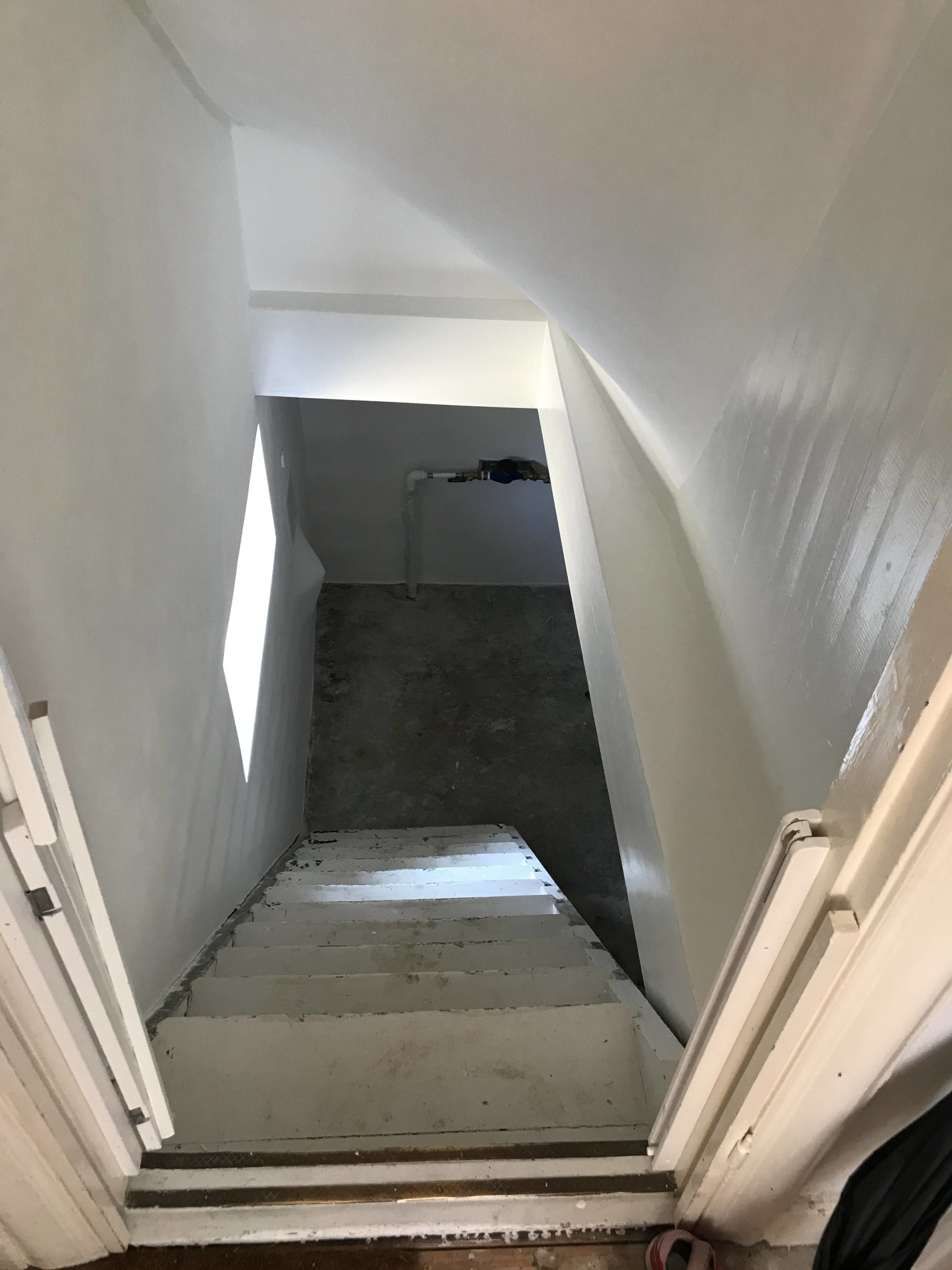
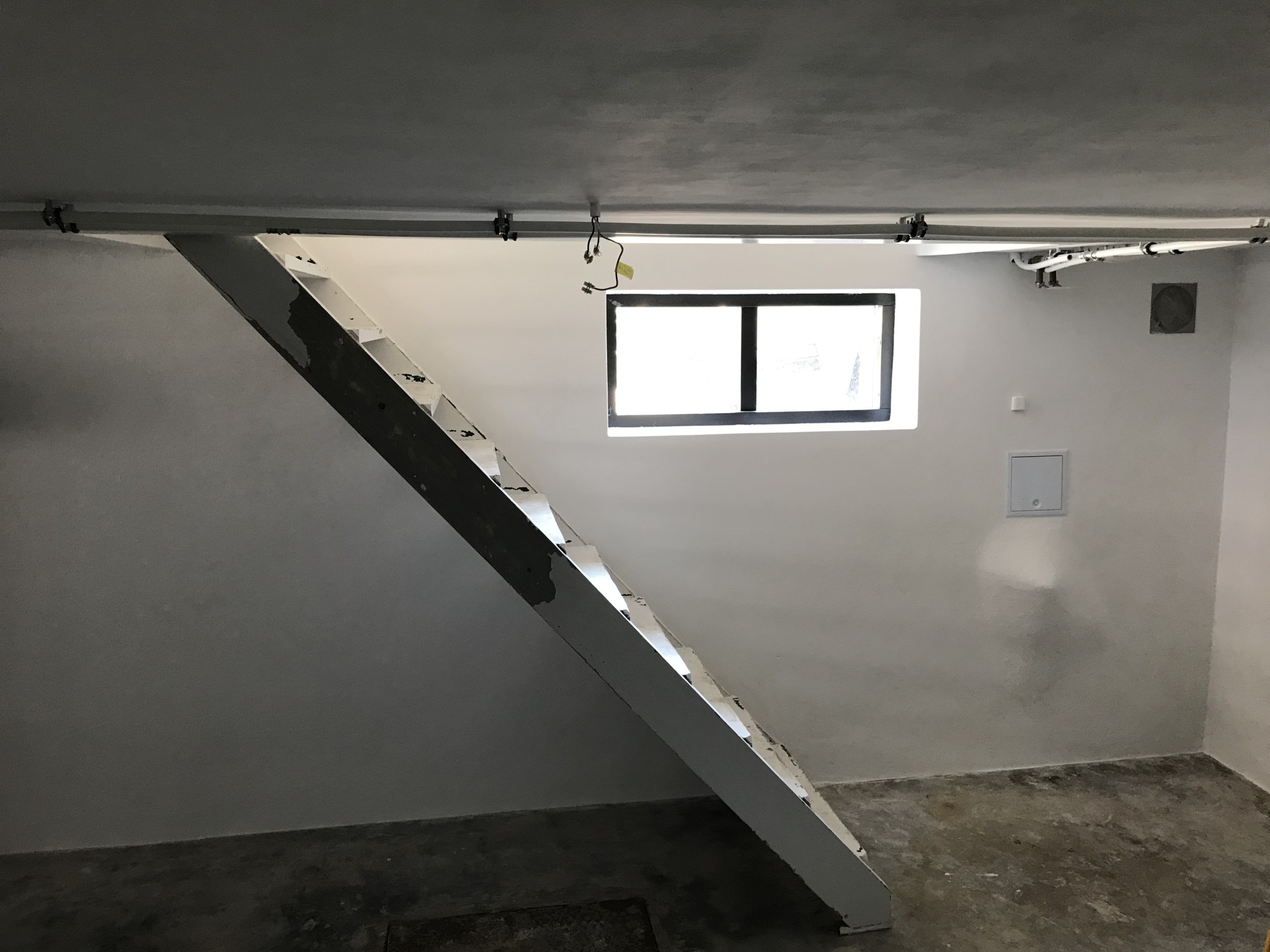
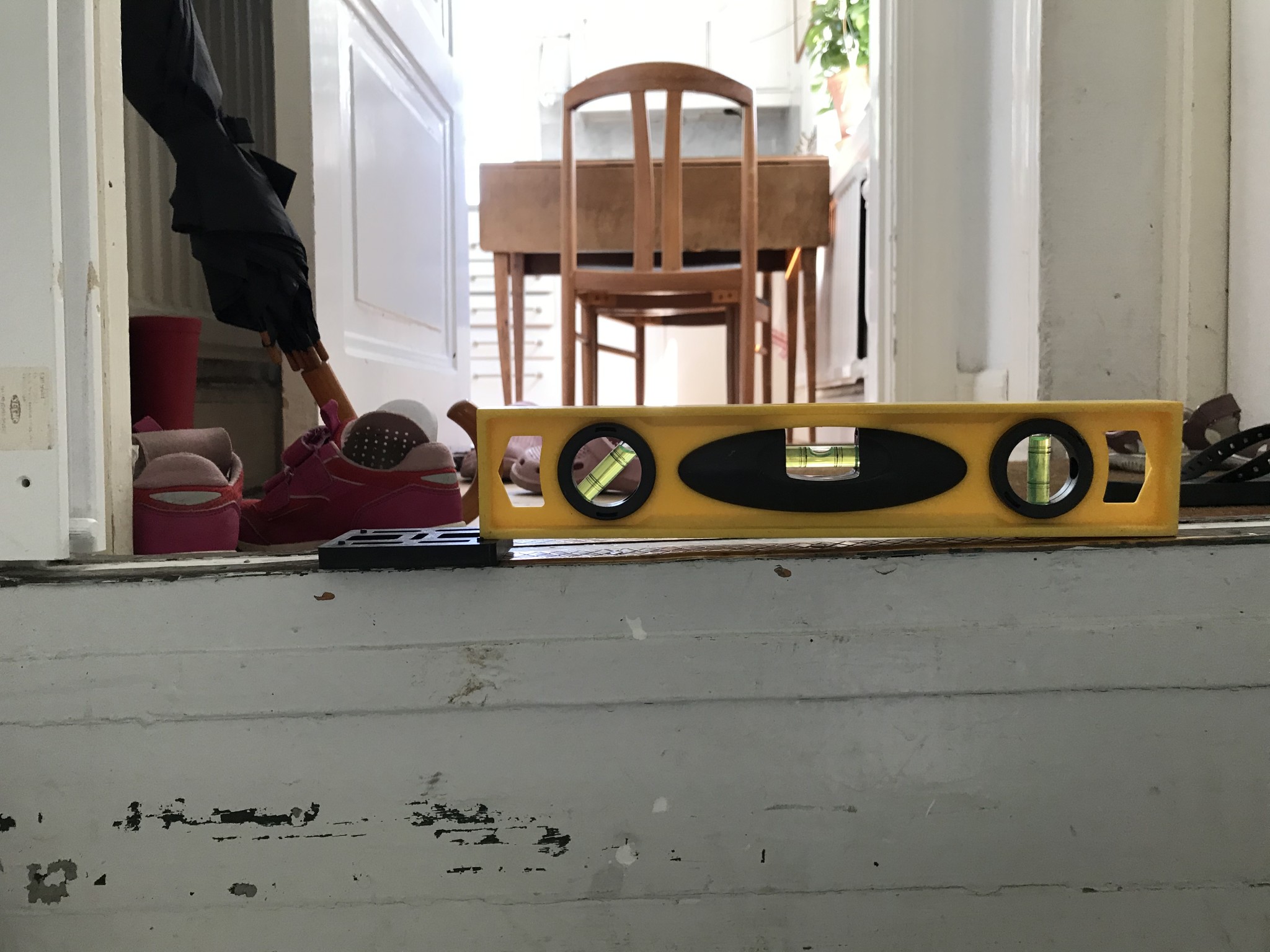
Hi, living in a house from '32 with wooden joists. I'm working on fixing the basement and wondering about the load-bearing capacity.
I believe the joists run in the direction of the stairs, spanning about 5m.
Above the stairs, the stairs go to the upper floor.
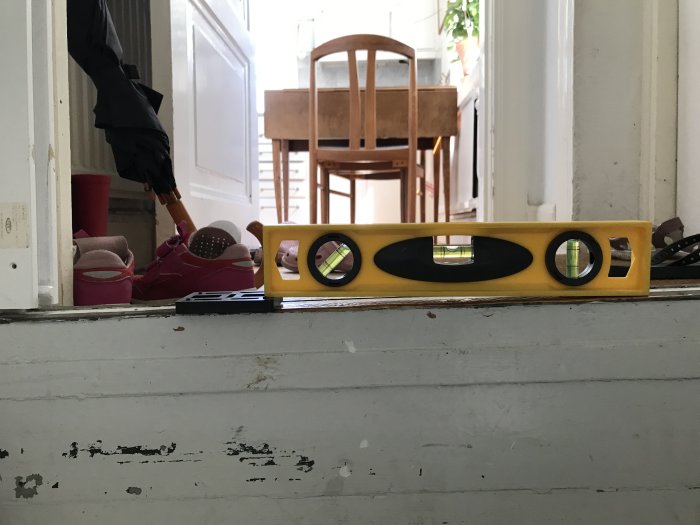
Should I support from underneath, or is there no point? There were no supports when we moved in. It slopes about 1cm/30cm according to the picture.
We don't mind the slope, but we don't want it to get worse.
Unfortunately, I don't have a construction drawing, but there's a load-bearing wall and the room with the stairs measures 3x5 meters.
I am relatively bad at older wooden constructions, but I am sure you have nothing to worry about. It looks practically identical to our stairs and has reportedly looked like that for at least the last few decades. Even upstairs, there are significant differences in the level of the finished floor, but that's probably how it was built. Most likely, @justusandersson will eventually show up and can give you a much more detailed answer.
I am relatively unfamiliar with older wooden constructions, but I am sure you don't need to worry. It looks practically identical at our stairs and has reportedly been like that for at least the past decades. Even on the upper floor, there are significant differences in the height of the finished floor, but that's probably how it was built.
Most likely @justusandersson will eventually show up and give you a much more detailed answer.
Thank you for your reassuring words! It's been like this for ten years and I've occasionally wondered if I should put in a support or not. Aesthetically, I'd prefer not to, and with the limited space we have, I'd rather avoid it. It's the same at my place too, but as you say, that's probably how they built it and then the large c/c exacerbates the issue.
Best regards, Magnus
Thank you for your reassuring words! I've had it like this for ten years and from time to time I've wondered if I should put a support or not. Aesthetically, I'd prefer not to have it, and with the limited space we have, I would rather avoid it. It's hanging in my place too, but as you say, that's probably how they built it and then with a large c/c which makes it worse.
Regards Magnus
I don't think it has gotten significantly worse over the years as, at least in my case, it's quite over-dimensioned with fastenings and such. In some places, there are also very short spans where it couldn't have started to dip. However, I don't think they were very careful with the heights of the beams, installing them level, etc.
Thanks @C.Lundin for the pass! I find it hard to imagine it being some kind of barighetsproblem. The floor structure between the basement and the ground floor can be a combination of concrete and wood. It's not uncommon if you have a garage in the basement. Generally, it can be said about wooden floor structures in 30s houses that they are often strong but bouncy. A common dimension for floor joists is 3x7 inches, which gives a lot of deflection. The knowledge of wood properties was also worse than today. Permanent deformations are very common. The large c/c is not the main problem but the insufficient height of the floor joists. If you are going to level the floors, that's the problem you need to tackle.
Thank you @C.Lundin for the pass! I find it hard to believe it's some sort of load-bearing issue. The flooring between the basement and the ground floor might be a combination of concrete and wood. Not entirely uncommon if you have a garage in the basement. Generally, you can say about wood flooring in 1930s houses that they are often strong but bouncy. A common dimension for floor joists is 3x7 inches, which results in a lot of flex. The knowledge about wood properties was also less than it is today. Permanent deformations are very common. The large c/c isn't the main problem but rather the floor joists' insufficient height. If you want to level the floors, that's the problem you need to address.
Thank you, Justus! Grateful for your input and thankful that you share your knowledge. The flooring is entirely wood, and we plan to keep it as it is, retaining the original scrubbed floor and parquet. We still have the original door to the basement, and it's perpendicular so it's probably been unhinged for a long time
I don't think it has gotten significantly worse over the years since, at least in my case, there is quite an over-dimensioning with the fastenings and such. In some places, there are also very short spans where it could not possibly have started to sag. However, I don't think they were very meticulous about the heights of the beams, installing them level, etc.
We skim-coated and painted when we moved in ten years ago and it hasn't cracked yet, so fingers crossed that it's settled.
Click here to reply
Vi vill skicka notiser för ämnen du bevakar och händelser som berör dig.