
12,437 views ·
89 replies
12k views
89 replies
Handling 16m long glulam beams (roof beams)
We are leaning towards some sort of crane right now. The beams shouldn't be visible, but it feels like an option worth spending a little extra on. Especially considering unloading isn't included upon delivery.A atomlab said:I would say that a crane truck/mobile crane is the only suitable option.
Handling something that is 16m long with a forklift will be incredibly difficult, if not impossible, to maneuver around. If they also need to be visible, be careful with edge protection and so forth. Otherwise, there will be marks due to their own weight.
See post #15. It should be possible to place a splice between the supports. But I'm too new at this to be able to do something like that. Maybe one should hire a consultant who will take on that responsibility.L Leif i Skåne said:

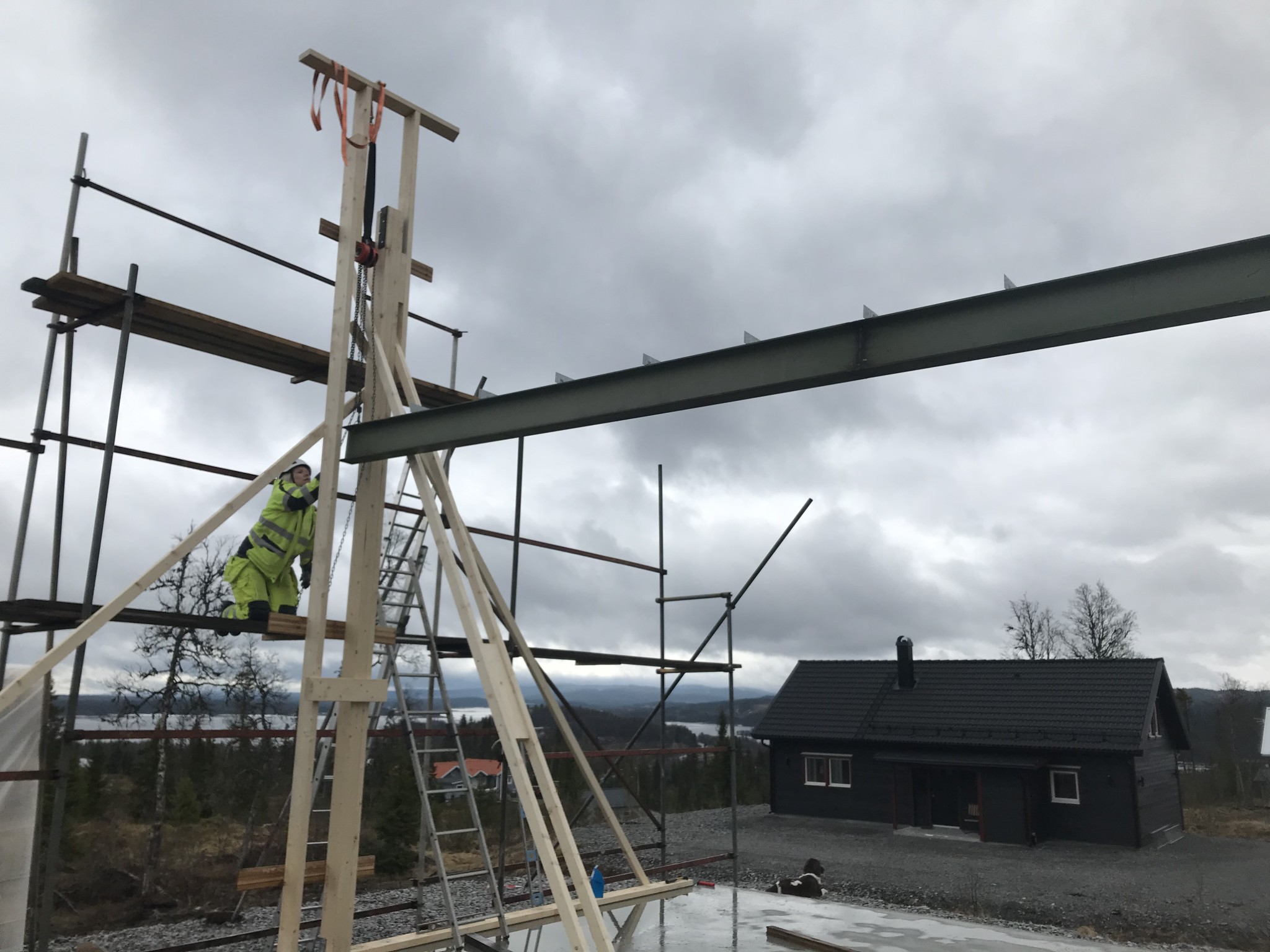
When I built the garage, the roof beams arrived with a crane truck along with other building materials. I asked the driver to place them on the walls instead of on the ground. Two men on scaffolding can then move them into the correct position by hand.
We could have built this, but the delivery must come with a crane truck. Otherwise, we need a crane to unload the delivery truck first. Then we might as well do everything with a crane truck.G Gabbe1 said:
Will push the supplier to deliver with a crane truck. How long were your roof beams?D Diablito said:
Finding a crane truck that can transport 16m legally will be difficult.
Why must they be exactly 16m if it's not for a 16m long room without pillars?
There are steel trucks that deliver 24m goods with a crane. But then you have to manage to get such a beast onto the property and also close to where it will be set up. But managing to rent such a truck probably requires some persuasion.
Why must they be exactly 16m if it's not for a 16m long room without pillars?
There are steel trucks that deliver 24m goods with a crane. But then you have to manage to get such a beast onto the property and also close to where it will be set up. But managing to rent such a truck probably requires some persuasion.
Last edited:
I understand the problem.H HEA260 said:
The I-beam in my picture was divided into three equal parts that were welded together lying on the concrete slab. In this way, we could carry the beam into place by hand.
Member
· Västernorrland
· 12 078 posts
As mentioned. Why the need for 16m long beams?
Probably to avoid joints and thus an unnecessarily thick beam. The original poster has described that the beam rests on three supports, a joint over the middle support would significantly reduce the utilization of the beam's strength, which would result in a thicker dimension to compensate for that reduction.S Stefan1972 said:
Thanks for a detailed description of the situation. That's exactly how it is.G Gabbe1 said:
Member
· Västernorrland
· 12 078 posts
Fast pra
Yeah, but is it tensile load then, or? If it's just weight from above, it shouldn't be much of a problem to have a bearing with a joint, I guess? I'm mostly thinking that 16m long beams are still quite "uncommon" unless you're dealing with purely industrial constructions. I'm just curious.H HEA260 said: