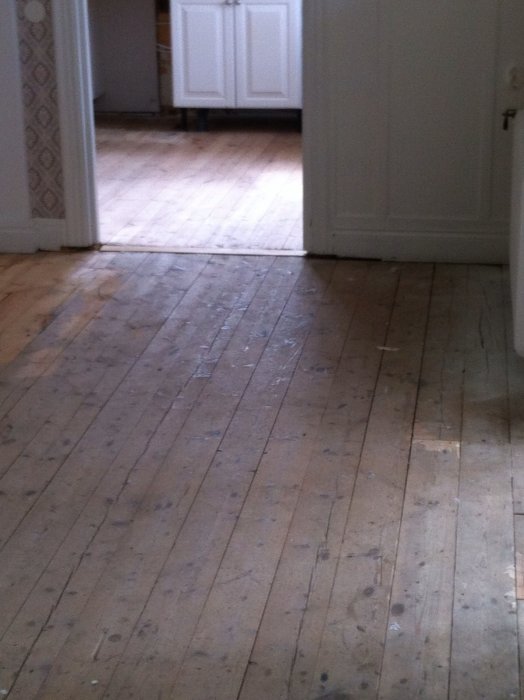
When I finally removed the old plastic flooring, glue, etc., and uncovered the underlying old wooden floor, it was time to install a new Dalafloda floor on top of the old wooden floor. To have a uniform look on the entire ground floor. I even decided, after careful consideration, to lay the new floor in the lengthwise direction of the house, just like the underlying old floor.
In come the guys who are supposed to lay the new floor and exclaim: "If this were our house, we would never lay a new wooden floor on top of this beautiful old wooden floor. Cracks, different plank widths, etc. just add to the charm of the old house. Instead, sand this floor down!"
Oh dear, now it's time to think it over again...
What would you have done? Sanded the old one or laid a new one?
A new one would be uniform in all rooms. If I sand the old one, planks will vary, both in width and have some blemishes.
If sanding the old one, how to treat it? I'd like to have a "vintage" feel if possible.
The house was built in 1893. Some of the floor planks are over 4 cm thick.
Do you want to keep an old floor with the marks, gaps, and variations that remain after sanding, i.e., it acquires a natural patina? Treatment of the old floor can then be oiled, soaped, possibly lacquered, depending on appearance. Or do you want a perfect floor that also looks new? How will it affect the levels between the rooms if you lay one on top according to your double doors and the floor you see on the other side?
The most important thing is how you want it where you live, think about the overall renovation of your house. I can comment on the options depending on what you do with other parts of the house, but old houses that are well-preserved should be cherished; we don't have many here in Sweden if we consider 100-200 years as old. In Europe, it's not unusual to find houses that are hundreds of years old and are carefully renovated. I saw one yesterday from England that was from 1340, but houses with parts from the 1500s-1600s are not uncommon. So consider how you want to approach the entirety of your house, if you want it to retain its origin, then keep the current floor.
If the old floor is in decent condition, neither rotten nor worm-eaten, I would definitely keep it. An old house should have some character; any imperfections tell a story about the house. Economically, it is probably much better to keep the old one, partly because it is cheaper to sand than to lay new and partly because the house is probably worth more with the original floor than a new pristine one.
Forgot the following in the previous post.
Even if you decide to install a new floor, keep the old one and then lay a new floating floor. This way, there is a possibility to restore the original floor.
Click here to reply
Vi vill skicka notiser för ämnen du bevakar och händelser som berör dig.