
8,827 views ·
28 replies
9k views
28 replies
Going CRAZY! Girl needs help...

Member
· Västerbottens län
· 18 057 posts
Put a threaded rod in the other end, and you have as long a thread as you want.saltrulle said:Can buy a bookshelf from me instead. No screws in the wall or anything.
Couldn't help but think about the spacer bolts we use in "electrical cabinets" when I saw the picture. However, I've never seen them with threading longer than the about 8-10mm they usually are... but maybe someone else has seen them... with longer threading, it probably would have worked great with an ordinary drywall expansion sleeve in the wall.
[bild]
Protte
Wwhhhaaattt?!?!
The Prototype!
Do you think you could specify that sentence a bit more in Donald Duck language or apples and oranges (i.e., the same language you use with children when teaching them something...)????
I think I'm reasonably clever otherwise but not on this subject obviously... *SUCK*
That's why I need a bit more detailed explanation/description/translation... :S
The Prototype!
Do you think you could specify that sentence a bit more in Donald Duck language or apples and oranges (i.e., the same language you use with children when teaching them something...)????
I think I'm reasonably clever otherwise but not on this subject obviously... *SUCK*
That's why I need a bit more detailed explanation/description/translation... :S
Last edited:

I believe that the best fitting for the purpose is the one Mattias linked to in post 3 above.
I thought the fitting (the rod with wooden threads) you showed in your first post was one that came with a pre-made shelf.
Otherwise, IKEA has a shelf with a similar construction, if I remember correctly their fitting is similar to the one Mattias linked to, however, it's not adjustable. The advantage of that fitting is that it has screw holes, allowing you to use a screw and plug suitable for the wall.
I thought the fitting (the rod with wooden threads) you showed in your first post was one that came with a pre-made shelf.
Otherwise, IKEA has a shelf with a similar construction, if I remember correctly their fitting is similar to the one Mattias linked to, however, it's not adjustable. The advantage of that fitting is that it has screw holes, allowing you to use a screw and plug suitable for the wall.
Member
· Västerbottens län
· 18 057 posts
If you could measure the "diameter" of your hexagonal bar not on the peaks but on the flat part (called key width, the measure the wrench must be open to grip the hexagon), it can be 7, 8 or 10 mm. This will determine which thread it is (M4, M5 or M6).
Then it's about finding a plaster anchor with the same thread.
The image shows a spacer with a meter cuttable threaded rod.
Protte
Then it's about finding a plaster anchor with the same thread.
The image shows a spacer with a meter cuttable threaded rod.
Protte

![[SKPG]Zamora](https://static.byggahus.se/forum/avatars/s/99/99332.jpg?1361526904)
Renovation rookie
· Östergötland
· 5 360 posts
Member
· Västerbottens län
· 18 057 posts
In plaster?
With hidden mounting of shelves?
With hidden mounting of shelves?
Renovation rookie
· Östergötland
· 5 360 posts
Yes, to the screw shown in post #1? The alligator plug folds out and becomes like a molly plug?

What race are you? I'm a mix of Smålänning, Stockholmare, Upplänning, and Dalmas.bassetasse said:

I'l wait for u babe.bassetasse said:
How's the shelf coming along?
Would have used one of these. http://www.bengtsandberg-byggprod.se/1/1.0.1.0/16/1/?item=prod_prod-s1/486&group=prod_prod_grp-s1/84
Also called speedplugg or driva. However, it should be noted that these shelves are not really made for heavy loads but mostly for appearance.
Also called speedplugg or driva. However, it should be noted that these shelves are not really made for heavy loads but mostly for appearance.
Member
· Norrbotten
· 3 390 posts
There are similar ones also in plastic, which are more forgiving if you don't have the exact right thread.raveper said:
I hung really large and heavily loaded shelf boards on a single layer of plasterboard with these, but on the other hand, I installed about 10 of them.
Raceman said:
*LAUGHS* I'm a mix of Skåning, Stockholmare, and Dalmas... Almost comical!
Raceman said:
Not so well... Given up hope of fixing the shelves with my "less visible" arrangements as I couldn't find a plug that fit with the "screw part".
So I ended up with the ugliest brackets anyone has ever created to hold up the shelves for the time being (see the picture where you can also see another of the holes from my plug testing before I gave up. AND that's just one of about the hundred holes I managed to create before I gave up... Just lacking that the wall collapses now because of all the holes...
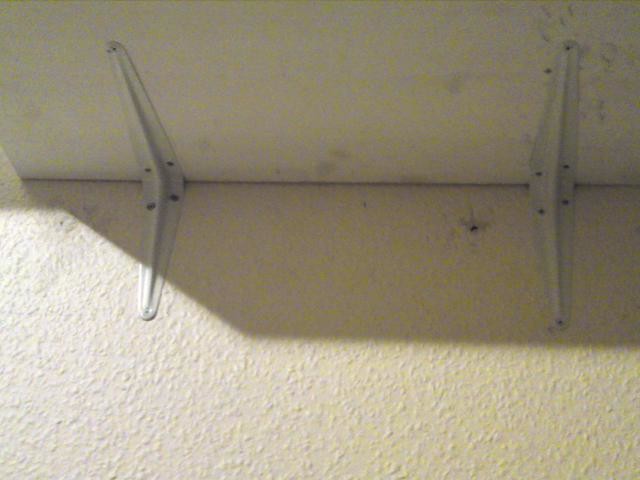
Thanks for the tip..., BUT I don't quite understand what you mean by how I'm supposed to attach the shelf??? I guess you mean I should attach a board with the widest side against the wall and find a stud so it sits securely, but then...???Gunnar_A said:
I've actually thought about doing a similar option with a "smaller version wood stud" that becomes a "square strip" under the shelf that I then drill the shelf into "from the top of the shelf down into the mini-stud, so to speak". But furthermore, I haven't tried it because it feels like it won't be stable if the shelf itself doesn't have any mounting into the wall but just underneath, or...???
(If there is ANYONE who understands what I mean because I'm almost not sure myself...).
Unfortunately, it's more than just for appearance. One at eight kilos (overweight then, huh..) and one at 6 kilos (picture without all kilos first and then with all the kilos..., unfortunately the pictures are unclear).raveper said:
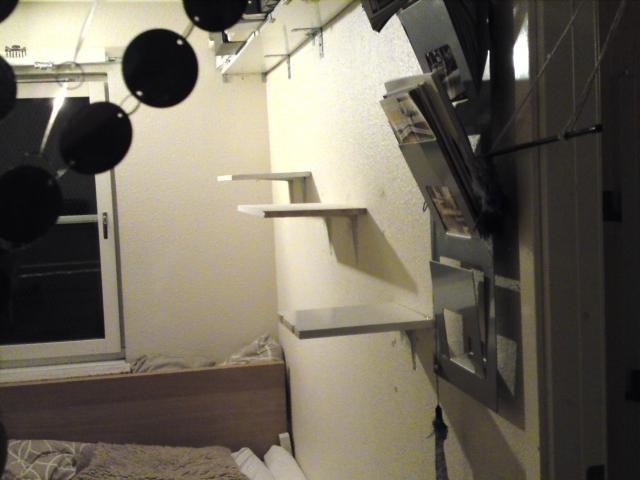
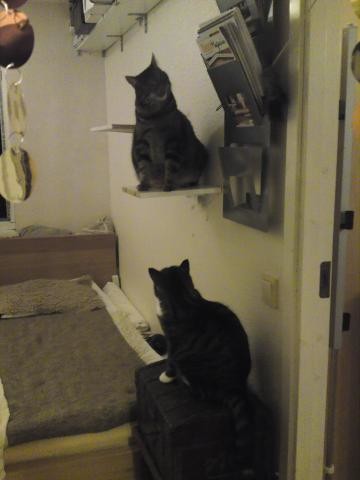
Click here to reply