
4,902 views ·
10 replies
5k views
10 replies
Framing wall - building loft - load-bearing?
Hello everyone,
Surely I can frame up a wall and build a loft
Long story short, we have an enormous living room that we want to divide. The ceilings are very high, so the idea is an extra room with a sleeping loft.
I have quite a bit of building experience but don't want to mess up, so I'm asking the expert panel.
To the right in the picture is a small wall that protrudes which was built along with the house, the idea is to extend that wall so it meets the wall on the other side, a door should go in on the left. The pink is to illustrate the wall.
I'm also planning to construct a loft that should hold its own weight + teenager + bed and possibly some friends.
The span of the loft will be 4m and extend about 2m into the room (in green).
My questions:
* How do I continue the wall that is there and make it completely straight? I measure out the middle of the wall on the floor, set a metal track, but the ceiling isn't as simple since it's really high?
* How large an opening should I leave in the metal track on the floor for a standard interior door?
* A span of 4 meters I would imagine requires its studs. Is there a handy way to calculate how thick they should be?
* Do I set a 4m long stud, and several shorter 2m across with cc60, or several long ones that are 4m?
* Last but not least, I place a load-bearing beam on the three supporting walls to attach the loft, but do I need to reinforce the new wall in any way, or is cc60 enough?
Many questions, and those who can, feel free to answer what they can
Thank you in advance!
Surely I can frame up a wall and build a loft
Long story short, we have an enormous living room that we want to divide. The ceilings are very high, so the idea is an extra room with a sleeping loft.
I have quite a bit of building experience but don't want to mess up, so I'm asking the expert panel.
To the right in the picture is a small wall that protrudes which was built along with the house, the idea is to extend that wall so it meets the wall on the other side, a door should go in on the left. The pink is to illustrate the wall.
I'm also planning to construct a loft that should hold its own weight + teenager + bed and possibly some friends.
The span of the loft will be 4m and extend about 2m into the room (in green).
My questions:
* How do I continue the wall that is there and make it completely straight? I measure out the middle of the wall on the floor, set a metal track, but the ceiling isn't as simple since it's really high?
* How large an opening should I leave in the metal track on the floor for a standard interior door?
* A span of 4 meters I would imagine requires its studs. Is there a handy way to calculate how thick they should be?
* Do I set a 4m long stud, and several shorter 2m across with cc60, or several long ones that are 4m?
* Last but not least, I place a load-bearing beam on the three supporting walls to attach the loft, but do I need to reinforce the new wall in any way, or is cc60 enough?
Many questions, and those who can, feel free to answer what they can
Thank you in advance!
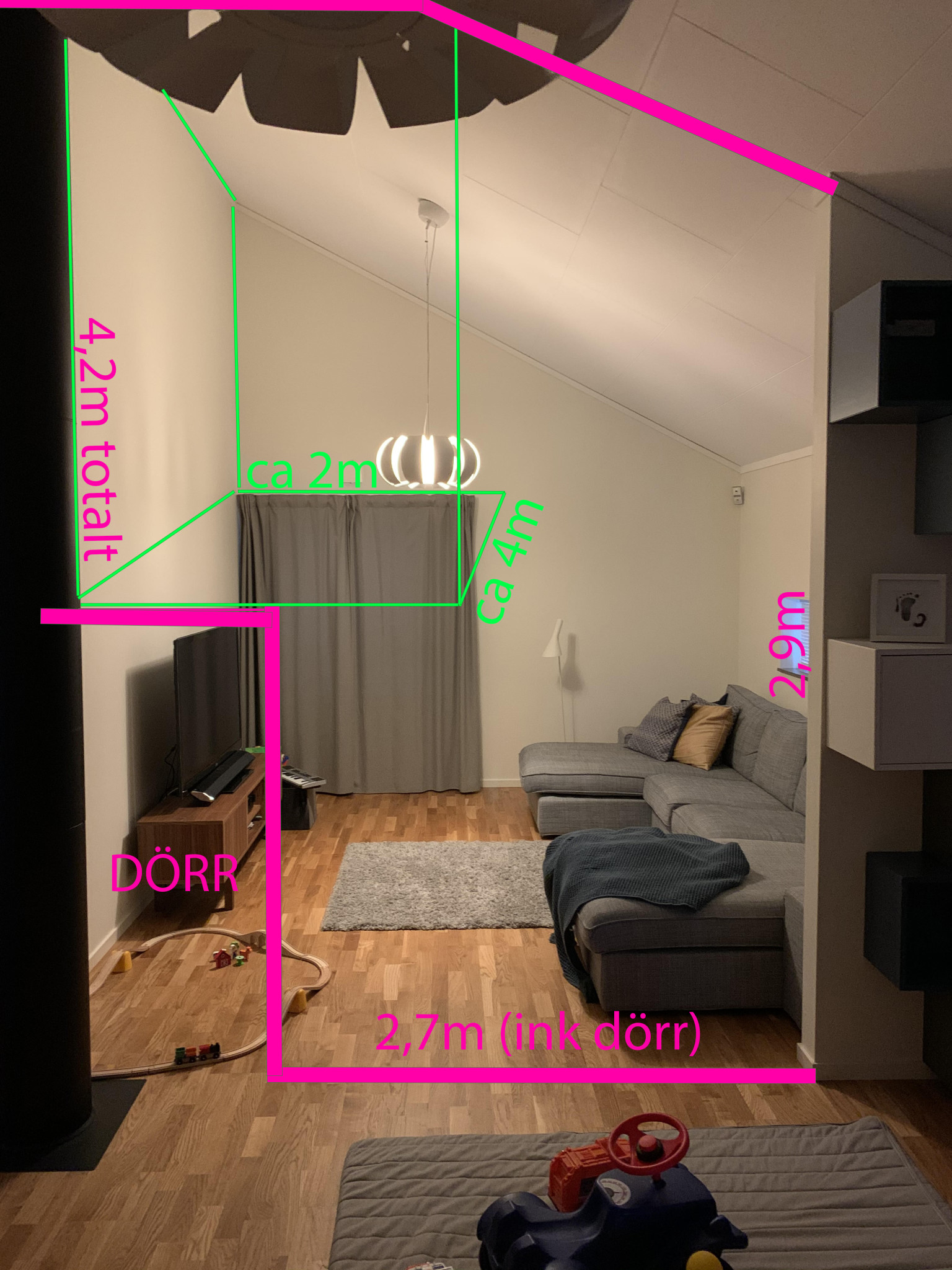

The 4-meter beam must be made of glulam (or an equivalent material). 90x225 is sufficient. For 2-meter joists on c/c 600 mm, 45x120 C 24 is sufficient. In the wall, you should preferably attach a load-bearing beam to the stud frame. It can also be 45x120. The glulam beam should rest at each end on a column. The foundation of these columns must withstand the point loads that occur. It is not possible to see from the picture how the column mounts should be executed, but it's something you need to handle.

Thanks for this, everything sounds reasonable.J justusandersson said:The 4-meter beam must be in glulam (or an equivalent material). 90x225 is sufficient. For 2-meter joists on c/c 600 mm, 45x120 C 24 is enough. In the wall, you should ideally attach a carrying beam in the framework. It can also be 45x120. The glulam beam should rest at each end on a column. The base of these columns must withstand the point loads that occur. It's not possible to see from the picture how the column attachments should be performed, but it's something you need to address.
One side of the beam will rest in the new wall, where I should be able to arrange something that can withstand the point load.
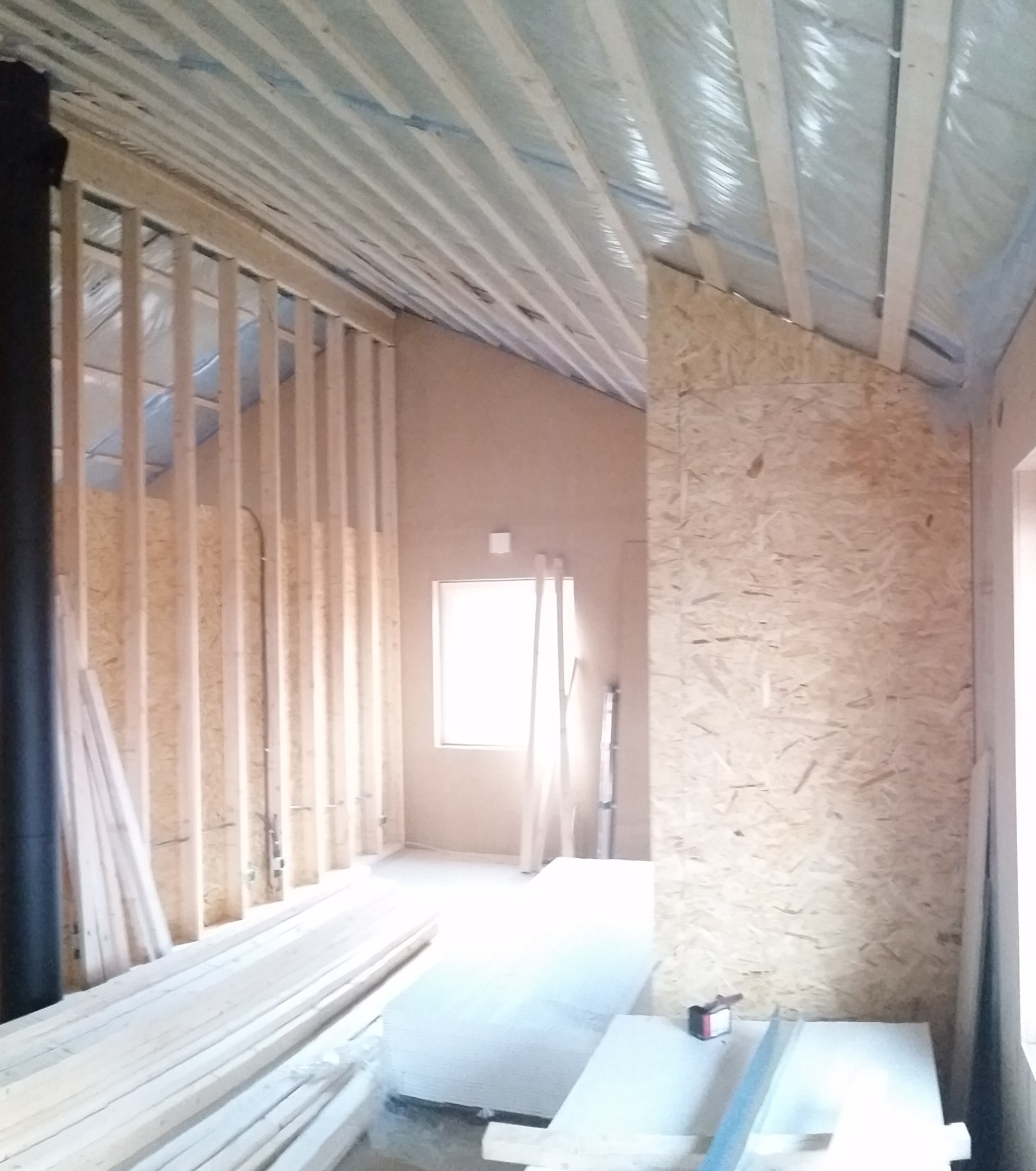
At the other end of the wall, by the window, there's a wood plate to the outer wall, how I'll solve that attachment I don't know.
I think it will create a bit of a "closed-in" feeling when entering under the loft..I ByggareSam said:
You avoid that feeling if the door is on the other side..
A Swedish wood Cheat Sheet is always good to have installed for calculating dimensions. Having the sleeping loft running lengthwise will steal a lot of light from the room. If instead, it is placed along the new wall, daylight can reach the entire room. A sleeping loft does not need to and should not be larger than the bed that will be placed there. Assuming a height of the sleeping loft at 2300mm gives you a normal impression of the room feel underneath.
Click here to reply