
Hi,
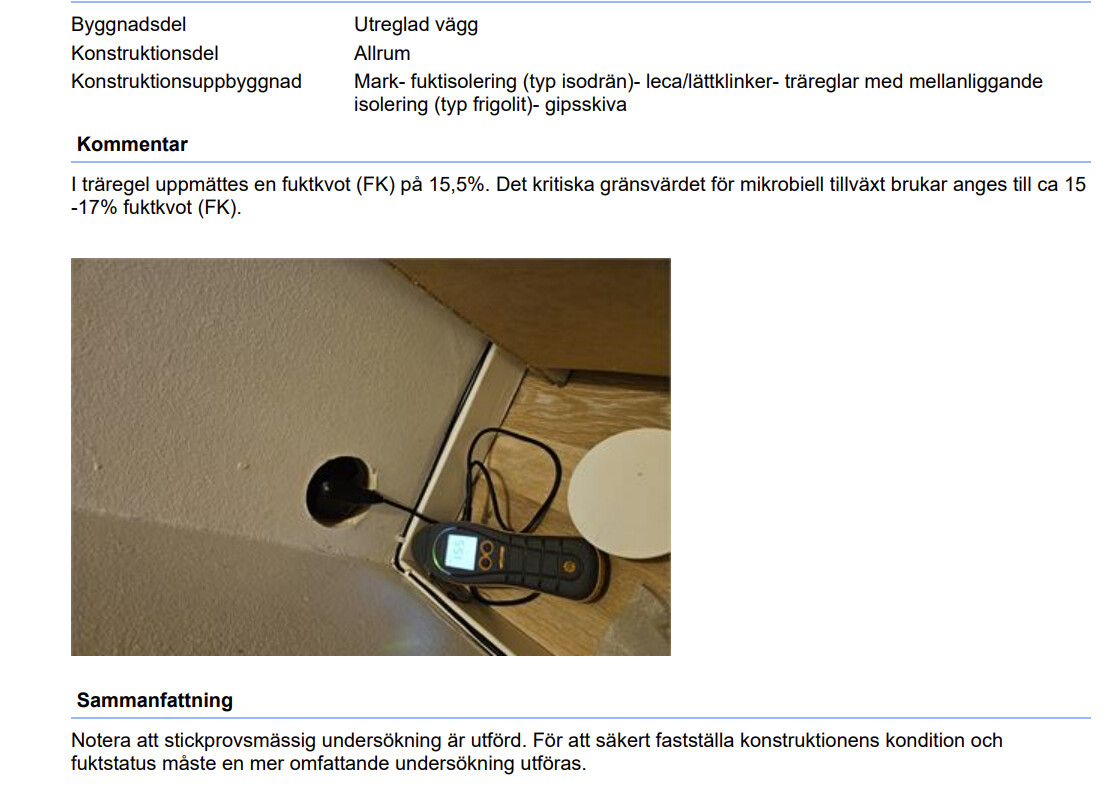
See image below. How critical is a moisture content of 15.5% in basement walls? The spaces are used as bedrooms. Is the risk value on the borderline? Does it need to be addressed immediately? Since the house was built in 2006 and is 18 years old, is there a construction defect in the house? Usually, such moisture problems appear in older house constructions. Approximately how much can it cost to fix in a 100 sqm area?
See image below. How critical is a moisture content of 15.5% in basement walls? The spaces are used as bedrooms. Is the risk value on the borderline? Does it need to be addressed immediately? Since the house was built in 2006 and is 18 years old, is there a construction defect in the house? Usually, such moisture problems appear in older house constructions. Approximately how much can it cost to fix in a 100 sqm area?

Self-builder
· Stockholm
· 8 592 posts
That is a sample that shows a value just above the threshold set for "increased risk."S skbathla said:hello,
see image below. how critical is the moisture content at 15.5% in basement walls? the spaces are used as bedrooms.
is the risk value on the edge? does it need to be addressed immediately?
since the house was built in 2006 and is 18 years old, is there a construction defect in the house? usually such moisture problems appear in older house constructions. approximately how much could it cost to remedy on a 100 sqm area?
Are there other indications of moisture?
Otherwise, I wouldn't be worried about it as such.
Addressing moisture can range from a couple of weekends' work + materials for rebuilding the basement and ensuring it is framed with inorganic material, as well as potentially checking drainage on the outside. It's a bit strange that the basement is used as living space in a house from 2006, which is usually advised against. On the other hand, the drainage should be okay if done correctly.
But such a measurement is, as mentioned, just a tiny piece of the puzzle: If you want to be more certain, you should have someone inspect specifically regarding moisture problems.
If it's only that measurement indicating some moisture problem, I wouldn't worry, but keep an eye (as always) after the house is purchased.
https://viivilla.se/bygg/glasbetong/stora-fuktskolan-allt-du-behover-veta-om-fukt-och-fuktskador/
Thanks for the answer. No other indications. The house is quite fresh otherwise (built in 2006). The basement has a ceiling height of 2.6m. But how much can it cost to replace walls with inorganic material? Can it be used as living space afterward?That is a sampling that shows a value just above the threshold set for "increased risk".
Are there other indications of moisture?
Otherwise, I wouldn't be worried about it as such.
Fixing moisture can range from a couple of weekends' work plus materials to rebuild the basement and ensure that it is framed with inorganic material, as well as possibly checking the drainage on the outside. It's a bit strange that the basement is used as living space in a house from 2006; it is usually advised against. On the other hand, the drainage should be fine if it is done correctly.
But such a measurement is, as mentioned, just a small, small piece of the puzzle: If you want to be more certain, you should have someone inspect specifically m.a.p moisture problems.
If it's only that measurement indicating a moisture problem, I wouldn't worry, but keep an eye (as always) after the house is purchased.
[link]
Self-builder
· Stockholm
· 8 592 posts
As mentioned, an elevated moisture level is not dangerous in itself, BUT it can cause mold growth in the construction if it is made with organic materials (like wood or gypsum with paper)S skbathla said:
There are various systems, you have to look around a bit here on the forum, for example, nivell, or platon mat (if the floor is a problem). Walls are usually framed with metal studs instead of wood, and possibly with a platon mat or other ventilation space against the wall. The exact cost needs to be quoted unless you do it yourself. Material costs shouldn't be too many tens of thousands, depending on the size and other factors, of course.
The question is whether it needs to be addressed now or wait until it gets really bad. It's about the cost of remediation, possibly less now with no moisture damage versus more later. I need to correct myself; it is a basement floor that is furnished as living space.Rejäl said:
Self-builder
· Stockholm
· 8 592 posts
I would never fix a wall just because a spot measurement showed 15.5%!S skbathla said:
It's a matter of dealing with an unusual odor, visible moisture, experiencing symptoms like a runny nose, or similar.
That wall can stay at 15.5% or higher for decades without problems...or there are already problems: The inspector is just pointing out that it is at a level that "can" mean microbial growth - it doesn’t necessarily mean that something like that is happening.
relief. thanks!I would never have addressed a wall just because a random measurement showed 15.5%!
It is a matter of having an unusual smell, visible moisture, feeling symptoms like a runny nose, etc., or something similar.
That wall can hold 15.5% or higher for decades without problems...or there might already be issues: The inspector is merely pointing out that it's at a value that "can" indicate microbial growth - it doesn't necessarily mean that something like that is happening.
Click here to reply