19,460 views ·
34 replies
19k views
34 replies
Floor on asphalt - insulation

The insulation function is equivalent, but it is usually difficult and tricky to get the boards exactly as wide as needed to completely cover the space between the studs. If there's even a millimeter gap, you'll immediately have a cold bridge.Anna-Sara said:
Then you might change your mind about "the yellow somewhat troublesome insulation" when you've cut into the styrofoam and have small styrofoam beads on your clothes, in your clothes, in your hair, in your mouth, on all your tools, etc.
I would always choose the troublesome yellow (or gray) insulation for the walls.

I haven't framed up yet and will try to frame so that I won't have to work too much with the boards, but it will definitely be a bit challenging to calculate so that everything fits well.
I'm actually quite flexible with the insulation. It doesn't bother me which type, but there are some who advocate for styrofoam, which is why I mentioned it before. The price will be the deciding factor, not the level of difficulty.
p.s. it's a bit of a shame that you can't insert an image directly here.
I'm actually quite flexible with the insulation. It doesn't bother me which type, but there are some who advocate for styrofoam, which is why I mentioned it before. The price will be the deciding factor, not the level of difficulty.
p.s. it's a bit of a shame that you can't insert an image directly here.
Where and how do you upload images directly in connection to the text you are writing here in the thread?
I get an image icon, but it wants to link to an image on the internet, but I actually want to insert an image from the computer.
I get an image icon, but it wants to link to an image on the internet, but I actually want to insert an image from the computer.

Okay, let's try again.
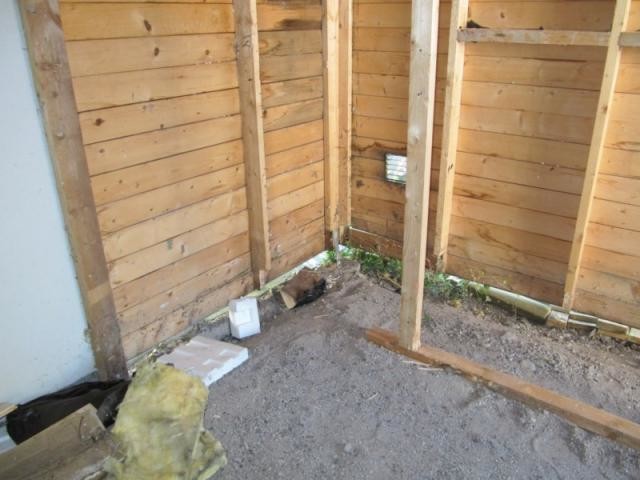
This is how it looks today. I had a visit from a concrete company and I got prices (approximately) and I must say I was very surprised as I thought it would be cheaper than that.
The estimate is that it should be about 2 tons. If you choose lightweight concrete, the price is 7 SEK/kg which means about 14,000 SEK + plastic, insulation, and labor costs.
If you choose regular concrete, the price is cheaper but then the cost of the truck delivering the concrete is added, and the price is 4,000 SEK for just the truck.
Do these prices sound reasonable or what do you think?
Should it cost about 20,000 - 25,000 SEK for this work?
This is how it looks today. I had a visit from a concrete company and I got prices (approximately) and I must say I was very surprised as I thought it would be cheaper than that.
The estimate is that it should be about 2 tons. If you choose lightweight concrete, the price is 7 SEK/kg which means about 14,000 SEK + plastic, insulation, and labor costs.
If you choose regular concrete, the price is cheaper but then the cost of the truck delivering the concrete is added, and the price is 4,000 SEK for just the truck.
Do these prices sound reasonable or what do you think?
Should it cost about 20,000 - 25,000 SEK for this work?

If the price is very important, you can cheat a little.
Laminate,
Foam + ålderb plastic approx. 500kr
Styrofoam (XPS200) 100mm approx. 2000 kr
Setting sand (stone dust) 10-30mm to level the surface approx. 500kr
This gives you a price of 3000 + laminate.
Laminate,
Foam + ålderb plastic approx. 500kr
Styrofoam (XPS200) 100mm approx. 2000 kr
Setting sand (stone dust) 10-30mm to level the surface approx. 500kr
This gives you a price of 3000 + laminate.
If you're building with wood, you should use the yellow insulation. And other materials as well. How should the lower part of the insulation rest? Against Masonite? Wood? How will you inspect it? I mostly believe in Styrofoam.
Ps. The storage that I'm building will have the floor as mentioned above. However, I'm going to have a vinyl floor on chipboard.
Ps. The storage that I'm building will have the floor as mentioned above. However, I'm going to have a vinyl floor on chipboard.
I was thinking in the following way:
1) gravel/sand (already on site)
2) plastic
3) wooden framework
4) list where the yellow insulation can lie. Distance between plastic and insulation about 3-4 cm.
5) floor chipboard
6) plastic
7) foam
8) laminate
Vinyl flooring is actually really good and warm. I have vinyl flooring in three other rooms and it works excellently, it's warm and nice, looks like birch laminate.
1) gravel/sand (already on site)
2) plastic
3) wooden framework
4) list where the yellow insulation can lie. Distance between plastic and insulation about 3-4 cm.
5) floor chipboard
6) plastic
7) foam
8) laminate
Vinyl flooring is actually really good and warm. I have vinyl flooring in three other rooms and it works excellently, it's warm and nice, looks like birch laminate.
The advantage of this proposal is that there is no wood or other organic material on the ground that can start to mold. And on the "warm side" of the styrofoam, you also manage since the temperature is sufficiently high to keep the rH low.kamilenski said:
The disadvantage is... well, I actually don't know, maybe relatively untested construction, or something else, what do I know.
Here, there is an obvious mold risk.Anna-Sara said:I was thinking the following way:
1) gravel/sand (already in place)
2) plastic
3) wooden framework
4) strip where the yellow insulation can lie. Distance between plastic and insulation about 3-4 cm.
5) floor chipboard
6) plastic
7) foam
8) laminate
Plastic flooring is actually really good and warm. I have a plastic floor in three other rooms and it works excellently, it's warm and nice, looks like birch laminate.
If wood is against the ground only separated with plastic foil, but insulated on the top side, the wood will be approximately at the ground temperature constantly. That is 10-15° during summer and 0-10° during winter.
Then there is a high risk that moisture condenses against the plastic foil and the wood closest to the ground with subsequent mold and decay damage.