Do you mean that a modern staircase is constructed entirely without glue? I'm curious because I am going to design and build a rather complicated staircase for my father (a wooden spiral staircase that goes around a wooden pole, with stringers on the outside).
Sorry for hijacking the thread but felt it was very close to the topic.
It would be interesting with some rational arguments instead of carpenters' opinions.
Post 18, I devoted to some opinions on why stairs creak. Based on views from vocational school, ingrained perceptions from literature on building maintenance, etc., a lot of personal thinking, and experience from manufacturing and assembling stairs, which by now I have lost count of.
In post 21, I tried to point out the difficulties in implementing rigid gluing of a staircase regardless of whether the method works.
Besides, it doesn't work because a staircase is a complicated construction where the wood is oriented in all possible directions and subjected to point loads. It is for the same reasons that no sensible person tries to glue an entire ship together. It has been tried and always fails.
Sure, it's possible to explain why in every individual question. Unfortunately, most people get tired after three sentences, so it's quite pointless. Especially when someone who clearly doesn't understand anything interrupts and says idiotic things all the time based on so-called common sense. And ignores all the arguments he gets back.
Instead of wasting my time trying to get trolls to give up, I can give the TS and others who genuinely want useful information a couple of rules of thumb.
Stairs should be secured at the top and be loose at the lower end.
Attachments between stringers and treads should not be glued.
Tenons should not bottom out.
Creaks occur when wood rubs against wood.
Theoretically, if one could step on all steps simultaneously, the risk of creaking would be significantly less. However, that is not how stairs are used. One step at a time is loaded. If the staircase is wide enough for the tread to flex, it moves concerning the stringer, and creaking can occur.
The older theory (that is, the one conveyed by vocational school) is to do as little as possible to prevent the movement so that it can happen as easily as possible, and the creak should be less or completely absent. Then, you assemble the staircase and attach the treads by angling screws or nails from underneath.
Nowadays (when no one can attend the fantastic vocational school that I had access to), people try to fasten staircases as tightly as possible. Often I see a bunch of really heavy screws through the stringer into every tread covered with wood plugs. That seems to work too, but when it creaks, it is not a discreet squeak but sounds loud enough to wake the dead.
Regardless of how it creaks, it can disappear if you can prevent the treads from flexing. Risers are classic. In old stairs, the risers are made of solid wood that shrinks. This creates air under the treads, and the staircase can start to creak. Sometimes seasonally.
In a modern staircase, you can use plywood that does not move in the same way; it is safer.
In a flight staircase like the TS has, you can place a rail under each tread as reinforcement. It's not certain that this will be enough. But it will reduce the problems.
Additionally, from a safety standpoint, it is very wise to limit the space between the treads so that you cannot get a foot between if/when you stumble on the stairs. This way, you avoid the kind of complicated lower leg fractures that can result from such an accident.
Do you mean that a modern staircase is assembled entirely without glue? I'm curious as I'm about to design and build a rather complicated staircase for my dad (a spiral wooden staircase that goes around a wooden post, with stringers on the outside).
Sorry for hijacking the thread, but I felt it was very close to the topic.
Just noting that KOW doesn't know what he's talking about. Wise of him to choose a single-story house.
It wasn't to avoid the creaking, of course.
I have lived in both 1½-story and 1½-story + basement, and have actually never been disturbed by any creaking.
Could the creaking be due to choosing too flimsy dimensions for the treads and risers?
It is for the same reason that no sensible person tries to glue together an entire ship. It has been attempted and always fails.
No, nowadays you don't build "ships" in wood, you build with steel plates and weld. No creaking there!
But I have personally had a fully glued 34-foot sailboat, the best boat I have had.
No creaking when it heeled over to 45° in the gusts.
findus42 said:
Of course, it is possible to explain each individual issue. Unfortunately, most people get tired after three sentences, so it's pretty pointless. Especially when someone who obviously doesn't understand a thing interrupts and says idiotic things all the time based on so-called common sense. And ignores all the arguments he gets back.
I understand you mean me. Thanks for the judgment!
findus42 said:
Tapers should not bottom out
OK, we might be talking about different things. In my world, you glue and screw/nail battens, say 22x22 mm on the stringers, and on these "battens" you place the treads.
No problem gluing there, right?
To mortise the connections between treads and stringer is apparently asking for trouble.
Why do it then? Appearance over function? Crazy in that case, I think, as I am practical.
Tapping in the connections between the treads and stringer is apparently asking for trouble.
Why do it then? Appearance over function? Silly in that case, I think, as I am practically minded.
So, "my" way of building tread then, without creaks, is okay then.
Besides Findus and other school-learned instructions about "this is how you should do" when building stairs.
Knock
TS staircase is not cold cast with epoxy. It's not welded or masonry either. Many have opinions on how the staircase in the home looks and want a traditional appearance. Your comments do not help these.
Furthermore, boats
and ships
are still built with traditional methods. There are quite a few old ships that enthusiasts keep alive with respect for old craftsmanship. The ships die when they get an owner who encases everything in plastic and rebuilds the interior so that it looks like a three-room apartment in Farsta under the deck.
I'm jumping into this thread over six years later because I find the discussion about avoiding creaks very interesting.
I've installed several modern staircases for clients. These are always of the model with grooved tracks in the stringers where the treads are inserted. You wax thoroughly beforehand and the steps are then screwed with substantial screws from the outside of the stringer. This seems to be the modern way to build, and the wax is there to prevent creaks when the tread inevitably moves slightly against the stringer under load.
Now to the question.
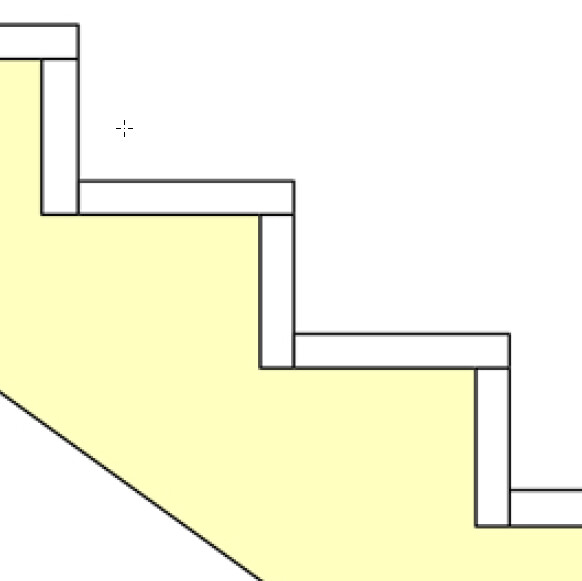
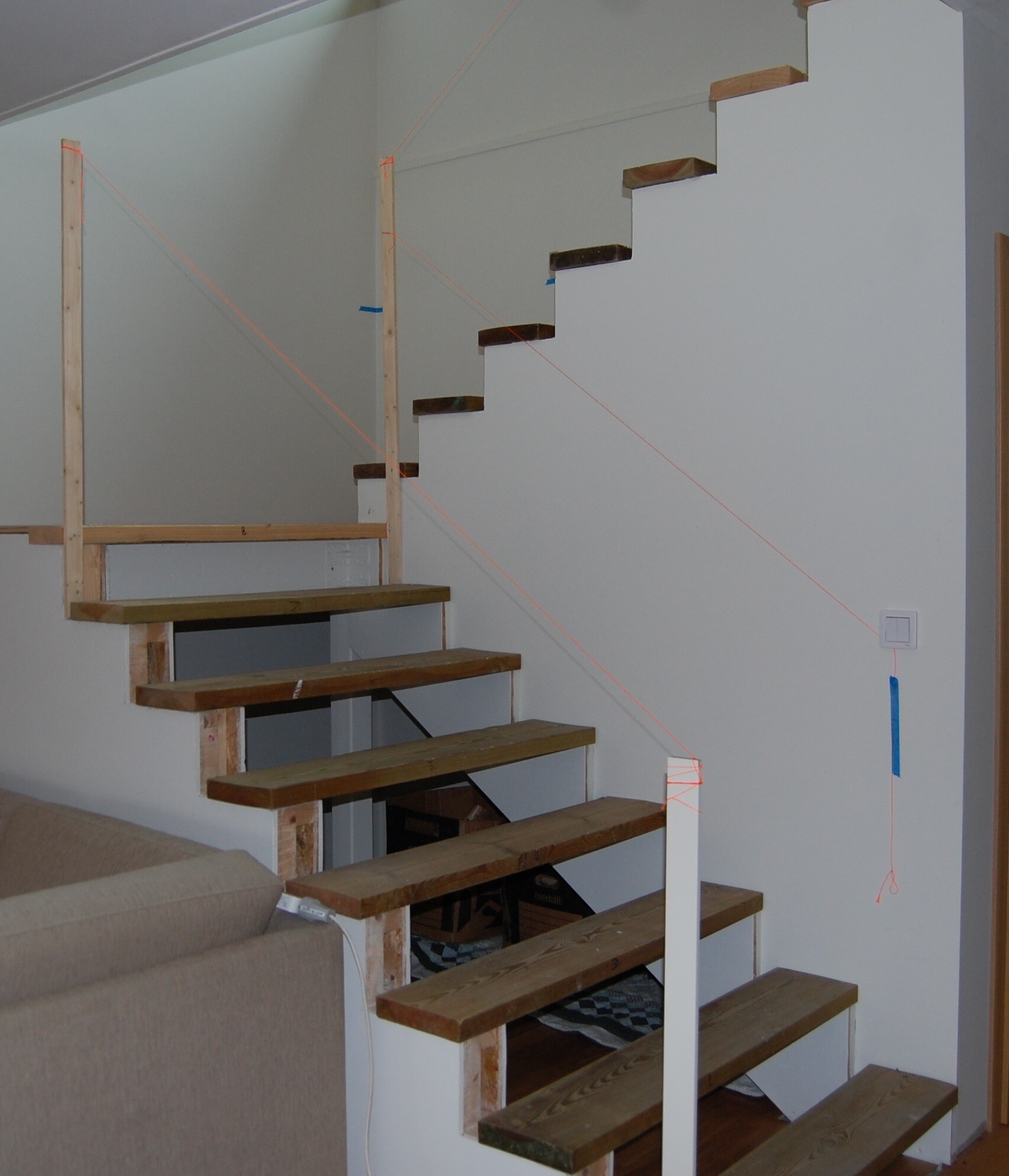
The conditions are that I am building an entirely new staircase. See pictures. I ordered CNC-milled stringers to get them exact. About 1 meter between stringers. Treads and risers in 40 mm edge-glued oak cut from countertops. These will be matte lacquered before installation.
What differs from many other stairs is that I will place the steps on top of the stringers, not fit them between.
Avoiding creaks is an important issue for me. How should I make the fixings?
My thoughts are as follows:
* The risers standing up should result in very little deflection. Not measurable. The front edge of the treads should somehow benefit from this, right?
Glue them together? Put a strip behind to screw them together?
Nail small pins to hold them together?
* The steps are already cut. Considering using a groove cutter to make slots for a spline in the same material that connects the riser and tread at the front edge. Glue these?
* The bottom edge of the risers can easily be screwed into the edge of the treads.
* Glue the treads and risers to the stringers? Which glue?
* Or, cut strips to 30x30 mm, or alternatively metal brackets, to attach the treads and risers from underneath to the stringers?
When I read the thread, there are many wise opinions on whether to glue or not.
What's interesting regarding creaks is that the temporary steps I laid today (mostly pressure-treated planks 45 x 220) screwed directly into the stringer with hefty wood screws, don't creak at all. So when installing the actual steps, it can only get worse... 🤣
The treads will move with the seasons. I think there might be problems if you try to attach them rigidly with glue and screws. Additionally, the risers should be made with glued panels that do not have end joints in the middle of the board. It is possible that the countertop you mentioned does not have end joints, but it might be worth pointing out.
Click here to reply
Vi vill skicka notiser för ämnen du bevakar och händelser som berör dig.



KnockOnWood said:
Immobil said:
findus42 said: