Hello
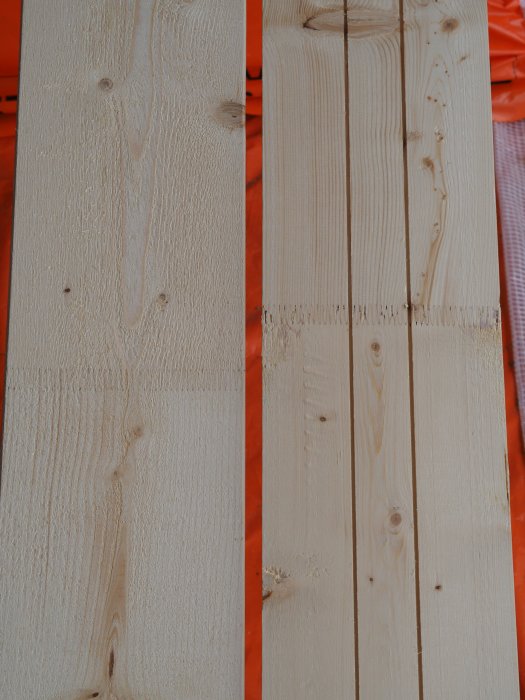
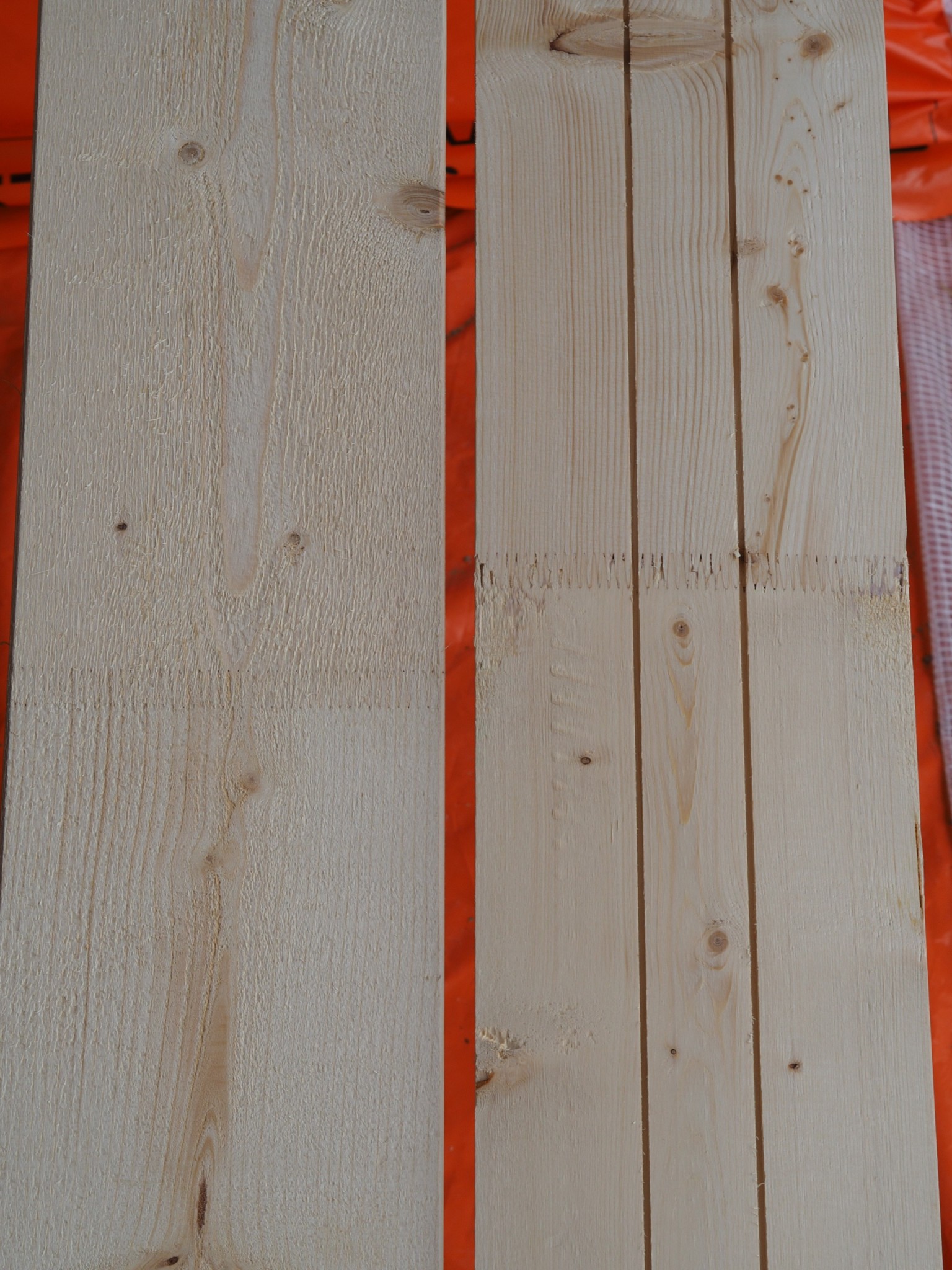
I'm planning to put new paneling on the house and have received a batch of exterior paneling that is finger-jointed, and I'm quite unsure about how to handle it.
The wood is 22x170 and 3000 long, so there seems to be no direct reason to finger joint it, other than the sawmill wanting to use wood that would otherwise have been discarded.
Many boards consist of two parts where one part has the pith outwards, so it's very noticeable that the board is jointed, even when it's painted twice (I've test painted 3 of them). Several other boards consist of three parts, meaning they have two finger joints on them.
How well will the finger joints hold over time, and is there a risk of rot with these end grain joints all over the facade?
If I understand correctly, finger jointing is usually done when you want long wood, like 7 m and longer, but these are 3 m lengths that will be mounted vertically.
Has anyone else encountered/seen anything similar?
Thanks KnockOnWood, nice to have almost a namesake
The company that supplied the wood is known for doing things properly, and the chain they are part of is one of the big well-established ones.
I don't know which sawmill supplied them, but I will find out.
A friend who is also going to renovate his house stopped by, and he called yesterday after talking to his carpenter, and his carpenter just told him that he wouldn't get finger-jointed panel wood since he chose primed wood.
-Wonder why???
I've also only seen it on construction wood and planed and painted moldings before.
For studs in house partitions, it is an advantage to have finger jointed since the studs cannot twist.
Could there be a similar reason for finger jointing panel boards?
I can't see that this timber is any straighter, less twisted, or for that matter more bent than timber that is not spliced, so I don't think that can be the reason the sawmill spliced it.
Certainly, it is spliced to fill up a length where the raw material does not correspond lengthwise.
The timber that is sawn does not always match the need, and then you can splice to get an "infinite" length to cut the correct length from.
I definitely believe that a glue suitable for outdoor environments has been used, and therefore does not pose any risk of rot or such.
Those boards with joints will look strange when painted with stain, opaque stain, Falu red, or iron vitriol.
The structure on either side of the joint is completely different, and the wood's annual rings and knotting always show through.
That's how it's usually done to keep costs down with little waste.
Was the price lower than normal?
I thought it used to be stated in price lists whether a product is finger-jointed.
There should be the possibility to determine if it is suitable for what you intend to use it for or not.
Have you asked the seller if they consider it normal to receive such without knowing it beforehand?
Or is it assumed because you ordered an exact length of the boards?
I have the same type of panel on my house, bought 3600 if I remember correctly and there wasn't a single finger-jointed board. It looks at the very least strange? I could buy up to 5000-something without joints, after that it was jointed.
The panel you received is intended to be mounted horizontally. These finger joints are used to achieve tight joints and can be delivered in long lengths if desired.
I have seen that a house factory used finger-jointed exterior paneling 30 years ago, so it's nothing new.
Back then it was also vertical.
However, the fingers were milled in the opposite direction (milling visible on the edge side). It only gives a diffuse line on the surface where the joint is.
The panel you received is intended to be installed horizontally. These finger joints are used to achieve tight seams, as well as to be delivered in long lengths if desired.
Such a panel cannot lie horizontally. Completely impossible to make it tight
Of course, you can have such paneling both horizontally and vertically. The joint is filled with glue, and it seals completely if done correctly. Provided that you use the right glue, but I guess that's something people won't skimp on.
Then painting or other surface treatment should protect the wood as usual.
You can't have that kind of panel lying down. Completely impossible to make it tight
Do you mean that the finger joints leak???
Maybe you mean that horizontal panels are usually tongue and groove?
This panel is laid in the same principle as a roof. That is, the lower edge of the upper board is nailed over the upper edge of the lower board.
But as Byggis mentioned, there is nothing to prevent using it vertically..
Click here to reply
Vi vill skicka notiser för ämnen du bevakar och händelser som berör dig.



 )
)