
4,433 views ·
5 replies
4k views
5 replies
Filling a larger space/hole in the floor before laying tiles
Hi!
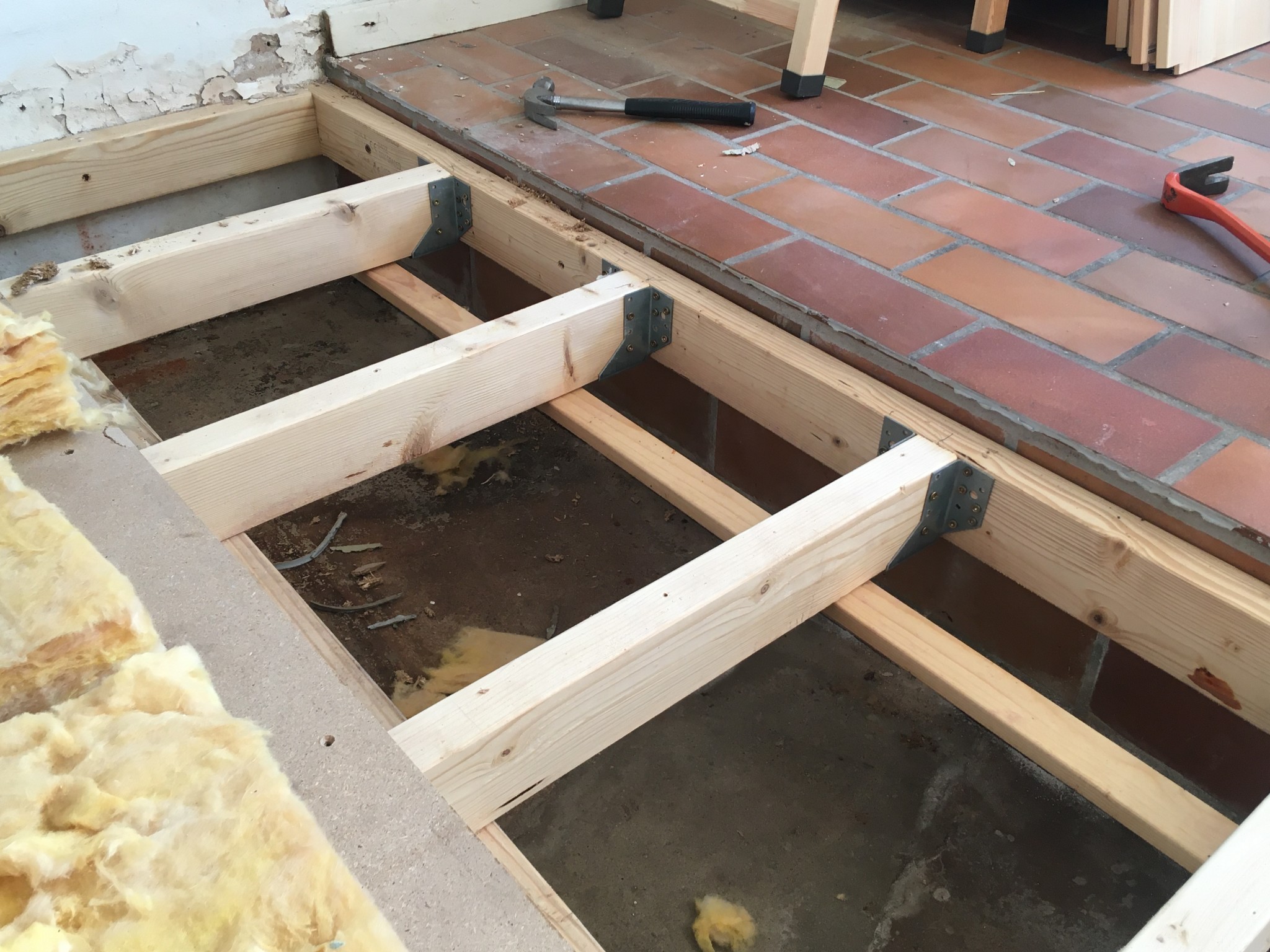
In a room in my basement, there are ABC tiles, except for an area about 3 sqm where there used to be an oil boiler. When the boiler was removed about 10 years ago, a laminate floor was laid instead. I have always thought the floor was laid directly on the slab, but today when I tore up the laminate flooring to install tiles (that match the old ones), I was surprised to see that it rests on installed wooden battens with insulation. It turns out there's a space that measures about 40 cm below the surrounding tiles.
I would prefer to remove all organic material, otherwise, the alternative would only have been to lower the wooden construction a few centimeters, level it, and then tile on top of that. The question is, how should I fill the cavity? Can I fill it with sand and a layer of concrete and then lay tiles, or can I fill it with lightweight concrete blocks or loose expanded clay pellets and then concrete? Other options?
In a room in my basement, there are ABC tiles, except for an area about 3 sqm where there used to be an oil boiler. When the boiler was removed about 10 years ago, a laminate floor was laid instead. I have always thought the floor was laid directly on the slab, but today when I tore up the laminate flooring to install tiles (that match the old ones), I was surprised to see that it rests on installed wooden battens with insulation. It turns out there's a space that measures about 40 cm below the surrounding tiles.
I would prefer to remove all organic material, otherwise, the alternative would only have been to lower the wooden construction a few centimeters, level it, and then tile on top of that. The question is, how should I fill the cavity? Can I fill it with sand and a layer of concrete and then lay tiles, or can I fill it with lightweight concrete blocks or loose expanded clay pellets and then concrete? Other options?


Gravel and then a layer of concrete on top gives you an uninsulated solution. With foam plastic, you get insulation. Keep in mind that concrete needs a long time to cure, dry, and therefore shrink before tiling. There are fast-drying quality types available for a bit more money if you're in a hurry.
Another option is clay pebbles, which provide some insulation. There's also the variant where they are mixed with a little cement to create something like lightweight blocks.
Another option is clay pebbles, which provide some insulation. There's also the variant where they are mixed with a little cement to create something like lightweight blocks.
Normally, you lay Isodrän or a similar product, about 20 cm, and then 10 cm of concrete. If you need to fill up, use something like 8-16 crushed stone since it can be handled with a shovel.

Is the space ventilated, like a crawl space? Otherwise, you have to manage the ground moisture. In the past, there was a boiler here, possibly with a brick chimney that kept the space a few degrees warmer than the ground underneath, causing the moisture to migrate downward and condense in the ground, which is normally 7-9˚C a meter down. This is how crawl spaces have worked for hundreds of years! But if you stop heating the space, the moisture must be stopped with plastic sheeting that can be covered with a few cm of sand.Jonatan79 said:
Thank you for the response. To clarify, I can say that it's a cast concrete floor in the space, and on the walls/sides there are tiles. So it's not bare ground or soil I've reached and no particular moisture. The space is not ventilated, and it's located in the middle of the house. In the same room, there are some water pipes (the district heating system is here, among other things), and that's why I want to remove the existing wooden construction in case there is a leak.
Hadn't thought about the solution with isodrän, which feels very simple and convenient. Is there no problem laying it on an existing slab and then a new layer of concrete as it will be in this case?
Hadn't thought about the solution with isodrän, which feels very simple and convenient. Is there no problem laying it on an existing slab and then a new layer of concrete as it will be in this case?
Click here to reply