
Hello,
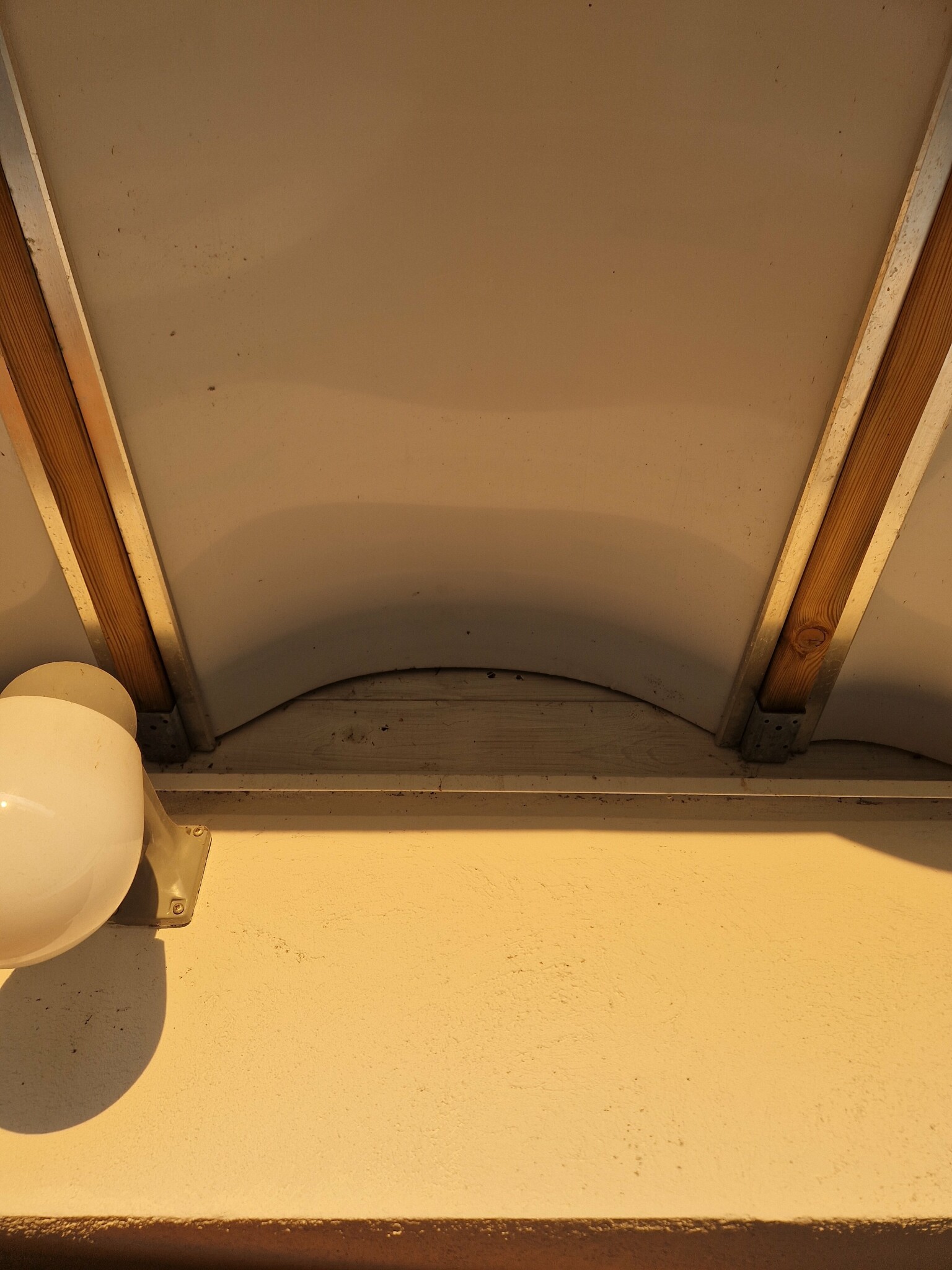
I have a balcony that I would like to use as a roof. Currently, it's a regular construction with treated joists and decking that rain goes right through.
My house is a plastered house, an adjacent terrace is made of concrete, and the pillars that the balcony rests on are cast, which is why I think a fiber cement board would be suitable as an underside.
I was thinking of installing it with a slight incline towards a gutter. However, I'm not sure how much moisture and humidity the board can withstand. According to Cemberit, the manufacturer of the fiber cement board, it is completely insensitive to moisture. It does not mold or suffer from fungus. On the other hand, it is advised not to mount the board unprotected so that it is exposed to water. However, it can be mounted vertically, i.e., on a wall.
I have been in contact with the retailer K-rauta, who was very helpful but, like me, did not entirely understand the recommendations from Cemberit. Therefore, I contacted Cemberit directly and got to speak with a customer contact who seemed to think she had better things to do than talk to a prospective customer. However, she stated that the board could not be used as rain protection. For some reason, it didn't feel like she wanted to explain why, but eventually, she said that there could be efflorescence if the board is exposed to water. That doesn't sound unreasonable, and after searching more thoroughly in the information leaflet, I found the same information there.
My question to the forum is if anyone has personal experience. How big is the issue?
This is what it says on the website:
"Cembrit Construction is a high-quality building board made of high-quality fiber cement and is also used as cladding in ventilated facades. The board is often used on residential buildings, villas, office buildings, schools, sports halls, hotels, and storage sheds, etc.
A mineral substrate for "concrete paints." Cembrit Construction is a fiber cement board that should always be painted for aesthetic reasons.
The boards are robust. The boards are also fireproof and P-labeled for use in BR-1 buildings even on wooden battens.
They are used in simple applications and for exposed encasements. But also in designed facade solutions.
• Entire facades
• Complements to other facade materials, e.g., paneling
• High plinths, e.g., on terraces
• Outdoor screens
Cembrit Construction also has a variety of special uses such as traffic noise screens (the entire cladding or just the most exposed ground connection)
Product
Cembrit Construction (formerly Heavy Duty) is a gray frost-resistant fiber cement board that can be exposed as it is but should always be painted due to aesthetic reasons. Cembrit Construction should be painted once mounted. An untreated board can have aesthetic deviations like blotchiness and efflorescence. The same problem can occur if the boards are pre-painted before mounting, especially if they are painted on both sides.
Cembrit Construction Plinth Board. If the boards are used on building plinths and partially mounted in the ground, we recommend leaving them untreated. A surface treatment is then negatively affected by moisture, humidity, and frost.
https://www.cembrit.se/download/binary/22565
I have a balcony that I would like to use as a roof. Currently, it's a regular construction with treated joists and decking that rain goes right through.
My house is a plastered house, an adjacent terrace is made of concrete, and the pillars that the balcony rests on are cast, which is why I think a fiber cement board would be suitable as an underside.
I was thinking of installing it with a slight incline towards a gutter. However, I'm not sure how much moisture and humidity the board can withstand. According to Cemberit, the manufacturer of the fiber cement board, it is completely insensitive to moisture. It does not mold or suffer from fungus. On the other hand, it is advised not to mount the board unprotected so that it is exposed to water. However, it can be mounted vertically, i.e., on a wall.
I have been in contact with the retailer K-rauta, who was very helpful but, like me, did not entirely understand the recommendations from Cemberit. Therefore, I contacted Cemberit directly and got to speak with a customer contact who seemed to think she had better things to do than talk to a prospective customer. However, she stated that the board could not be used as rain protection. For some reason, it didn't feel like she wanted to explain why, but eventually, she said that there could be efflorescence if the board is exposed to water. That doesn't sound unreasonable, and after searching more thoroughly in the information leaflet, I found the same information there.
My question to the forum is if anyone has personal experience. How big is the issue?
This is what it says on the website:
"Cembrit Construction is a high-quality building board made of high-quality fiber cement and is also used as cladding in ventilated facades. The board is often used on residential buildings, villas, office buildings, schools, sports halls, hotels, and storage sheds, etc.
A mineral substrate for "concrete paints." Cembrit Construction is a fiber cement board that should always be painted for aesthetic reasons.
The boards are robust. The boards are also fireproof and P-labeled for use in BR-1 buildings even on wooden battens.
They are used in simple applications and for exposed encasements. But also in designed facade solutions.
• Entire facades
• Complements to other facade materials, e.g., paneling
• High plinths, e.g., on terraces
• Outdoor screens
Cembrit Construction also has a variety of special uses such as traffic noise screens (the entire cladding or just the most exposed ground connection)
Product
Cembrit Construction (formerly Heavy Duty) is a gray frost-resistant fiber cement board that can be exposed as it is but should always be painted due to aesthetic reasons. Cembrit Construction should be painted once mounted. An untreated board can have aesthetic deviations like blotchiness and efflorescence. The same problem can occur if the boards are pre-painted before mounting, especially if they are painted on both sides.
Cembrit Construction Plinth Board. If the boards are used on building plinths and partially mounted in the ground, we recommend leaving them untreated. A surface treatment is then negatively affected by moisture, humidity, and frost.
https://www.cembrit.se/download/binary/22565

Thank you for the suggestion. I think I would aesthetically like the smooth fiber cement board, so I will probably buy a board and install it over the entrance. If it doesn't look good, I'll just take it down and reconsider. I'll update once I've tested it.
How did your test above go?
I'm looking for sheet material, as a render carrier, since the bottom 20cm of a basement wall now consists of vertically blasted rock (floor lowered) - where water (!) runs down to the gravel/drainage pipes 🙄 i.e. 100% humidity during heavier rain. Water should not be tamed - it should be followed…
Fiber cement board is the plan. On this, fiber concrete/render. Then tiles... it could work...
Hence the interest in your test and other ideas as well - better than my plan? Maybe cast a freestanding wall instead?
Space constraint - 15mm board (50cm high) sounds appealing for that reason.
I'm looking for sheet material, as a render carrier, since the bottom 20cm of a basement wall now consists of vertically blasted rock (floor lowered) - where water (!) runs down to the gravel/drainage pipes 🙄 i.e. 100% humidity during heavier rain. Water should not be tamed - it should be followed…
Fiber cement board is the plan. On this, fiber concrete/render. Then tiles... it could work...
Hence the interest in your test and other ideas as well - better than my plan? Maybe cast a freestanding wall instead?
Space constraint - 15mm board (50cm high) sounds appealing for that reason.
Click here to reply