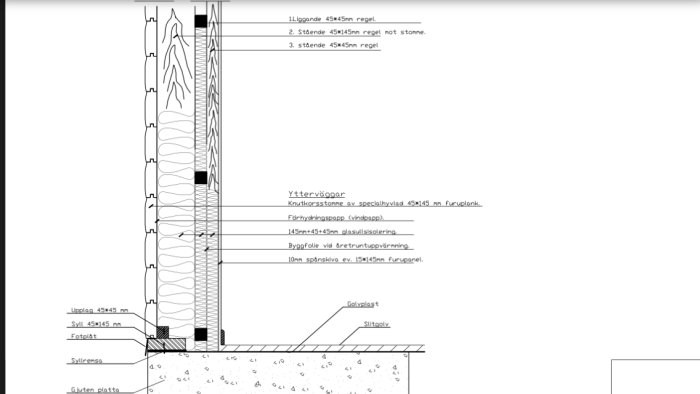
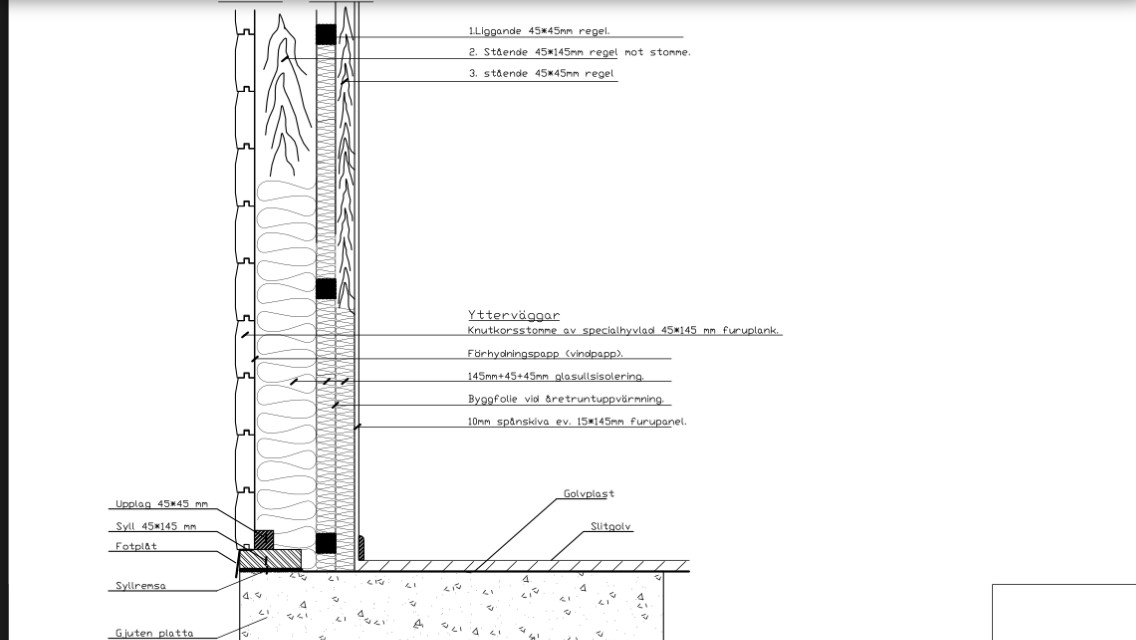
I have received a construction drawing from a house manufacturer I am considering. I'm somewhat surprised to see that they don't have any air gap between the outer panel and the wind barrier. Is this common? Could there be problems if there is no ventilation? Additionally, they install the wind barrier from the inside instead of on the outside of the studs, which seems much more cumbersome but perhaps doesn't affect the function?
It seems strange, they have specially planed 145x45 planks as the outer panel. It looks stable. But the fact is that it will be a single-stage sealed facade that will eventually have problems with water penetration.
How can you tell that they plan to put the paper from the inside? Which manufacturer is it?
No, I definitely would not want to build like that today!
I had a house, built in 1969 without an air gap, but with only 95 mm of insulation.
We bought the house in 1998, and the following year we had to replace an entire side, because it was completely rotted through to the gypsum board on the inside.
This was in Göteborg.
They told me that they attach the papp from the inside when I talked to them. I wanted it to be frame raised but do the rest myself, and then they said that papp was not included in the frame raising, it was done from the inside at a later stage. In a description they have, they have stapled papp to the outer panel!
I feel like it's intended to have an additional layer that constitutes the real facade. I had that feeling already when I saw the drawing for the first time.
Then it's not so strange that they apply a wind barrier outside the wooden plank.
a real facade with specially planed planks? Not very likely. It all probably depends on what they plan to treat the wood with afterwards. If it's supposed to be unpainted or just oiled in some way, it will probably work excellently without an air gap. If you paint with some modern dense paint, it surely won't work for long............
No, I would absolutely not want to build like that today!
I had a house, built in 1969 without an air gap, but with only 95 mm insulation.
We bought the house in 1998, and the following year we had to replace an entire side because it was completely rotten up to the drywall on the inside.
This was in Gothenburg.
The air gap is a must!
I just talked to a colleague about this (we are laymen). His house from 1920 has no air gap and the exterior paneling has held up well.
No older house is usually built with an air gap; it's a more recent invention when facade paints started to become dense. A house from 1900-1920 is likely to rot as well if it's painted with plastic paint............
What the air gap is supposed to do is ventilate away moisture that is in the wall for some reason, including that which travels from the inside out. In old houses, the walls were thinner as described above, and then the moisture would have enough time to escape and be ventilated away; in modern houses with significantly thicker walls, the air doesn't have time to escape, which means it will stay in the wall and condense, creating problems. That's why the house is sealed inside with construction plastic, no moisture will migrate, and the walls are not at risk of molding or rotting. Therefore, an air gap is unnecessary since the moisture it is supposed to vent out comes from outside in the form of rain and snow and can just as easily travel back the same way. The humid indoor air is ventilated mechanically. So, an air gap shouldn't be necessary in that wall construction, but why not, so to speak, it's always good to have both belt and braces. When you contact them next time, ask why they are installing windproofing from the inside; I suspect they want a sealed house that they can work in as quickly as possible, saving them some time by being able to put up the incredibly stable panel directly.
The problem as I see it is that water, for example from driving rain, very easily gets behind the facade but has a very hard time finding its way out. If there is a proper air gap, the constant ventilation will carry the moisture out as soon as the humidity is somewhat lower.
Previously, the problem didn't exist because the facade was heated by the warmth from the inside, which then evaporated the moisture.
The problem as I see it is that water from, for example, driving rain easily gets behind the facade but has a hard time getting out. If there is a proper air gap, the constant ventilation will carry the moisture out as soon as the humidity is somewhat lower.
Previously, the problem did not exist because the facade was heated by the heat from the inside, which then evaporated the moisture.
Exactly, and therefore one should be made immediately, the extra costs are only a fraction of the total and it doesn't cause any harm, on the contrary.
As long as you don't paint the exterior facade with a diffusion-tight paint, such as acrylic paint, it should probably be fine without an air gap. When making comparisons to the past, one must consider that the timber material was better before. More densely grown and with a greater presence of heartwood. Facades from the 1930s hold up well if you use the same type of paint that was used when the house was new. Modern houses with fast-grown spruce in the facade need an air gap. Especially if you plan to paint them with modern paint. In this case, one might assume that the timber facade has good quality wood. It is also thicker.
As long as you don't paint the exterior facade with a diffusion-tight paint, like acrylic paint, it should go fine without an air gap. When making comparisons to the past, one must consider that the wood material was better back then. More densely grown and more heartwood content. Facades from the 1930s hold up well if you use the same type of paint that was used when the house was new. Modern houses with fast-growing spruce in the facade need an air gap. Especially if you plan to paint them with modern paint. In this case, you can probably assume that it is good timber in the log facade. It is also thicker.
If you don't have an air gap. Older houses often have windproofing paper behind the outer panel. Is there a better alternative that lasts longer? Or should you not change the construction of the paper to plastic, for example? Or does paper work just as well as plastic or similar?
Vi vill skicka notiser för ämnen du bevakar och händelser som berör dig.