
6,158 views ·
7 replies
6k views
7 replies
Explain this with Vapor Barrier and moisture...
Member
· Västra Götaland
· 70 posts
Can someone explain in detail how moisture and vapor barriers work? Where should they be placed, what function do they have, what causes mold to start growing, etc. I am building a recording studio in a larger uninsulated industrial space. The large space provides protection against weather and wind, but maintains about the same temperature as outside. Now in the winter, the inside of the roof is covered with ice which then melts and drips down when the sun shines on the roof. I have an example below of how I was planning to build (the double walls are for soundproofing), my question is: Should I have plastic somewhere in the wall? Where should I have plastic in that case and do I need to have any air gap near the plastic? I know absolutely nothing about moisture and how it travels through walls, ceilings, and floors and what can cause problems, so if anyone has a good link or would like to take the time to explain that part, I would be very grateful!
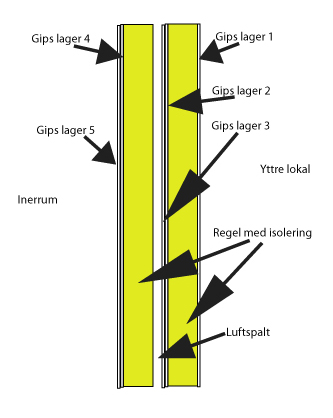
Will the room be continuously heated or only temporary heating when used occasionally?
If the wall is said to have the same function as a regular exterior wall, then you should have diffusion-tight plastic between the insulation and "Gypsum layer 4". No air gap with regard to the plastic is needed.
Attach the plastic according to the instructions on the inside of the stud frame and then screw the gypsum.
If the wall is said to have the same function as a regular exterior wall, then you should have diffusion-tight plastic between the insulation and "Gypsum layer 4". No air gap with regard to the plastic is needed.
Attach the plastic according to the instructions on the inside of the stud frame and then screw the gypsum.
Warm air can hold more moisture than cold air. When warm, humid air cools down, the moisture condenses. That is, water in steam phase transitions to liquid. The vapor barrier prevents the warm, humid air from traveling into the wall, cooling down, and depositing water droplets.
In, for example, vacation homes that are left unheated during the winter, it is advantageous if the insulation is not particularly thick and also lacks a vapor barrier. During the period when it is heated, the air does travel out into the wall, but since the insulation isn't thick, the dew point is often far out in the wall or even on the outside.
Overstated, but roughly so.
If you seal the recording room, you will probably want to ensure some air circulation with the help of an exhaust fan and one or more intake vents.
In, for example, vacation homes that are left unheated during the winter, it is advantageous if the insulation is not particularly thick and also lacks a vapor barrier. During the period when it is heated, the air does travel out into the wall, but since the insulation isn't thick, the dew point is often far out in the wall or even on the outside.
Overstated, but roughly so.
If you seal the recording room, you will probably want to ensure some air circulation with the help of an exhaust fan and one or more intake vents.
Member
· Västra Götaland
· 70 posts
Thanks for the response!
The premises will be used continuously and will always be warmer than the outdoor air (except maybe on a hot summer day). The premises will be more or less airtight, so we will have supply and exhaust ventilation in all rooms.
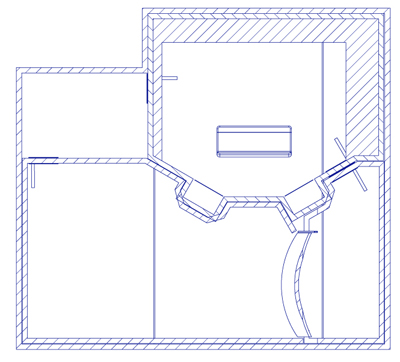
One problem with putting plastic on the studs behind drywall layer 4 is that those studs and drywall belong to a freestanding room inside a larger room (see image below). So if I wrap plastic around all those walls, I'm also wrapping interior walls, and I haven't wrapped all the walls facing outside (I hope it's understandable what I mean).
What would happen if I didn't use plastic but ensured the ventilation was on year-round?
The premises will be used continuously and will always be warmer than the outdoor air (except maybe on a hot summer day). The premises will be more or less airtight, so we will have supply and exhaust ventilation in all rooms.
One problem with putting plastic on the studs behind drywall layer 4 is that those studs and drywall belong to a freestanding room inside a larger room (see image below). So if I wrap plastic around all those walls, I'm also wrapping interior walls, and I haven't wrapped all the walls facing outside (I hope it's understandable what I mean).
What would happen if I didn't use plastic but ensured the ventilation was on year-round?
It would likely work well to omit the plastic. The moisture load should be less than in a residence where you also have to include shower/bath, dishwashing, laundry, pets, etc.
As you describe, the plastic should be as close to the inside as possible, so I understand the issue with a room within a room. If building an airtight bubble is not possible, the whole idea falls apart.
An alternative that might work is to install a smaller dehumidifier with mold guard function and a timer. Turn off any fans, leave doors open inside, and let the dehumidifier run when no one is there. It can be considered that air that is too dry may not be perfect for the vocal cords... unless you're aiming for a hoarse and raspy voice, of course.
If you plan to frame directly against a concrete floor, you should definitely moisture-proof there.
As you describe, the plastic should be as close to the inside as possible, so I understand the issue with a room within a room. If building an airtight bubble is not possible, the whole idea falls apart.
An alternative that might work is to install a smaller dehumidifier with mold guard function and a timer. Turn off any fans, leave doors open inside, and let the dehumidifier run when no one is there. It can be considered that air that is too dry may not be perfect for the vocal cords... unless you're aiming for a hoarse and raspy voice, of course.
If you plan to frame directly against a concrete floor, you should definitely moisture-proof there.
Here is some information about plastic and roofs. As stated in the document, the most important thing is to stop the airflow of warm, moist air to a cooler environment. This can be achieved just as well by using something other than plastic. The plastic prevents diffusion, but diffusion is not a big problem regarding moisture damage.jonathanGubbe said:
http://www.sp.se/sv/units/energy/eti/Documents/Kalla vindar.pdf
Member
· Västra Götaland
· 70 posts
Thanks for all the info!
Does anyone have any formulas or know how to calculate when steam condenses as moisture?
I've been thinking a little; now in the winter, there should be a lot of condensation since the outside temperature is cold and it's warm inside, but when it's this cold, mold can't grow very well, right?
My outer wall isn't very tight, so it should be ventilated a little by the outside air, so then water shouldn't stay in the wall. In the summer, when it might be as warm or even warmer outside than inside, there would be no condensation, so the problem is biggest in spring and autumn? Have I understood this correctly?
I have an air gap between my walls, what would happen if I installed a constant exhaust there, so that I had a slight negative pressure in the entire air gap, would that save me from future problems?
Does anyone have any formulas or know how to calculate when steam condenses as moisture?
I've been thinking a little; now in the winter, there should be a lot of condensation since the outside temperature is cold and it's warm inside, but when it's this cold, mold can't grow very well, right?
My outer wall isn't very tight, so it should be ventilated a little by the outside air, so then water shouldn't stay in the wall. In the summer, when it might be as warm or even warmer outside than inside, there would be no condensation, so the problem is biggest in spring and autumn? Have I understood this correctly?
I have an air gap between my walls, what would happen if I installed a constant exhaust there, so that I had a slight negative pressure in the entire air gap, would that save me from future problems?
My premises are 3m in the air; they are the roof of another company that is in the large hall, my floor consists of chipboard resting on 145 joists resting on 250 I-beams.

Click here to reply