
Hi!
I am planning to widen our chimney in the kitchen and am considering two options:
1. Build out with wooden studs, apply gypsum, then plaster everything
2. Build out with wooden studs, apply gypsum to EVERYTHING, even the chimney, then plaster everything.
I would prefer option 1 but am afraid of cracking between the chimney and the framework. Is there a way to avoid this? Can the joint be reinforced with something? I would like the old chimney to remain "original".
Grateful for suggestions.
//Henke
I am planning to widen our chimney in the kitchen and am considering two options:
1. Build out with wooden studs, apply gypsum, then plaster everything
2. Build out with wooden studs, apply gypsum to EVERYTHING, even the chimney, then plaster everything.
I would prefer option 1 but am afraid of cracking between the chimney and the framework. Is there a way to avoid this? Can the joint be reinforced with something? I would like the old chimney to remain "original".
Grateful for suggestions.
//Henke
Option 1 works excellently, use putsnät, a type of reinforcement for plaster that you attach with staples beforehand. It looks like a regular grid that can be used for underfloor heating, but it tends to be a bit stronger when it's used for self-leveling compound and electric underfloor heating. If you have a piece left over, it's excellent to use when building a rabbit hutch. 

You are not allowed to have combustible material (wood) directly against the chimney?

Ah, it's probably best to check with the chimney sweep
We have a brick chimney that is ceramic sealed, and the chimney stack gets warm anyway. It doesn't get burning hot maybe, so personally, I don't think it would start a fire from that... But the chimney sweep mentioned something about it the last time he visited, on the other hand, our chimney stack is built into the log wall, and he didn't say anything about that so...
What does it mean to have a hose by the way? I'm not very knowledgeable on the subject. Do you insert some kind of pipe into the chimney or something??
We have a brick chimney that is ceramic sealed, and the chimney stack gets warm anyway. It doesn't get burning hot maybe, so personally, I don't think it would start a fire from that... But the chimney sweep mentioned something about it the last time he visited, on the other hand, our chimney stack is built into the log wall, and he didn't say anything about that so...
What does it mean to have a hose by the way? I'm not very knowledgeable on the subject. Do you insert some kind of pipe into the chimney or something??
Installing a liner in the chimney does not mean you can place combustible materials on the outside. When you install a liner, you're simply restoring the flue to its original condition (if it was in poor condition before, that is—if the flue is not in poor condition, there's no need to waste money on a liner unnecessarily). Is it not possible to use metal studs?
Thank you for your answers. I found another thread where it was described that there should be a distance of at least 30mm between the chimney and the wooden stud. This works if you attach the stud to the floor and ceiling. You can then allow the plaster to extend accordingly so that it connects to the chimney. Reasonable?
Sounds like a good solution, especially if you use reinforcing mesh. That way, it won't crack between the chimney and your stud/drywall construction.
Borrowing the thread and asking:
Why has it been done like this (see image)?
It looks like half of the brick is embedded and the other half sticks out.
Can we use an angle grinder on the bricks that are sticking out
so that the entire chimney is even all the way
or is there a risk that it will collapse?
Why has it been done like this (see image)?
It looks like half of the brick is embedded and the other half sticks out.
Can we use an angle grinder on the bricks that are sticking out
so that the entire chimney is even all the way
or is there a risk that it will collapse?
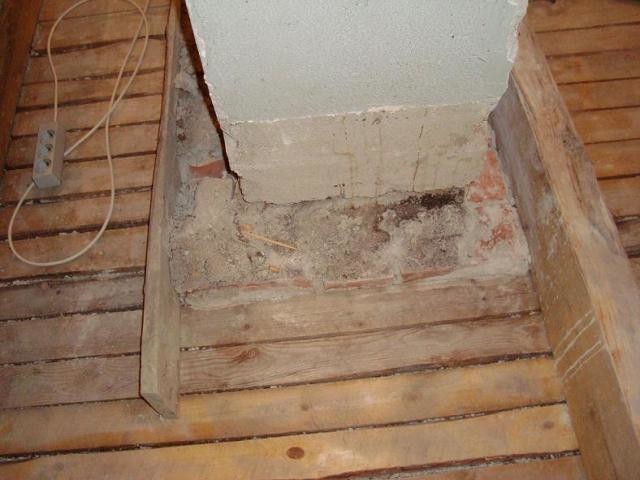
Regarding the image above, that projection is called a "utkragning," something that was done in the past. This was done to be able to lay wooden beams flush, but this method is no longer recommended (stopped being used in the 60s) as these ledges can crack and break the chimney at the floors. I would probably aim to remove them and have a ventilated space instead (much, much better). Just make sure to plaster and restore the chimney after the intervention. Good luck!
Click here to reply