
20,045 views ·
26 replies
20k views
26 replies
Excavating basement, the walls are not enough!
Hello
Completely new to this, but I hope it will go well anyway.
I have read here on the forum about some who have similar projects, but none that fit quite right.
As I said, I plan to excavate my basement. The ceiling height today is only 170 cm, which I would like to change to at least 200 cm.
The house is one and a half stories from 1917 with a basement under half of the house. The exterior walls in the basement consist of granite blocks that are about 70-80 cm thick.
I have seen here that some have poured under their existing walls to extend them. But since I have very thick walls, it will be incredible amounts of clay/sand that I have to dig away, and also incredibly much concrete to fill in with.
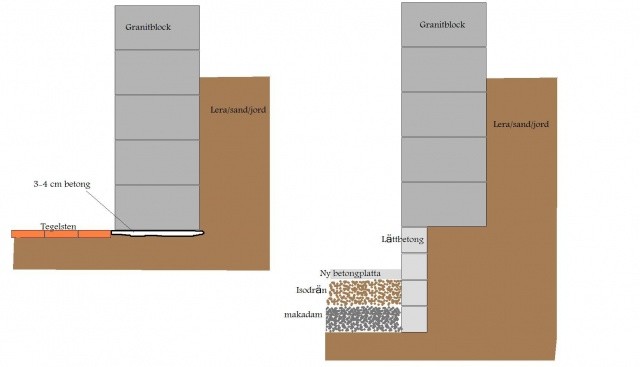
So my idea is to only dig in 20 cm under the granite blocks and then build up with lightweight concrete.
I attach a couple of pictures that better describe my thoughts. The left picture shows how it looks today, and the right one how I have planned.
I plan to complete drainage and insulation externally later.
Can the lightweight concrete even handle the pressure?
I hope now that with your wide experience, you can critique or praise my suggestion.
Completely new to this, but I hope it will go well anyway.
I have read here on the forum about some who have similar projects, but none that fit quite right.
As I said, I plan to excavate my basement. The ceiling height today is only 170 cm, which I would like to change to at least 200 cm.
The house is one and a half stories from 1917 with a basement under half of the house. The exterior walls in the basement consist of granite blocks that are about 70-80 cm thick.
I have seen here that some have poured under their existing walls to extend them. But since I have very thick walls, it will be incredible amounts of clay/sand that I have to dig away, and also incredibly much concrete to fill in with.
So my idea is to only dig in 20 cm under the granite blocks and then build up with lightweight concrete.
I attach a couple of pictures that better describe my thoughts. The left picture shows how it looks today, and the right one how I have planned.
I plan to complete drainage and insulation externally later.
Can the lightweight concrete even handle the pressure?
I hope now that with your wide experience, you can critique or praise my suggestion.
I agree with you, it doesn't feel right to start messing with a foundation that has stood for almost a hundred years.
But unfortunately, it can't be helped, the space down there was a big reason we bought the house. So the floor will be lowered whether it feels right or not. So the question really is whether I can do as in the drawing above or if I have to do as the others who have written in the forum (casting all the way underneath).
Best regards, John
But unfortunately, it can't be helped, the space down there was a big reason we bought the house. So the floor will be lowered whether it feels right or not. So the question really is whether I can do as in the drawing above or if I have to do as the others who have written in the forum (casting all the way underneath).
Best regards, John

Keep in mind that when you lower the "groundwater level" in this way, the boulders will stand on dry clay/soil, which may no longer be as stable. So it is questionable to do so. In this case, you must somehow ensure that what is beneath the stones does not dry out. Therefore, you probably need to build a new wall a bit inside the old one so you can ensure that it doesn't dry out and not drain on the outside...
The next is to do as you propose without changing the density in the ground under the new wall. Then when you drain from the outside, dig in under one stone block at a time and cast with concrete mixed with leca. This method is probably preferred if you "have to" dig out...
I know how it is... The house I bought was on pillars buried 30cm in the ground.. I dug by hand, removed a pillar, supported, cast a beam, and built up with leca blocks... took the next pillar... In a similar way, you "should" remove the stone wall and build up a new one... Keep in mind that the house should be sellable one day...
The next is to do as you propose without changing the density in the ground under the new wall. Then when you drain from the outside, dig in under one stone block at a time and cast with concrete mixed with leca. This method is probably preferred if you "have to" dig out...
I know how it is... The house I bought was on pillars buried 30cm in the ground.. I dug by hand, removed a pillar, supported, cast a beam, and built up with leca blocks... took the next pillar... In a similar way, you "should" remove the stone wall and build up a new one... Keep in mind that the house should be sellable one day...
No, it probably won't work… but if you then cast from the outside so that you get the same thickness on the new wall under as the upper one, it will "probably" work, but I wouldn't dare… instead, I would probably completely remove the old wall and build a new one…b8q said:
I should add that I am also an amateur… but have built quite a bit…

One option is to lift the house and build up as much as you want to raise the basement. We did that and cast a new slab for the underfloor heating on top of the old one. It might be easier than chipping away in your case, depending on a lot of factors, of course.
Yes, that's exactly what I wrote a little further up...thomasx said:

But you do lose some floor space then.
I think if you put a new wall inside, you should think 45°, i.e. lower the level by 1m, move the wall inward by 1m.
And you have to think ahead.
Eventually, you'll sell, and you don't want solutions that reduce the price.
But everything is a consideration of what it costs to execute and what it can return.
And you must still live, so you can't only think of it as an investment.
But as one gets older, suddenly you can't manage to have a house... then you want
the money to be enough for the world cruise and more than a standing room in Brunnsviken.
Thank you all for taking the time to help me with my problem!
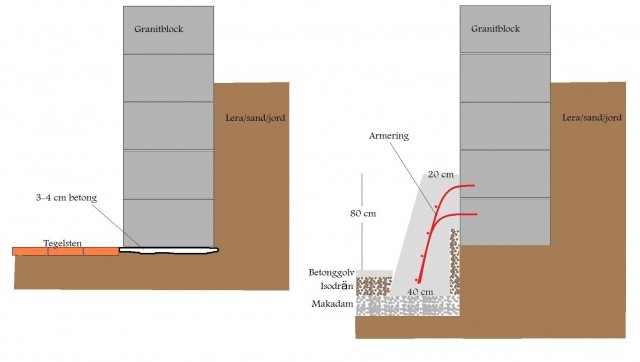
What thomasx suggests sounds like a reasonable proposal. Maybe it's enough to just cast a ledge inside? and thereby avoid casting all the way up, and then have a smaller room. When the new floor has been cast, it's really only 30cm that is lowered. It would be nice to avoid digging under the granite blocks.
If I cast a ledge, I will actually get more support for the walls than I have now! The question is if I should perhaps try to cast in some isodrän inside the ledge? Maybe drill in reinforcement into the granite, which is then bent down and cast into the ledge together with a bunch of horizontal reinforcement bars? When I get home from work, I'll update with a couple of pictures.
What thomasx suggests sounds like a reasonable proposal. Maybe it's enough to just cast a ledge inside? and thereby avoid casting all the way up, and then have a smaller room. When the new floor has been cast, it's really only 30cm that is lowered. It would be nice to avoid digging under the granite blocks.
If I cast a ledge, I will actually get more support for the walls than I have now! The question is if I should perhaps try to cast in some isodrän inside the ledge? Maybe drill in reinforcement into the granite, which is then bent down and cast into the ledge together with a bunch of horizontal reinforcement bars? When I get home from work, I'll update with a couple of pictures.
Yes, a ledge was exactly what I meant, let it overlap the existing wall by about 50%. Reinforcing the walls together is probably a good idea, but be very careful with the vibrations when you drill into the exposed wall. Maybe it's best to drill before you dig down under the bottom of the wall. Or drill with a diamond drill, without percussion.jonnyboy said:Thank you all for taking the time to help me with my problem!
What thomasx suggests sounds like a sensible proposal. Maybe even just pouring a ledge inside might be enough? and in that way avoid pouring all the way up, and then get a smaller room. When the new floor is poured, it's really only 30cm that will be lowered. It would be nice to avoid digging under the granite blocks.
If I pour a ledge, I will actually get more support for the walls than I have now! The question is if I might try to pour in some isodrän inside the ledge? Maybe drill rebar into the granite, which is then bent down and cast into the ledge together with a bunch of horizontal rebar? When I get home from work, I'll update with a couple of pictures
Now it's not really "only" 30 cm because you want a capillary breaking layer under the new floor, and that's where the ledge that holds the boulders will drain. So it's probably not "only" and it depends a bit on what the space will be used for.. A wine cellar is probably fine.jonnyboy said:
But if you want it drier, it might cause problems.. you have to build tightly and dry without draining the water in the ledge....
Sorry if I sound negative... I have done similar solutions myself... Half the house has a crawl space with 1m "standing height" and the other 2.5m so sure it's possible... but there will be different solutions depending on the soil conditions...
Okay. I have checked with the previous owners and the neighbors around. I have also done some test digging in the basement. According to the previous owners and neighbors, the house is on gravel and large boulders mixed with some clay. The previous owners and I (in the last 3 years) have never had problems with moisture in the basement. The ground around is very draining and since we live quite high up on a hill, rainwater quickly runs off. So according to them, I don't need to drain.
The test hole in the basement confirms that it is gravel and stone mixed with dried clay. Really difficult to dig in! When you strike with the pickaxe, it's like striking stone! Need to get a power hammer!
Despite this, I would probably like to incorporate some isodrän or equivalent into the concrete foundation. Better safe than sorry. Plus, they insulate!
The space is intended to be used as a man cave. So a small bar, a pool table, and some manly stuff like that. Maybe at most going to be down there once a month and aim to keep the temperature around 17-18 degrees.
Maybe put the isodrän on the foundation after it's cast and then coat it? Is that possible?
Otherwise, I think it looks quite reasonable. It'll be like Fort Knox!
The test hole in the basement confirms that it is gravel and stone mixed with dried clay. Really difficult to dig in! When you strike with the pickaxe, it's like striking stone! Need to get a power hammer!
Despite this, I would probably like to incorporate some isodrän or equivalent into the concrete foundation. Better safe than sorry. Plus, they insulate!
The space is intended to be used as a man cave. So a small bar, a pool table, and some manly stuff like that. Maybe at most going to be down there once a month and aim to keep the temperature around 17-18 degrees.
Maybe put the isodrän on the foundation after it's cast and then coat it? Is that possible?
Otherwise, I think it looks quite reasonable. It'll be like Fort Knox!
17-18° perfect for a wine cellar... Yes, if you only go there one day a month, you won't raise the temperature too much/too often, so it will be perfect. You should also get a pedal-operated mill, and I will come and help pedal during the first harvest
I will probably have the billiard room on the upper floor and plan a dumbwaiter from the kitchen up there..
unfortunately, the lift does not go down to the wine cellar.
You can plaster on styrofoam, so why not on isodrän..
Usually, you first attach plaster mesh and then plaster on it. It adheres quite well to styrofoam without the mesh too, although it might not be as professional.
Yes, if you only go there one day a month, you won't raise the temperature too much/too often, so it will be perfect. You should also get a pedal-operated mill, and I will come and help pedal during the first harvest I will probably have the billiard room on the upper floor and plan a dumbwaiter from the kitchen up there..
unfortunately, the lift does not go down to the wine cellar.
You can plaster on styrofoam, so why not on isodrän..
Usually, you first attach plaster mesh and then plaster on it. It adheres quite well to styrofoam without the mesh too, although it might not be as professional.