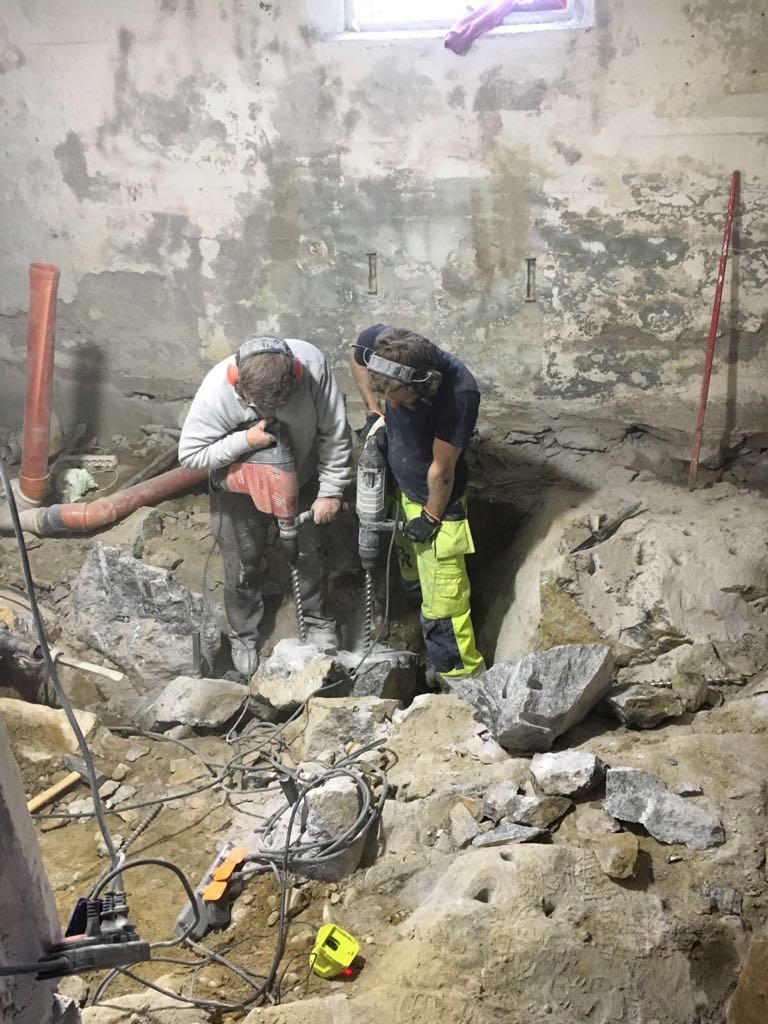
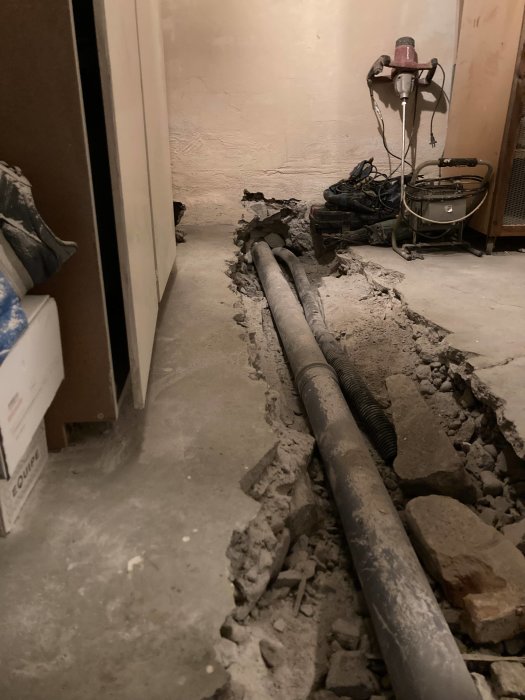
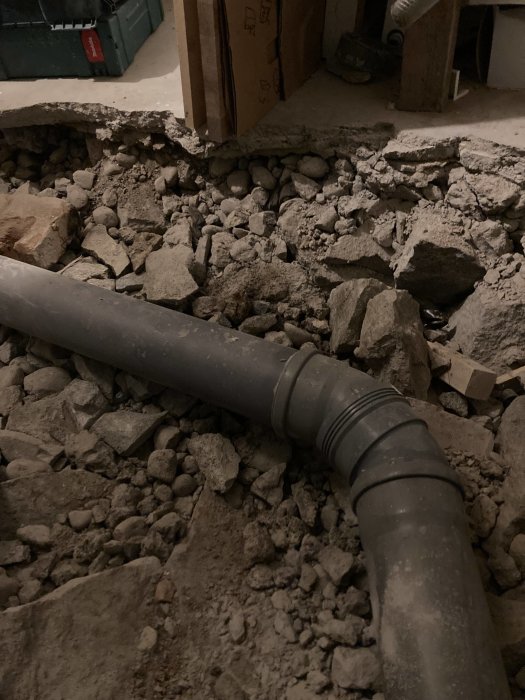
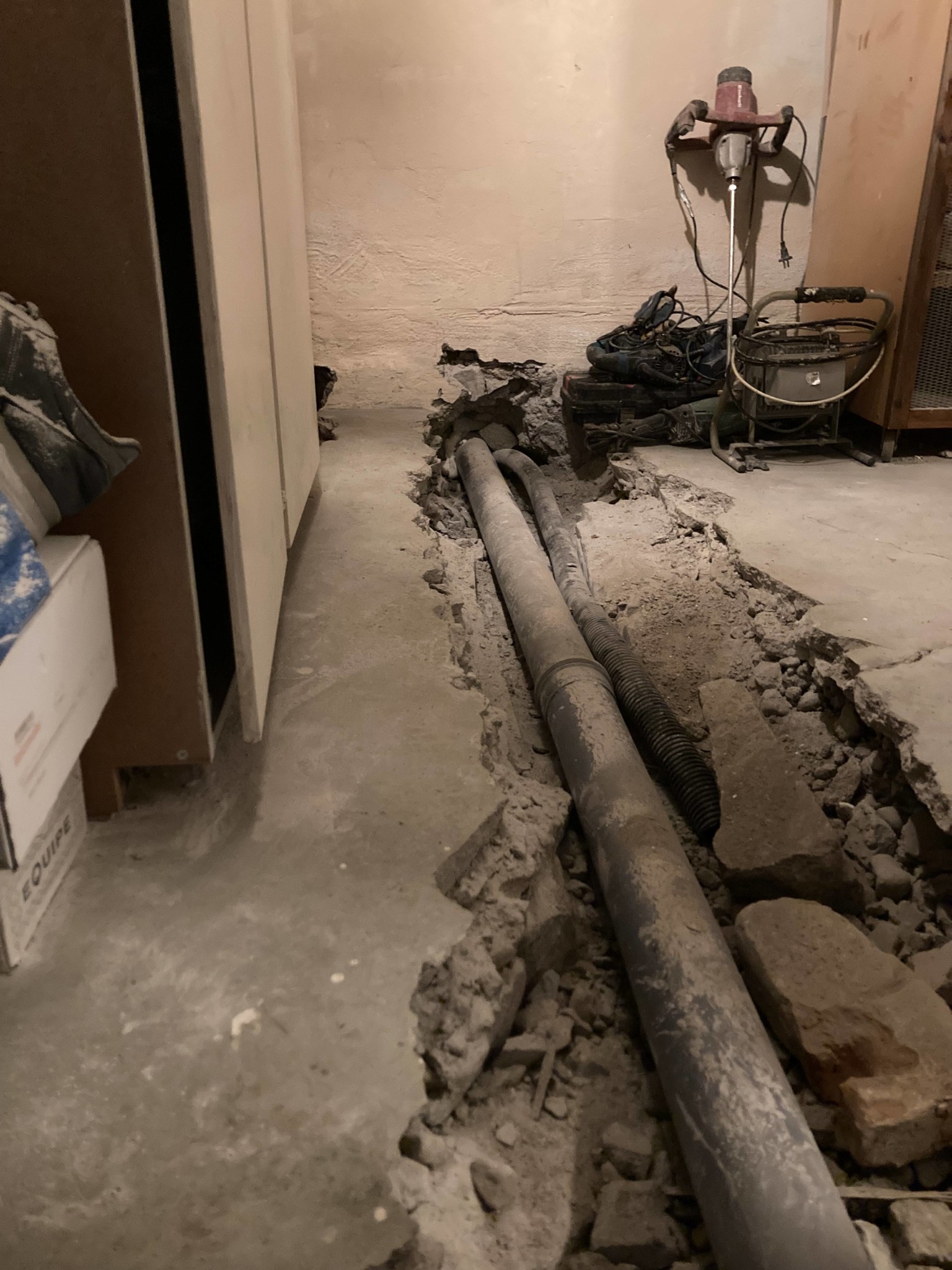
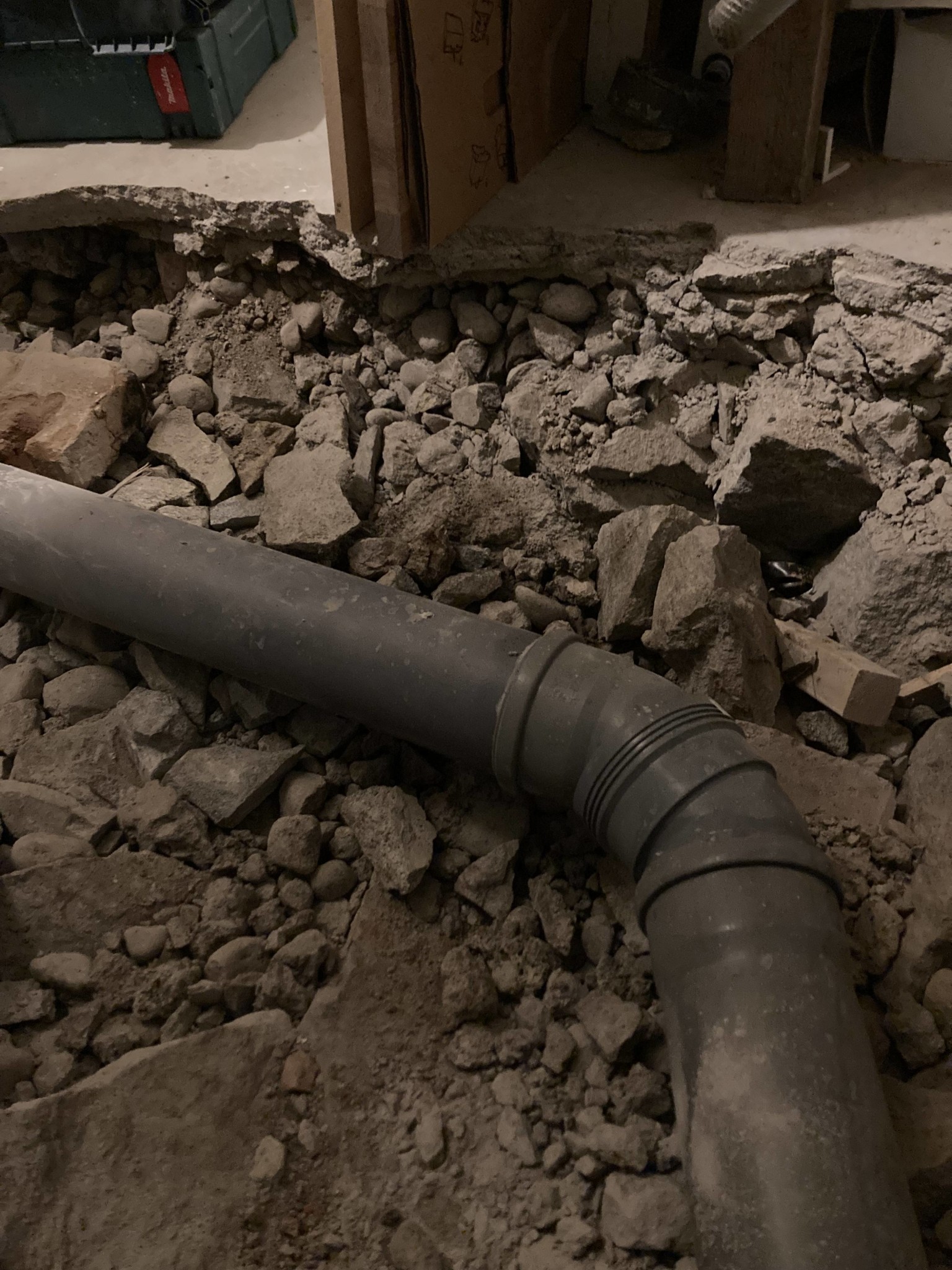
We are working on an expansion project in our 1930s house and needed to run sewage pipes through the floor in the existing part to connect to the existing pipes. The optimal solution here would be to break up the rest of the floor, insulate, and then pour a new floor with underfloor heating to create another room (the floor level is the same as the ground outside, making it a good room).
The problem here is that the rock is relatively shallow, as little as about 2.50 meters below the ceiling. In about half of the room, it is like this, and then the rock falls away, allowing access to significantly deeper levels (up to 2.80 meters).
The best thing in this situation is, of course, to remove rock and do it by the book, but after starting the expansion project by blasting away about 15 cubic meters of solid rock right next to the house, we, for various reasons (money, nerves, neighbors, etc.), do not want to blast more.
So what is the best solution? I've read and read and read, and the conclusion is essentially that there's no good way to do it.
Pouring with EPS concrete seems to be considered quite poor by most here. We would perhaps only get 15 cm to achieve a somewhat acceptable ceiling height, which is Finja's absolute minimum acceptable thickness.
Leveling with gravel and then using EPS boards partially on gravel with a layer as thin as a couple of centimeters and 10 cm of foam seems too thin. That's also what I've understood from the forum.
The same as above with XPS boards I've read about but haven't understood why it would be better.
A couple of alternatives I've thought about myself but haven't found anything about on the forum are the following:
- Level with EPS concrete and then finish with 5 cm of polyurethane foam before pouring a concrete slab with waterborne underfloor heating.
- Level with EPS concrete and then finish with 5 cm PIR boards before pouring a concrete slab with waterborne underfloor heating.
Are any of these options reasonable? Is EPS concrete sensible for leveling, or is gravel better?
It should be added that it is bone dry and has never had moisture problems before, and it is drained outside and under the adjacent extension where we, as mentioned, have reached down to the equivalent of 2.8 meters below ceiling level.
Big thanks to you who have managed to read the entire post, and even bigger thanks to you who take the time to answer.
Coming up with another variant. Level with Isodrän-like pellets and cast as usual. Much is written about 10cm thickness to hold, but my old floor was max 2cm and lasted for 60 years, so going down to 6-7cm should be doable to save a few cm.
Feels wasted to do all the expensive work to insulate properly there. What will the room be used for?
It will be a living room/TV room, so it will probably be used quite frequently. The room is centrally located in the house too, so if it's possible to have waterborne underfloor heating it would be great.
Coming up with another variant. Level with Isodrän-like pellets and cast as usual. Much is written about 10cm thickness to hold, but my old floor was a maximum of 2cm and held for 60 years, so going down to 6-7cm should be doable to save a few cm.
Interesting method! Maybe complement with a thin PIR board between the Isodrän pellets and the concrete?
What finished ceiling height are you aiming for then?
As high as possible, of course.
But if you use leca balls, it'll be 2.50 everywhere, xps 10 cm (about the same insulation value as PIR).
Then 10 cm concrete, then underfloor heating that you flow or cast in.
And then the flooring, then you'll get a ceiling height of about 2.20-2.23 cm
Alternatively, replace the concrete with eps cement, if that insulation is necessary.
I have decided that I want the same floor level as in the adjoining room (232), which gives me about 18 cm to work with.
Based on the suggestions here and more googling, I have two main approaches:
1. Level with isodrän beads a couple of cm above the highest rock, install this solution https://www.finnfoam.se/produkter/ff-floor and then a finished floor on top. Possibly, I might fit a thin layer of PIR boards between the isodrän and floor solution.
2. Level with isodrän beads above the highest rock, lay as much PIR as possible (maybe 7 cm), and then finish with a slightly thinner concrete slab of 7-8 cm. I'm thinking of a floor like microcement, which doesn't take much space and looks quite nice.




Jonatan79 said:
snuttjulle said: