I received a tip from a forum member to check if the existing beam is "sagging" due to the load today to get an indication of the sizing. I took a long level and tested it in the middle under the beam (where I expect the most "sagging") and with the long level (1.8 or 2m) it's impossible to find the slightest hint of "sagging". I'll see if I can get hold of a laser to look at the entire stretch.
I borrowed a fine leveling laser from a carpenter friend and tested it. I am fairly certain that I would have noticed if it had bent more than 1mm and I cannot see that it is bent at all.
This makes me (rightly or wrongly?) quite confident that I don't need to increase the dimension if I extend by 1m (from 5.1m to 6.1m). I don't know what is considered acceptable, but according to span/400, a deflection of 1.2cm would be acceptable with the current beam.
Sounds incredible that it hasn't bent down at all. Then it's more about removing the beam. Joking aside. It means that the wooden beams can span from side to side without significant sagging, or do you have a wall resting on top of the beam that is self-supporting and that the wooden beams hang in? Worth considering is that sagging (L/400 or whatever you're aiming for) is in a case where you have lots of people and heavy furniture in the house (200kg/m2). I'm sure you still meet L/400, but keep this in mind. Before you do anything, I think you should try to figure out WHY the beam isn't sagging.
I agree that it is a bit strange, so I checked twice. I can see that it leans a little, but not that it is bent at all. Above the beam are the floor joists spanning 6.5m, cc 40cm, and I believe it is 220mm (x45mm I assume). There is no wall above, the room above is the same size. It is furnished above, but clearly, it's far from 200kg/m2. Unfortunately, I can't guess at all what would happen if you were to load it with 200kg/m2, I suppose that's exactly what the professionals know.
Right now, I am thinking like this, I will let a real welder come here and extend the existing one by 1m (haven't gotten a price for the job, but I assume it's noticeably less than a new beam and above all significantly more manageable work). After that, I will check if the beam has "sagged" due to the increased span. If it has and it "worries" me, I will install a new HEB180 next to the existing one. In my mind, it should at least be stronger in total than the existing one. Am I being foolish? (feel free to wrap it nicely ).
Can't answer the question of whether you're dumb; a potential partner/roommate might be able to help you with that question
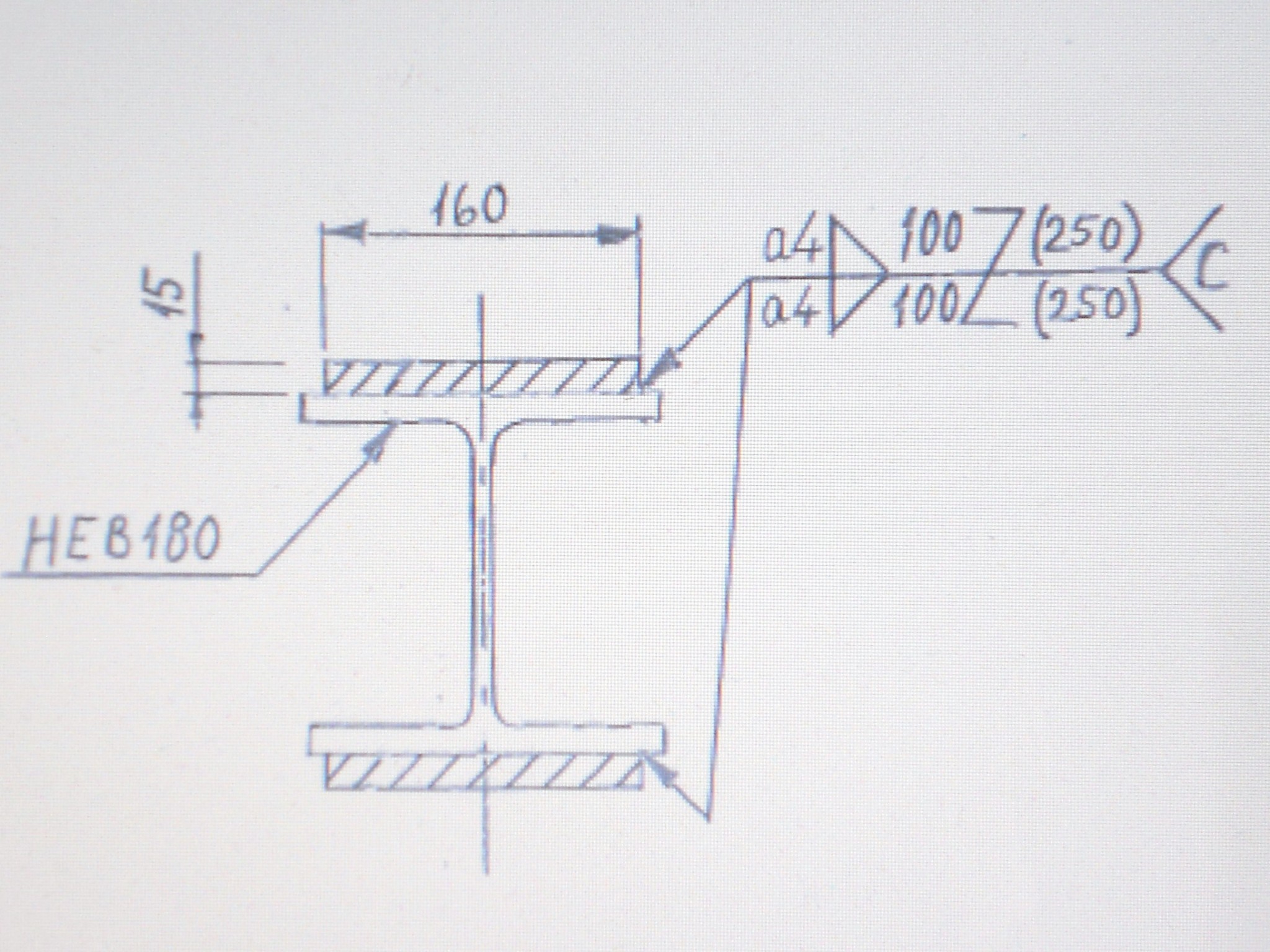
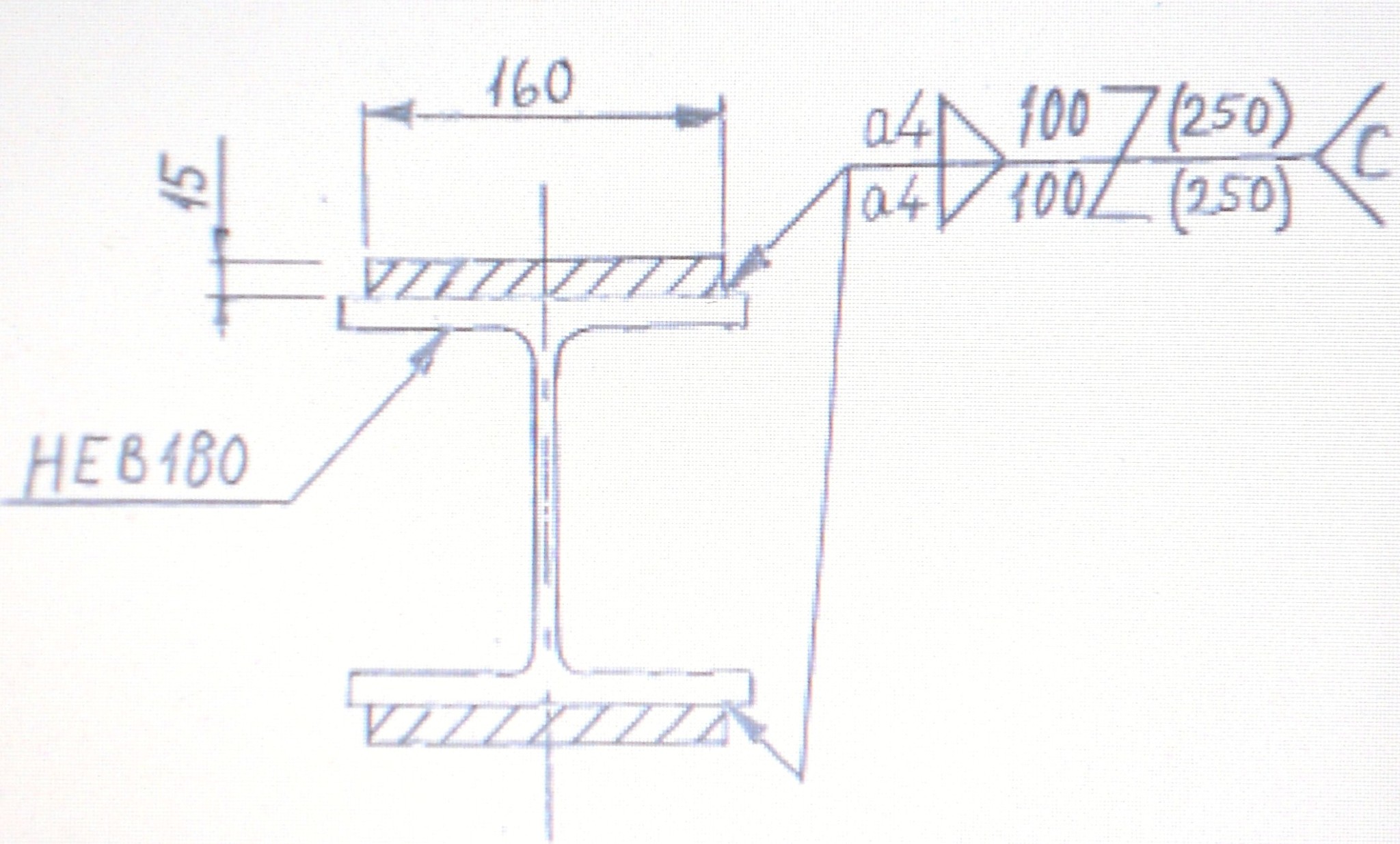
Regarding the beam, it sounds like a good idea to have a professional welder build on the existing beam. I suggest you also build up the flanges, according to the attached sketch, along the entire length of the beam. The addition of the flanges will give the beam a bending stiffness equivalent to HEB220.
You don't need to reinforce the web of the beam, as the HEB180 web is sufficient. Have you checked that it is indeed an HEB180 with a flange thickness of 14 mm and a web thickness of 8.5 mm? (It's easy to mistake HEA for HEB, they are similar).
The sketch is available as a pdf file, and I can email it to you if you'd like. (Couldn't attach the pdf file here, so I had to photograph the pdf on the computer screen with a digital camera to get a jpeg file)
Now it turns out that the welders were here yesterday and extended it. And yes, I had measured that it was a heb (and the welders extended with heb180 and it fits perfectly). Huge thanks for the idea to weld onto the flange, it would have been perfect to do to be on the safe side. In fact, I should probably see if I can get them here again and reinforce it according to your drawing. I'll think about it.
As I said, big thanks for your input and drawing. A day earlier and I would have gotten it done directly when they were here anyway.
Oh dear, too bad I wasn't a bit quicker with posting! The idea was of course that the welders would only need to come there once and that adjustments for the altered beam height would be made at the same time. Now it might be more complicated with that matter. Hope you find a smooth solution, now you have something to think about anyway
The lower reinforcement doesn't need to go all the way to the supports, which might make things easier.
The upper reinforcement is probably most practical to let go all the way, I guess you want a smooth top on the beam.
Hope you can get the reinforcements in now, so you don't have to redo the work later when you're tired of a wobbly beam.
No problem, Granngubben, I'm just glad for your input anyway, which will definitely be useful if the work that has been done isn't enough. Adding what you suggest and getting it welded isn't very difficult for me at this stage (or in the coming months).
Now it's fixed and the beam is extended. My partner and I frenetically tested the flex (no, not as you think ) and can note that the shelves along the wall move almost exactly as much as they did before we extended. And that movement is less when standing directly over the beam than when standing closer to the wall, meaning it's not the beam but the existing floor joists that are flexing. You can't feel the movement in the floor when walking over the beam.
I will borrow a laser and see what deflection we're talking about.
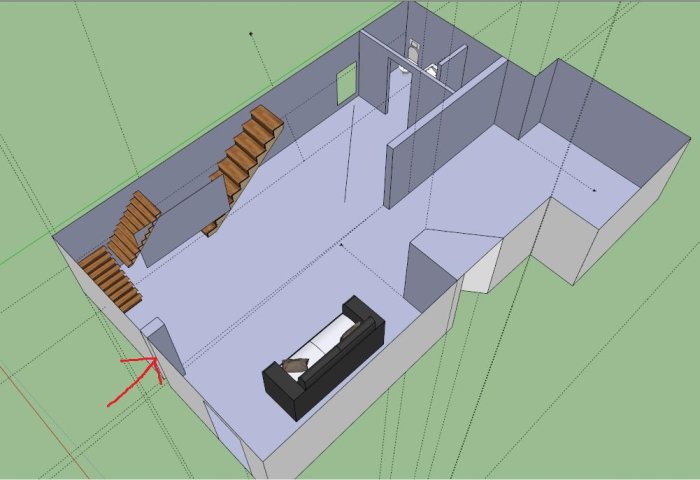
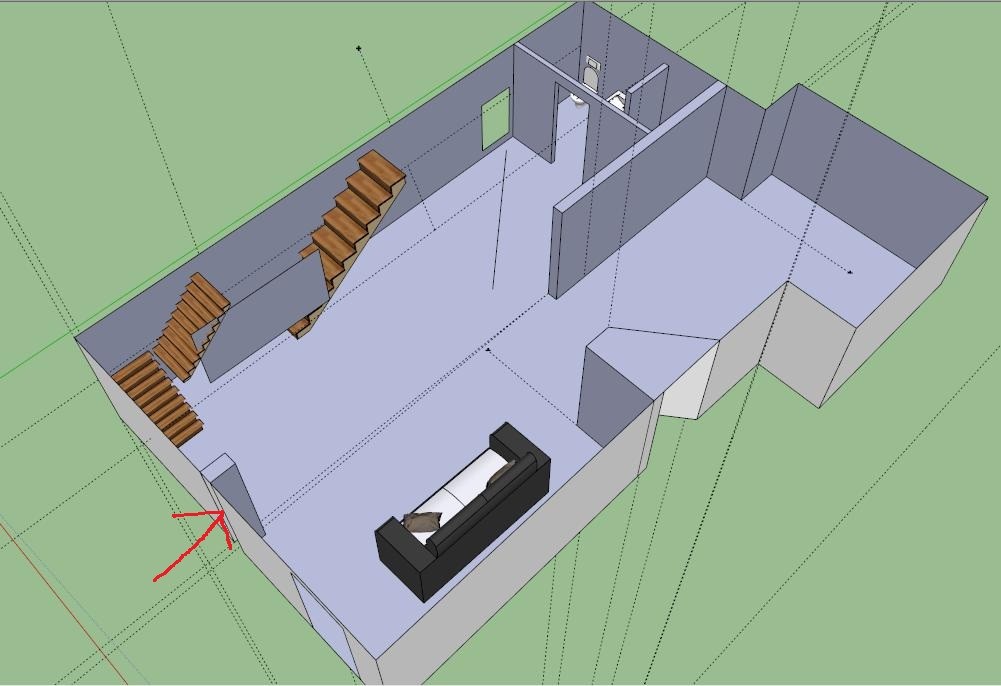
Noticed this morning that I got a crack on the outer wall (25cm leca, with plaster on the outside) where the beam was extended (see picture). Didn't examine it more closely this morning to see if it's deeper than the plaster but will check when I get home. I assume it's because I've moved the load point outward, causing the (quite hefty) footing the outer wall stands on to settle a bit further out than before. The beam is resting on a leca wall that stands on the same footing as the outer wall; it's a "gut" cast inward.
.
Upon a bit of investigation, it turns out I overestimated the size of the crack. For one, it doesn’t go across the whole wall, and it's only as wide as a fingernail. I think it was created because the builders used expanding concrete under the beam on the new setup, which slightly lifted everything and thus changed the load. It was apparently a quick and easy job for the welders since they had access from all sides. They had considered joints and the like, but now it was just neatly stitched together all around.
As a bit of follow-up, I checked with a laser after the extension and found that even now the beam has no visible bending. And then you can see that the welds have done a good job of getting the extra meter straight. If you wonder if it bends when someone walks above, you can hang from it, I tested this unscientific approach and felt quite silly when you realize you're like a fly to the beam. Sturdy stuff.
How will the deflection be on such a long beam? Will it be like on the Finland ferry or?
No, fortunately, it wasn't
When I stand and jump/sway above, it feels quite stable. About the same as before the extension.
I'm starting to suspect that the joist above is quite sturdy. I noticed that in the part that still has a load-bearing wall, what looked like a glulam beam was visible; I wonder if there could be a couple of glulam beams where I've removed the wall. I'll find out when I replace the treated timber that supports the subfloor, I suppose.
Now it so happens that the welders were here yesterday and extended it.
May I ask how much it cost to get the beam welded?
Did they manage to weld the beam from the top side as well?
Were you/they careful to ensure they had some sort of license for hot work near flammable materials?
May I ask how much it cost to get the beam welded?
Were they able to weld the beam from the top as well?
Were you careful to ensure they had some sort of license for hot work near combustible materials?
I actually don't know yet what it would cost. It was apparently much simpler than they thought, so it didn't take much time; I haven't received the invoice yet, though.
They were able to weld "parts" of the beam from above, but not completely.
I didn't check the license (I haven't even met them); they came on the initiative of a builder who was helping me a bit. He had worked with them on many projects. Apparently, it was the founder of Bromma stål who did the job, and from what I understand, they have a good reputation.
raveper said:
Who was the fire watch and did they bring fire extinguishers of an approved size?
My builder was there and acted as the fire watch. They brought extinguishers (I don't know what size), and I had pulled out a water hose (which they used to wet above the beam, i.e., the combustible material).
Vi vill skicka notiser för ämnen du bevakar och händelser som berör dig.

 Joking aside. It means that the wooden beams can span from side to side without significant sagging, or do you have a wall resting on top of the beam that is self-supporting and that the wooden beams hang in? Worth considering is that sagging (L/400 or whatever you're aiming for) is in a case where you have lots of people and heavy furniture in the house (200kg/m2). I'm sure you still meet L/400, but keep this in mind. Before you do anything, I think you should try to figure out WHY the beam isn't sagging.