Soon it's time for project Insulating and leveling the floor in the boathouse we bought last fall. As there seems to be a variety of different types of foam, there have been hours of googling over the last few weeks...
Conditions:
Cast floor that is fairly flat and without cracks. I assume it's uninsulated.
Area 22 sqm
The plan is to insulate with 40mm foam, lay a reflective foil, heating cable, and then use fiber-reinforced self-leveling compound.
This is where I need your help to guide us on what type of foam to use!
EPS or XPS.. 100/200/300, what is suitable?
I'm leaning towards using EPS 200 or XPS 200/300 depending on what we can get.
What does the expertise say?
Also sent out 3 quotes to local dealers for foam and fiber self-leveling compound...
Have received replies from 2 out of 3 with the following materials...
1 - EPS 150 plain and Fiber 260 (Finja)
2 - EPS 100 plain and fiber (manufacturer unknown)
Feels a bit weak with EPS 100 and 150, or could it be enough for us?
Regarding the amount of self-leveling compound, both dealers calculated 20 bags for 22 sqm...
Any thoughts on that?
The best option, I think, is to follow a manufacturer-approved construction or something generally well-proven.
The critical component in this context is the self-leveling compound, so that's where you start looking.
Finja has their document "Floor Structures" (https://www.finja.se/storage/ma/f3f...8009225B987DCC43E9B476/Golvkonstruktioner.pdf). They probably also have a more comprehensive project planning guide.
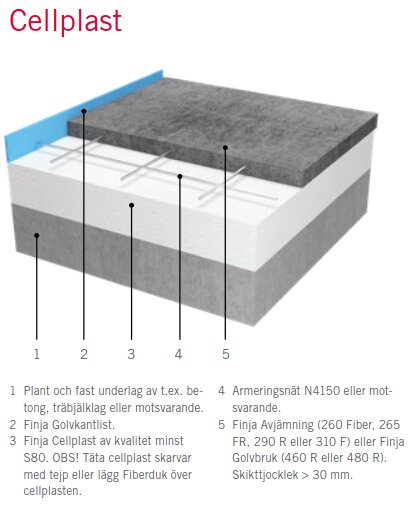
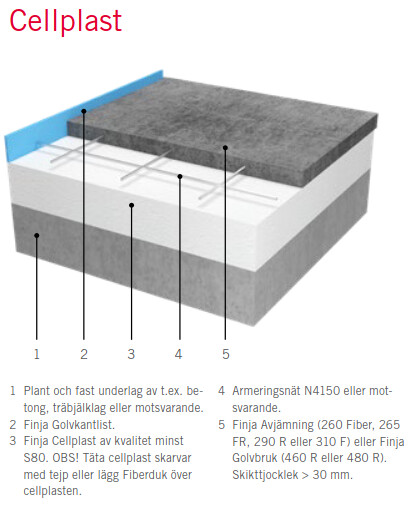
The following is stated for cellplast:
That is, cellplast at least S80, reinforcement mesh, and at least 30 mm leveling.
Based on that, you can then calculate how much leveling you need.
It should be noted that 40 mm is extremely poorly insulated. Partly you won't achieve great energy efficiency with underfloor heating (which I assume you're aware of), and it might be a point to choose a board with maximum insulation value (thinking PIR), and there are probably indirect higher demands placed on a firm and even base so that you don't experience any movement in the boards that would stress the leveling.
Thanks for the input @cpalm, yes I've read through various instructions including Finja's..
And I know this will be a bit of trial and error as it isn't easy to follow any handbook from A to Z, but I still want to try to get it good enough.
Regarding the thickness of the cell foam, it's more about wanting to build as little height as possible and the underfloor heating is primarily meant as extra comfort, so..
I could use 50 mm since the extra 10 mm isn't that critical.
The reason I want the substrate to be as firm as possible is why I'm considering EPS 200 or even XPS.. PIR feels a bit excessive.
And my concern about why 100 / 150 is recommended in the quotes...
To give the boards the best possible conditions, my thought is to use adhesive both to even out any dips and to "glue" the boards down..
Good or bad, I don't know, but I want to believe it will make a difference.
The best would absolutely be to break up the existing slab and start from scratch, but it's a boathouse.. a summer house.
I almost think the other way around, that a softer board adapts better to an uneven surface when you apply the leveling compound. The important thing is not that it is exactly even, but that you don't get any settling after the floor is cast. I think you're on thin ice if you try to compensate for inadequate groundwork with a stiffer board, glue, etc. Focus on ensuring the boards have a solid foundation, that is the basic prerequisite in the construction. Hopefully, not an issue if you are insulating on an existing concrete slab.
The reason they are offering 100/150 may be because they are offering their standard product, which has the best price.
Whether it's a holiday home or not, the insulation in the floor has a significantly greater impact on heating economy with underfloor heating compared to regular radiators.
Ah, a thought I hadn't had, I've been completely focused on having the board be as rigid as possible to minimize the risk of cracking, that is as if it has been leveled on the cast slab.
According to the quote, the 150 board isn't that much cheaper compared to the alternatives I've looked at.
Hmm, again, thanks for the input... maybe I need to reconsider...
Finja 260 is very nice to work with, I have poured it in the basement. Good price at Hornbach if you take the whole trailer full. However, I have doubled and also use reinforcement mesh (rotnät).
Finja 260 is great to work with, I've poured it in the basement. Good price at Hornbach if you take a full trailer. However, I've doubled up and also use reinforcement mesh (rotnät).
I think there must be gold dust in that bag considering the price, lol.
Almost 100 kr more expensive than a similar no-name.
How many mm flow? Have you experienced any cracks or other issues?
The floor will settle, more or less - it is inevitable. The trick is to make it settle evenly across the entire surface. Therefore, you must make the floor construction floating, meaning it shouldn't be attached to anything like a wall or doorway. In places where there is a risk of cracking, it is often recommended to place a dillationsfog (expansion joint).
The floor will settle, more or less - it is inevitable. The trick is to get it to settle evenly over the entire surface. Therefore, you must make the floor construction floating, i.e., so it doesn't hang on, for example, any wall or doorway. In such places where there is a risk of cracking, it is often recommended to lay a dilation joint (expansion joint).
Therefore, S80 is sufficient.
Interesting, of all the research and reading I've done, this is new information, but once you get it, it's completely logical. Thank you.
Do you have any suggestions on how to create a good expansion joint?
When I google, things like edging strip appear.
Or should one use some form of soft joint between the foam insulation and the lightweight concrete the sill rests on?
Between foam plastic and Leca blocks, you need nothing; it is the self-leveling compound that must not adhere and risk the slab sticking and thus cracking when settling. This is especially important if you're using tiles.
Either lay a strip of 20mm foam plastic along the sill as you pour the self-leveling compound (but not over), or double-fold construction plastic (allowing movement between the plastic). However, this assumes that the wall is fairly even.
In a doorway, for example, it might be better to split the slab with a gap filled with a suitable soft sealant so it moves right there, rather than it cracking somewhere else out of your control.
Between foam plastic and leca block, you need nothing, it's the self-leveling compound that must not adhere and risk the slab sticking and cracking when it settles, if you’re having tiles this is especially important.
Either you lay a strip of 20mm foam plastic along the sill against which you pour the self-leveling compound (but not over), or alternatively, you fold construction plastic double (then it can move between the plastic). This assumes, however, that it is reasonably even along the wall.



mexitegel said:
The floor will settle, more or less - it is inevitable. The trick is to get it to settle evenly over the entire surface. Therefore, you must make the floor construction floating, i.e., so it doesn't hang on, for example, any wall or doorway. In such places where there is a risk of cracking, it is often recommended to lay a dilation joint (expansion joint).