Hello, building a small toilet, not a bathroom, in a 2m2 basement. I'm deciding whether to connect a water-based radiator or electric underfloor heating. If electric underfloor heating is chosen, I wonder the following:
Planning to lay styrofoam, heating cable, and then self-leveling compound and tiles. Is there any risk of capillary action? Will the natural moisture in the ground travel or will the heat only rise upwards?
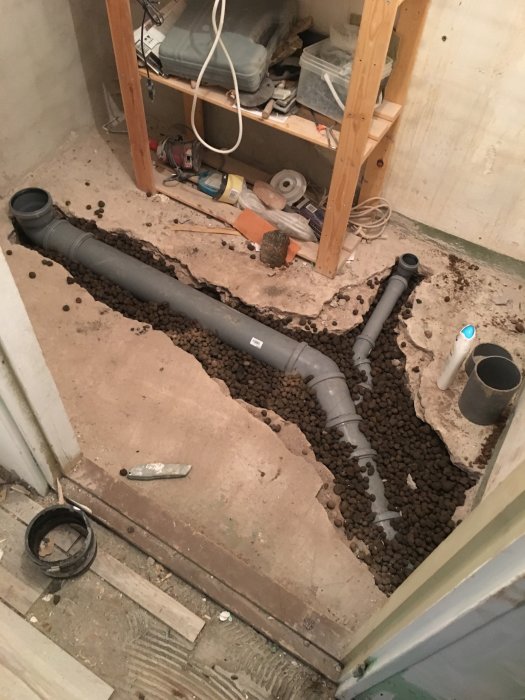
Apparently, the styrofoam should cover the entire room, how do you handle around the drain? See picture of the room today.
Can the electric underfloor heating be connected to a grounded socket with cables from the 1960s? For those who say no, why?
That's right, you can see when it needs to be replaced, it's for your own safety's sake, replacements aren't done if there's no reason, cables generally last at least 30-40 years so just accept it.
Electric cable from the 60s is often OK. But let the electrician determine if it is all right. There is no reason to replace it just because it is from the 60s.
It is natural ventilation, has a vent in the small room. We have an LV pump controlled by a sensor. If I install a radiator, it will probably be cold in the summer when the system shuts down. Therefore, I thought that underfloor heating feels more reasonable but not if ground moisture can migrate???
With the heat on all the time, the moisture is prevented even if someone were to be without styrofoam, the risk with that is if there's a lot of moisture, it might be forced up into another room or into the walls, but such a small space, as mentioned, is unlikely to be affected much.
As long as you don't add any dense layer it doesn't matter, there will be significant heat loss anyway, what kind of ventilation is it?
It's easy to get it really warm in such a small space with a regular radiator unless the air circulation is very high..
Following the thread, and if it's okay, adding some thoughts that might also suit the original poster.
How does the seal layer affect underfloor heating?
I have an upcoming basement project (laundry room + shower option in a turn-of-the-century villa) and can't build upwards, don't want to dig too much and close to the walls, the house seems to be standing on fine sand (gravel ridge) - don't want to risk any settlement, my idea has been to dig up where the pipes go, plus in the middle of the floor where you walk and just where the shower will be to lay some form of insulation, quite thin... then tiles on this... An alternative is to have a rug on the floor where you walk... But right by the shower it wouldn't hurt to have underfloor heating so any water dries away... But it's not worth risking settlements or moisture migration, then a cold floor is preferable... Worst case would be to lay some leca and cast with EPS concrete to get some form of insulation, I assume it doesn't hurt anything?
Click here to reply
Vi vill skicka notiser för ämnen du bevakar och händelser som berör dig.

 but I know that electricians usually argue about old cables needing to be replaced left and right.

