
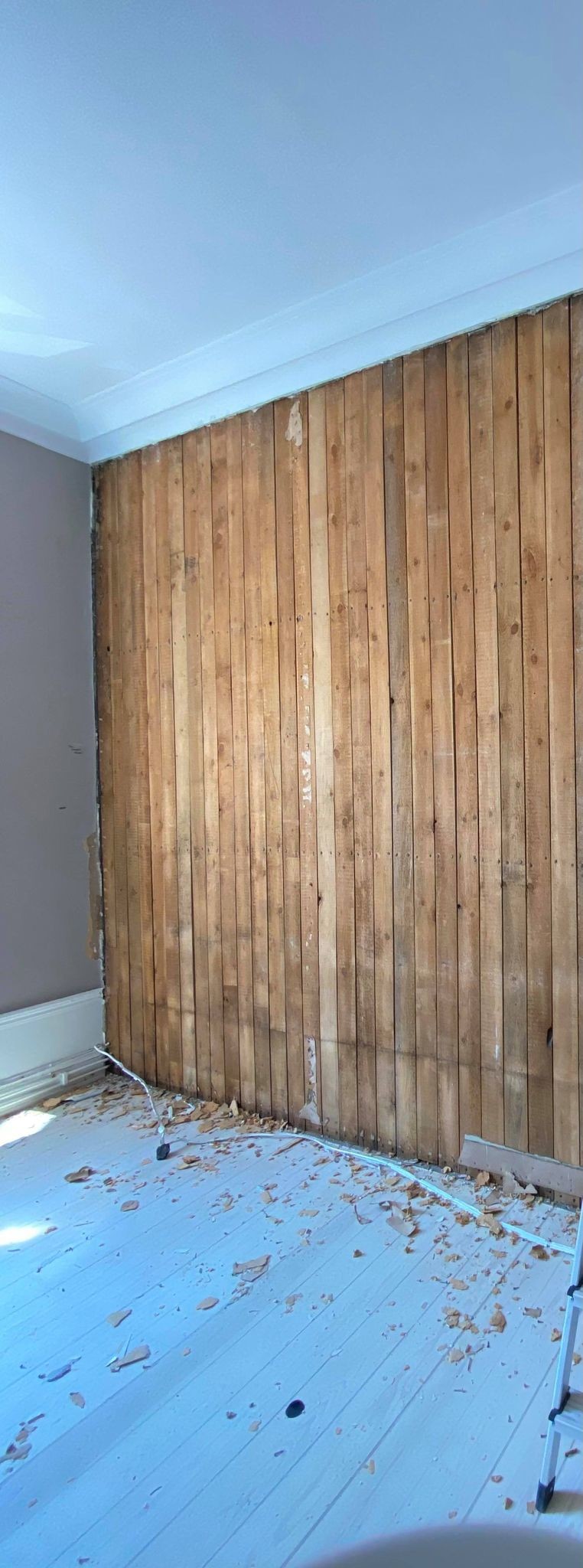
Renovating the turn-of-the-century apartment and moving the kitchen to a new room. I want to tile on the wall (more than just a couple of rows), so I'm planning to screw a 13mm drywall onto this plank wall. How sensitive is the drywall to possible irregularities? Does it matter if the irregularities are outward or inward?

I would probably remove the planks and screw the plasterboard into the existing nail battens, or alternatively, install new battens.J (-: said:Renovating the turn-of-the-century apartment and moving the kitchen to a new room. I want to tile the wall (more than just a couple of rows), so I'm planning to screw a 13mm plasterboard onto this plank wall. How sensitive is the plasterboard to any irregularities? Does it matter if the irregularities are protruding or recessed?

Thank you for the wise answers. I want to avoid as much as possible the extra thickness on the wall that new nail battens entail (looks odd against the ceiling stucco) and taking down planks from the existing nail battens damages the ceiling stucco and I also have no idea about its condition. Is it really unthinkable to place the drywall on an somewhat even plank wall?
No, with a multitool, you can cut the planks without damaging the ceiling cornice.J (-: said:Thank you for the wise answers. I want to avoid as much as possible the additional thickness to the wall that new battens entail (looks strange against the ceiling cornice) and removing planks from the existing battens damages the ceiling cornice, and I also have no idea of the condition of this. Is it really unthinkable to place the drywall on an somewhat even plank wall after all?

Well, it should be able to be tiled without looking crazy. The biggest difference is about 0.4-0.5 mm. How crazy can it get?
It might be worth taking down the planks, I would think. Then you can choose how the gypsum should sit in relation to the ceiling molding. You can adjust the thickness of the nailing battens accordingly.J (-: said:
Thanks for this. I'll go with an OSB board and then renovation drywall (6mm) on top - is that sufficient for tiling?J Johan456 said:
For those interested, it was just possible, after addressing the worst irregularities, to put up plasterboard on the existing plank wall. No problems with tiles thereafter.

Thanks (-: read the thread as I have the same problem, but I’m not going to tile anything, just put up a drywall and paint.J (-: said:
Click here to reply