@bossespecial Well, the drawing is from '45, so a lot has happened since then But to manage getting the same riser height on the top step, you would have to remove up to 10cm of concrete (out of 15), but maybe that's a possibility?
Now it might also be a matter of load-bearing capacity and function. If you have no information on what the floor structure looks like, you should think twice. The floor structure will hold together, but it's not fun to risk getting a lot of cracks in the ceiling. However, it's up to each person...
I completely agree with bossespecial. Sawing off rebar is a bit like sawing off a beam in a wooden beam system without providing offset. You just don't do that. Provide the dimensions of the opening and its distance from the outer wall in the basement, and then we can sketch a bit ourselves. Staircase construction requires some experience.
I completely agree with bossespecial. Cutting through rebar is a bit like cutting through a beam in a wooden beam floor without reinforcing it. You don't do that. Provide the dimensions of the opening and its distance from the exterior wall in the basement, so we can sketch a little on it ourselves. Staircase construction requires some experience.
The dimensions are on the sketches I attached earlier. The hole is 1856x690mm, with the possibility of an 85mm extension as there is a ledge along one short side. The exterior wall runs along the same short side.
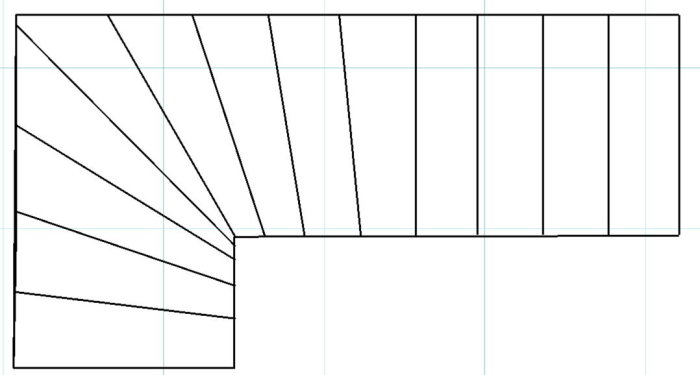
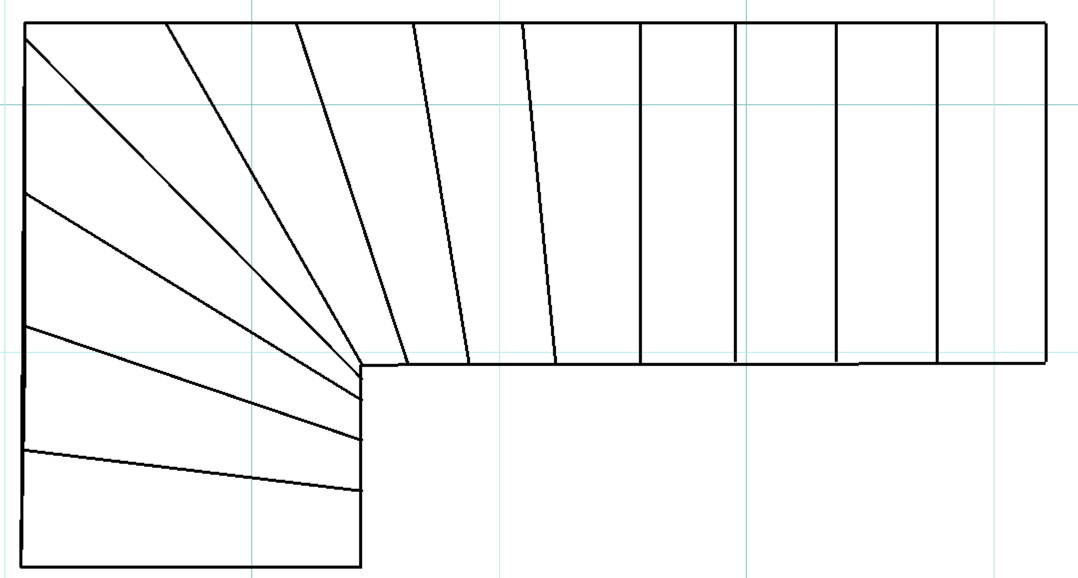
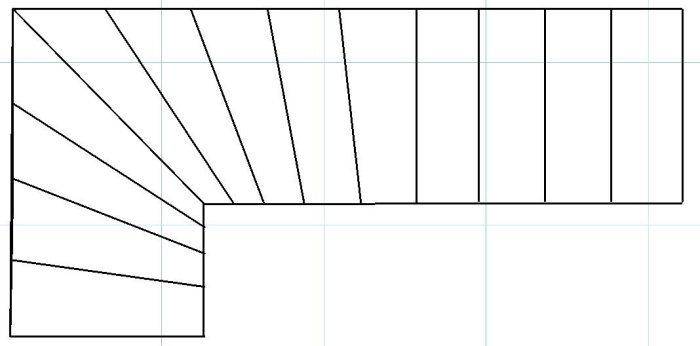
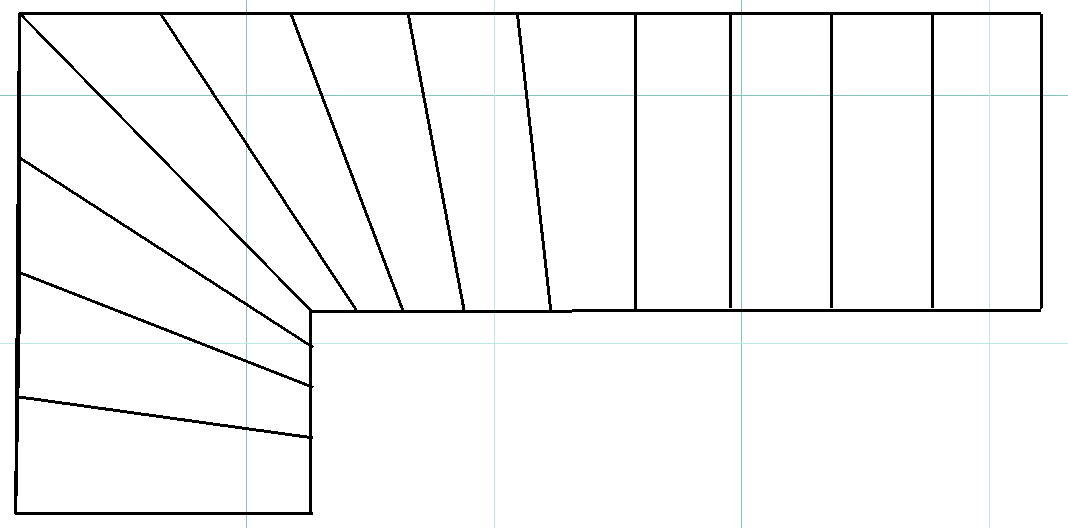
It will be a bit tricky, but it should work. Principal solution according to this image. Step height: 18.8 cm, step depth: 20.4 cm. The last step is taken into the floor structure, which means having to cut out about 5 cm of the concrete.
Do you mean that you only take out a 5cm riser along one long side? When I've calculated, I get a tread line of about 230cm total, and that's when I've calculated that the riser you can take out is about 20cm.
Your staircase measures about 270cm in the tread line. How many steps do you have under the roof?
Are you suggesting that you only make a cut of 5cm along one long side?
The 5 cm is removed from above in the concrete to fit the top step into the floor structure. I think my sketch might need some adjustments. I will try to find time for it later this evening.
When I draw a staircase (indoors in a small house), I usually start with a step height of 17 cm. I divide the floor height by 17 to find the number of steps needed, choose the nearest whole number, and then divide the floor height by this number instead. 245:17=14.4, 245:14=17.5. Then I use the staircase formula, 2xh + d = 60-63. If h is 17.5, then d = 25-28. In this case, 14 steps with a 17.5 cm height don't fit, so I tried with 13 steps at 18.8 cm instead. Instead of 60-63, I try with 58 as the total sum. This is acceptable in this specific case. I then get a step depth of 20.4 cm, which is what I've used in the sketch in #21.
If the house is from the late '40s, is there really reinforcement in the floor structure? You can cut 150 mm with an angle grinder from both sides, but it creates a lot of dust, so some water is needed to reduce the dust.
If the house is from the late 1940s, is there really reinforcement in the flooring? You can cut 150 mm with an angle grinder from both sides, but it creates a lot of dust, so some water is needed to reduce the dust.
A quick Google search shows that concrete reinforcement began as early as the mid-1850s.
If the stair width is reduced to 600 mm, it will be even better. A single-person staircase doesn't need to be any wider. Otherwise, as before: step height 18.8 cm, step depth 20.4 cm. The stringers must be underneath the risers and treads, not on the side.
A quick Google search shows that concrete reinforcement began as early as the mid-1850s.
[link]
The industrial revolution quickly led to many technological advancements that people were eager to experiment with.
It started being used, yes, but many slabs from the 1940s are without reinforcement, although it likely came earlier to load-bearing structures like, for example, a floor slab.
One must distinguish between slabs and flooring. A free-standing flooring without reinforcement will not hold, whereas an unreinforced slab cast on a gravel bed can. Most basement floors in houses built between 1920 and 1970 lack reinforcement, but they also have no load-bearing function.




MultiManOriginal said: