
22,019 views ·
9 replies
22k views
9 replies
Dress windows internally without moldings?
Hi,
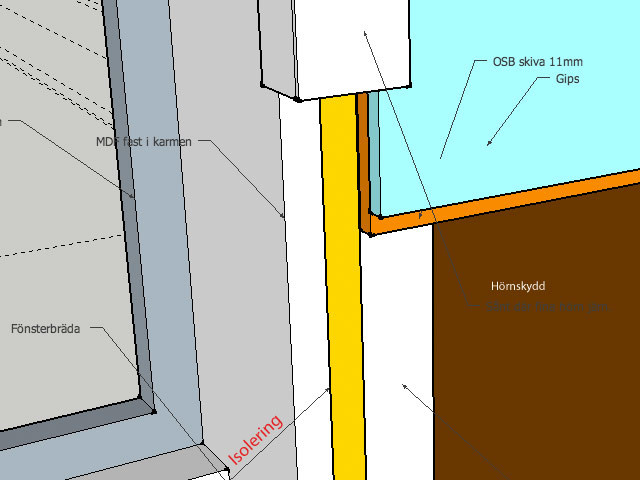
I don't know all the window terms, so I've made a sketch of the intended construction. Look at the picture and you'll understand immediately.
http://muffincreative.com/privat/fonster_utan_list.png
I want a straight corner into the window, no trim covering the insulation. I was thinking of attaching the MDF board directly to the frame (not the wall) because I've heard you shouldn't do that, using clipped nails + wood glue. I won't bother countersinking and screwing it in since it seems difficult to drill straight so far by hand.
But does it work to attach a corner guard with, for example, paper and putty from the MDF to the plasterboard?
Or am I thinking wrong? Maybe I need to get a wider corner guard than what Byggmax has. Or let the OBS board and plasterboard extend further over the insulation (drevet)?
How would you solve this to minimize cracking when painting? I'm thinking about the window and MDF moving as one and the wall as another.
The house has a wooden frame.
Many thanks to everyone trying to help, I've been thinking and thinking, but I don't know how to do this. (I've just become a new homeowner, so it was in middle school I last got to show carpentry skills...)
/Erik
Corner guard
http://www.byggmax.com/se-sv/Prod/PID-20802.aspx
I don't know all the window terms, so I've made a sketch of the intended construction. Look at the picture and you'll understand immediately.
http://muffincreative.com/privat/fonster_utan_list.png
I want a straight corner into the window, no trim covering the insulation. I was thinking of attaching the MDF board directly to the frame (not the wall) because I've heard you shouldn't do that, using clipped nails + wood glue. I won't bother countersinking and screwing it in since it seems difficult to drill straight so far by hand.
But does it work to attach a corner guard with, for example, paper and putty from the MDF to the plasterboard?
Or am I thinking wrong? Maybe I need to get a wider corner guard than what Byggmax has. Or let the OBS board and plasterboard extend further over the insulation (drevet)?
How would you solve this to minimize cracking when painting? I'm thinking about the window and MDF moving as one and the wall as another.
The house has a wooden frame.
Many thanks to everyone trying to help, I've been thinking and thinking, but I don't know how to do this. (I've just become a new homeowner, so it was in middle school I last got to show carpentry skills...)
/Erik
Corner guard
http://www.byggmax.com/se-sv/Prod/PID-20802.aspx
Last edited:
Hmm
was I that unclear?
I just want a window without trim and to expose myself to as little risk as possible of the paint cracking later...
Anyone done something similar?
Kind regards
/Erik
was I that unclear?
I just want a window without trim and to expose myself to as little risk as possible of the paint cracking later...
Anyone done something similar?
Kind regards
/Erik
The thicker the MDF, the better. A lining in 22 mm MDF is screwed right into the frame with about 30cc on the screw, and it holds like a rock; it can stand on its own. If you're unsure about drilling all the way through, find a drill press (e.g., at a school, workshop, etc.) nearby. Don't forget to countersink for the screw head.
Whether you choose to have the MDF level with the plasterboard or the plasterboard over the MDF doesn't matter (consider it practically, which you install first). Then apply metal corners and fill them. The corner should extend onto both MDF and plasterboard.
Let a painter handle the filling and painting for a perfect finish.
One alternative is to biscuit join the lining (MDF) to the frame instead of screwing, but this is more applicable when the lining sticks out about 1 cm and frames the window.
Whether you choose to have the MDF level with the plasterboard or the plasterboard over the MDF doesn't matter (consider it practically, which you install first). Then apply metal corners and fill them. The corner should extend onto both MDF and plasterboard.
Let a painter handle the filling and painting for a perfect finish.
One alternative is to biscuit join the lining (MDF) to the frame instead of screwing, but this is more applicable when the lining sticks out about 1 cm and frames the window.
Great, then I feel safer, thanks!
I'll see if I can borrow my father-in-law's smaller model pillar drill, not sure if it's tall enough...
Do you really attach the corner guard with screws in both materials? The gypsum & mdf
Doesn't it make it more difficult during the plastering?
oh, now I've revealed myself, apparently lemon doesn't know anything...
I'll see if I can borrow my father-in-law's smaller model pillar drill, not sure if it's tall enough...
Do you really attach the corner guard with screws in both materials? The gypsum & mdf
Doesn't it make it more difficult during the plastering?
oh, now I've revealed myself, apparently lemon doesn't know anything...
A column drill model-smaller works, as long as you get the first 5-10cm straight, you can finish with a regular drill afterwards (don't forget to lift the drill out periodically as MDF dust clogs the hole, you'll notice). A metal angle can be screwed in without problems in MDF and in drywall (if there's something behind it, like OSB to grip). The pros use a special tool, but I've screwed (drywall screws 38mm) about 20m corner strips in my house and the painter solved this brilliantly.
ps.
I've asked countless silly questions here, but it's better to ask than not to ask at all. You always learn something.
ps.
I've asked countless silly questions here, but it's better to ask than not to ask at all. You always learn something.
Last edited:
We have done according to this model on all of our 20 windows, but I didn't use MDF; I used plaster both on the walls and on the recess. The plaster recess is, of course, not attached to the window frame but to the frame structure that the window is also mounted in; then we have a sealant strip between the plaster recess and the window frame.
I agree that it results in a much neater solution than with interior trims, but there is quite a bit of work with setting the corner profiles and with plastering and sanding. We think it works very well in combination with our custom-made cast window sills.
I agree that it results in a much neater solution than with interior trims, but there is quite a bit of work with setting the corner profiles and with plastering and sanding. We think it works very well in combination with our custom-made cast window sills.
thanks for the great answer! now it's just measure, cut, measure, drill, screw, swear a little, done!
First, test a scrap piece of MDF to determine how much you need to countersink the screw, as it depends somewhat on the length of the screws you have. Typically, 1-2 cm is sufficient. However, if you have 120mm and the jamb is 150mm, you'll need to countersink more (5-6 cm). Also, try screwing it against a stud to get a feel for how tightly you can drive the screw without damaging the MDF. PL400 glue can also be used for an even better attachment to the frame, but then the jamb is fixed. The advantage of PL400 compared to other adhesive glues is that it is water-soluble and can be easily washed off if it is squeezed out.
You might have already rejected this, but I think it looks nicer to let the mdf protrude a couple of millimeters and butt the plaster against the mdf. Then you paint the front of the mdf the same color as the reveal and thus get a 22mm (for example) 'trim' around the window. I also use flexible caulk between the plaster/mdf to minimize the risk of cracking.
Danne, yes it sounded smart and neat, but it turned out well just like my drawing.
Click here to reply