
15,112 views ·
28 replies
15k views
28 replies
Does regular timber work for indoor stairs?
Hello,
I am in the process of building a staircase. L-shaped with a landing. Both the stringers and steps will thus be completely straight. For the steps, I was thinking of using something like sawed countertops, but for the stringers, I was thinking of using 45x195 dimensional lumber. Does dimensional lumber work for this purpose? I have heard that one should use laminated wood, but I happened to already have the dimensional lumber.
Regards,
Erik
I am in the process of building a staircase. L-shaped with a landing. Both the stringers and steps will thus be completely straight. For the steps, I was thinking of using something like sawed countertops, but for the stringers, I was thinking of using 45x195 dimensional lumber. Does dimensional lumber work for this purpose? I have heard that one should use laminated wood, but I happened to already have the dimensional lumber.
Regards,
Erik
Thanks for the answer! It doesn't bend and cause problems then? I have no experience in building stairs but have heard something about regular lumber tending to twist. I understand if the steps need to be more stable...R Rigor said:
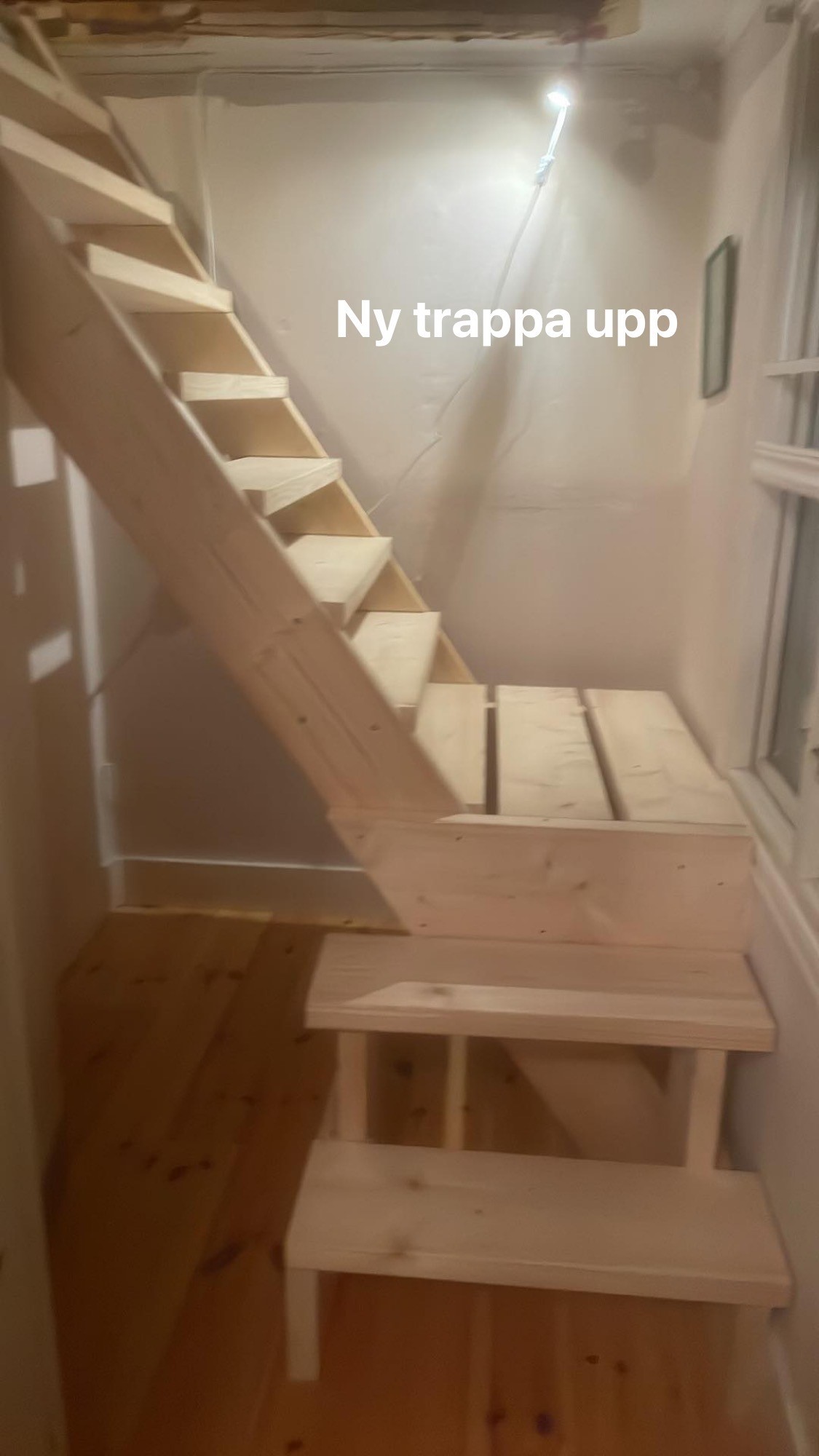

I think the total rise will be 2.4 floor to floor. I'm planning to have storage underneath, so I'll probably add a support beam underneath as well. So a total rise of about one meter per plan.R Rigor said:
Thanks... built it in the cottage, as the old stairs to the "attic" were through the bathroom... Now I have built a room up there for guests and the wife thought it would be nice to have another place to go up and I agreed with that ;-) A little tight, but it works... If it had been a permanent residence, I would have cut a load-bearing beam and shifted... and a slightly different angle
I've built things with lumber and it took a few months before it fully shrank. Nothing dramatic, but I used, for example, wooden dowels and sanded to an even surface on studs that had dried inside for a month. As I said, no catastrophe at all, but after a while, the dowels were noticeable because the wood around them had shrunk. So go ahead and build, but be prepared for gaps and the like to appear after a while.Antwerpen said:

The stringers support the staircase, so their dimensions should be chosen based on the length and slope of the stairs. With a staircase height of 2.4 meters and a 45° slope, 45x195 is sufficient, but you don't need to reduce the slope much before you need sturdier stringers. A 30° slope should preferably have laminated wood 42x270 as stringers. This applies if you want a staircase that doesn't sway too much and stringers that do not have pillars as support along the way.
thanks for the info! I will attach one side of the staircase along a wall that I haven't built yet. The staircase will go around that wall. Should I build it with 45x95 studs or is 45x70 enough?J justusandersson said:The stringers support the staircase, so their dimensions should be chosen considering the length and slope of the staircase. With a stair height of 2.4 meters and a 45° slope, 45x195 is more than sufficient, but you don’t need to decrease the slope much before you need stronger stringers. A 30° slope should preferably have laminated wood 42x270 as stringers. This applies if you want a staircase that doesn't sway too much and stringers without posts for support along the way.
Stairs have somewhat intricate geometry. It's best to first decide on the step height and step depth and, in that way, calculate the length of the stairs in the horizontal plane. Often, these numbers have to be adjusted back and forth. The function of the stairs is also important. An attic or basement stairway can be steeper than a main stairway. Not until all step dimensions are determined can you start considering the dimensions of the stringers. Even if one stringer is attached to the wall, both should have the same dimensions. When considering the dimensions of the steps, you should start with the so-called stair formula. 2*H + D =60 - 63. H is the step height and D is the step depth measured in cm. If the step height is 17 cm, then the step depth should be 63 - 2*17 = 29 cm if it's a main stairway. In a basement stairway, the step depth can instead be 60 - 2*17 = 26 cm. If your stair height from floor to floor is 2.4 meters, it might be suitable to have 14 step heights, each being 17.15 cm. The step depth would then be 28.7 cm, and the length of the stairs 13*28.7 = 3.73 meters. If you're going to have a winding staircase, the steps in the corner must be wedge-shaped. On a wedge-shaped tread, you measure the step depth along the walking line, which is 40 cm from the wall. To allow the treads to be recessed into the stringer in a winding staircase, you usually need to base it on fairly high stringers. My recommendation is to find a winding staircase that is good to walk on, study it carefully, photograph it, and note the dimensions.
thanks for the great answer! I will have a curved staircase but with a landing in the middle, partly because it looks quite nice and partly because I avoid different dimensions on the treads. It becomes like two small straight stairs, something a layman like me should be able to handleJ justusandersson said:Stairs have a somewhat complicated geometry. It is best to first decide on riser height and tread depth and use this to calculate the stair length in the horizontal plane. Often you will need to juggle these numbers a bit back and forth. The function of the stair is also important. An attic or basement stair can be steeper than a main stair. Not until all step measurements are determined, can you start considering the dimensions of the stringers. Even if one stringer is attached to the wall, both should have the same measurements. When considering the step measurements, you should start from the so-called stair formula. 2*H + D = 60 - 63. H is the riser height and D is the tread depth measured in cm. If the riser height is 17 cm, then the tread depth should be 63 - 2*17 = 29 cm if it's a main stair. In a basement stair, the tread depth can instead be 60 - 2*17 = 26 cm. If your staircase height from floor to floor is 2.4 meters, it might be suitable to have 14 riser heights, each of which then becomes 17.15 cm. The tread depth then becomes 28.7 cm and the stair length 13*28.7 = 3.73 meters. If you are to have a curved staircase, the steps in the corner must be made wedge-shaped. On a wedge-shaped tread, you measure the tread depth on the walking line, which is 40 cm from the wall. For the treads to be able to be routed into the stringer on a curved staircase, you usually need quite high stringers to start from. My recommendation is to find a curved staircase that is good to walk on, study it closely, photograph it, and note the dimensions.

One question: How do I easily stabilize the landing? Do I need beams underneath or is there a smarter way?
regards