
12,933 views ·
100 replies
13k views
100 replies
Does Masonite withstand weather and wind?
Just having a 2-3mm masonite nailed on a wooden frame with boards without an air gap will lead to moisture reaching the frame...R Rodgar Den Frie said:
If there had been masonite, followed by ventilation and, for example, a lock panel, it would have been a better construction. In this construction, the moisture will be aired out in a better way...
ThanksRejäl said:Having only a masonite of 2-3mm nailed onto a wooden frame with boards without an air gap will cause moisture to seep through to the frame.
If one had masonite followed by ventilation and, for example, a lock panel, it would have been a better construction; in this construction, the moisture will be ventilated away in a better way...
It sounds like you're thinking that the wall has an insulating material that CANNOT transport moisture.
That is, a non-hygroscopic material.
Is that so?
But it doesn't matter, the framework must not be exposed to external moisture; if it is exposed to moisture load, it will be affected by, among other things, microbial growth such as mold.R Rodgar Den Frie said:
Last edited by a moderator:
Thank youRejäl said:
Is the horizontal timber in a log wall the frame?
Is it exposed to moisture?
Does microbial growth occur in it?
Yes, all wood that is built in and becomes too moist and does not have an air gap that allows drying out between the moisture-exposing periods runs a high risk of being affected by microbial growth and mold.R Rodgar Den Frie said:
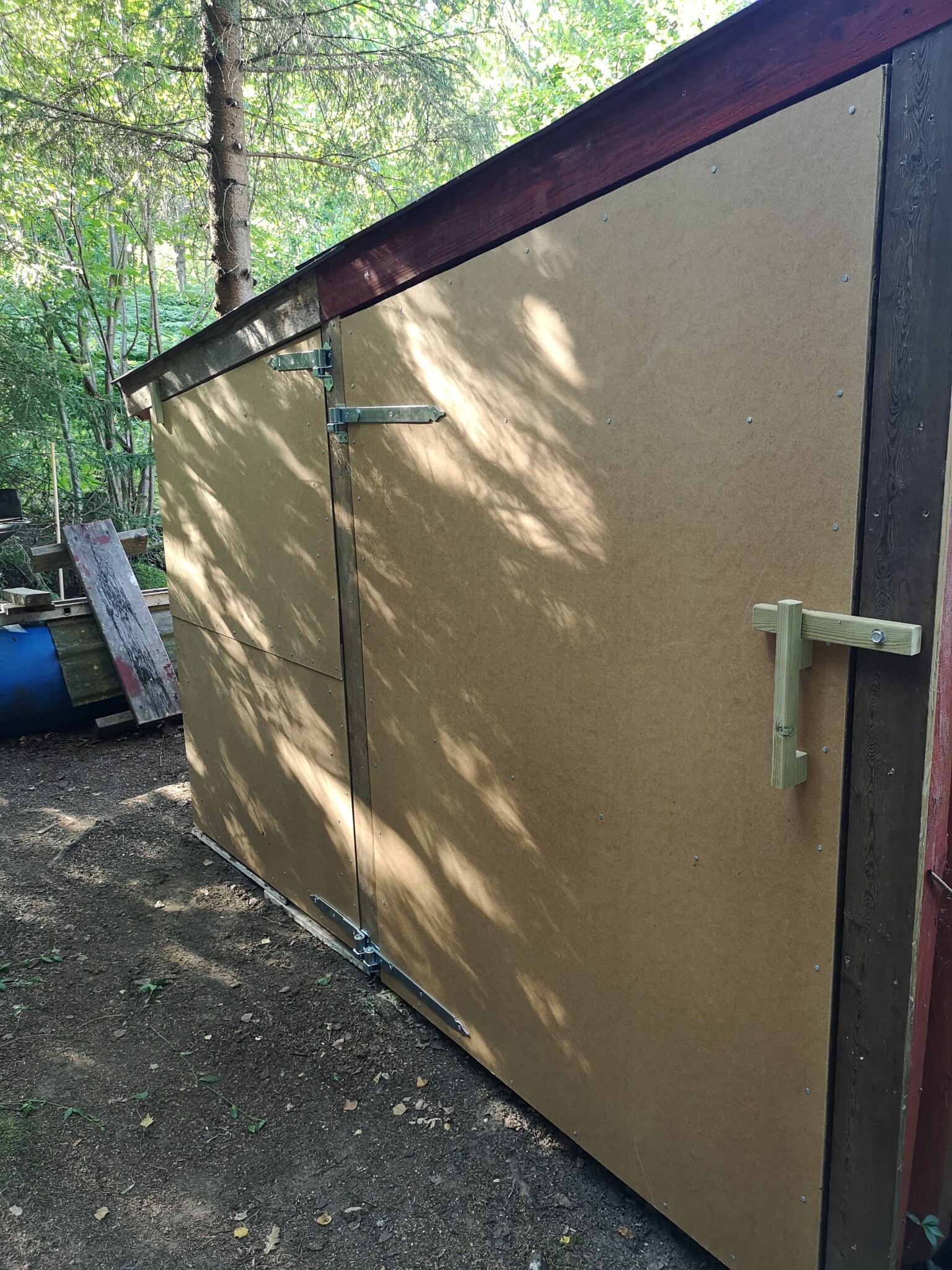
Then maybe you should consider what kind of building it is. If it is an outhouse, shed, or similar that you do not live in, then maybe it doesn't matter as much. But as a residential house, it is not recommended.
Masonite is oil-hardened. This makes it resistant to some moisture. But it absolutely does not keep dry. The oil not only prevents moisture from entering the board, but also prevents moisture from escaping. So the little moisture that does enter the board will stay there long enough to start molding. Masonite works excellently as windproofing instead. It can also be used as an underlay for metal roofing instead of roofing felt. But it works very poorly in the open air.R Rodgar Den Frie said:

ThanksRejäl said:Yes, all wood that is built in and becomes too moist and does not have an air gap that allows drying out during the moisture-loading periods runs a great risk of being affected by microbial growth and mold..
Then maybe one should look at what kind of building it is; if it’s an outbuilding, storage, or equivalent that you don't live in, then it might not matter as much. But as a residential house, it is not recommended..
I still think you are reasoning based on a modern conventional wall with plastic on the inside and non-hygroscopic insulation material
A log wall transports moisture in both directions
Just like the wall I am exploring
Yes, it's true that the log wall does, I am completely on board with your wall.R Rodgar Den Frie said:
Your wall can work if you have an air gap...


Just because the insulation is hygroscopic does not mean it can withstand moisture. I have two houses with masonite facades and can guarantee that it is neither windproof nor waterproof after a few years.R Rodgar Den Frie said:
Just because there is a house that survived does not mean that houses with masonite facades generally survive. It is likely due to many unknown factors and coincidences that have caused that house to survive. There are thousands of examples of houses that did not make it. Or actually, there aren't anymore, since almost all have been forced to be demolished. If it worked, we would see quite a few small houses and sheds clad with masonite, as it is cheap. It also has several advantages initially.F fribygg said:
No, masonite is hardly the answer to which is the best facade. For many, masonite has worked surprisingly well and for decades withstood weather and wind, and if you're in the process of changing facades this spring, you might appreciate that previous owners didn't choose Sidiplattor or metal?A AG A said:Just because there is a house that has survived, it does not mean that houses with masonite facades generally withstand. It is likely a number of unknown factors and coincidences that have allowed that house to survive. There are thousands of examples of houses that have not survived. Or actually, there aren't that many anymore, as almost all have been forced to be demolished. If it worked, we would see quite a lot of small houses and sheds clad in masonite, as it is cheap. It also has several advantages to begin with.