
- Status
- Not open for further replies.
Oh, how delightful it is when people dismiss my claims without having their own empirical basis for what they are talking about. Like with this 'new standard' on cc-spacing for 28 mm hsp floorboards (signed jon_h). I used to be the same when I was young until I gained the experience I have and still gain almost every day.
Here, jon_h will get an example of what I mean.
Had someone asked me to size a roof truss with cc 2.8-3.0 meters and span just under 10.0 m, with a roof pitch of 35 degrees, I would not have come up with 5"x8" for rafters and chords and certainly not the construction shown in the pictures. They are taken in a nearly 100-year-old barn. If some carpenter had claimed it would hold, I would have said a definite no. Especially since it's 1" rough-cut boards laid as siding from ridge to eaves on some rudimentary features as purlins, lacking cross bracing in the gable bays, etc. The roof was originally covered with shingles outside. But it has carried more than 40 tons of tiles on it. Today there is about 4 tons of aluminum sheet on it instead + the original shingle roof. The building is approximately 80 meters long.
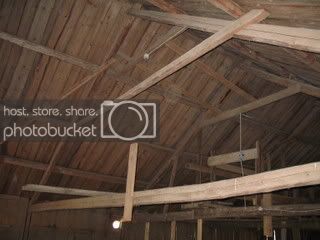
Here is a detail of the 'eaves.'
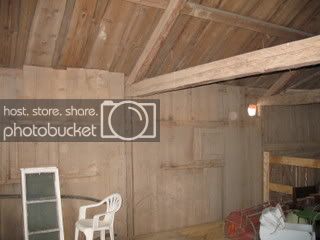
And here a poor picture towards the other gable.
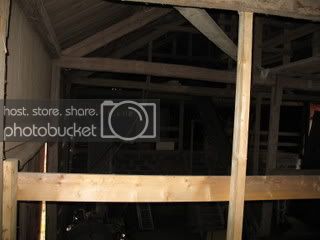
The question is: how can it hold? Answer: the timber is not literate and knows nothing about our allowable stresses, etc. It takes support where it can and does so until it breaks. But if you build with tried and tested experience (= empirically), it doesn't go that far.
If you calculate it, that roof construction should have been firewood long ago. Especially since it's rough-cut timber taken from a whole log and in full length (up to 10 m) i.e., of the lowest strength class for timber.
The storms here on the east side of Orust, 2 km from the coast, are of such strength that they easily topple a few hundred cubic meters of forest every autumn that is 30 m high without further ado. But the barn remains, even though it lies completely open in a field without protective terrain.
And you can have another example:
When the owner, our landlord, asked me to calculate the floor I'm standing on when the pictures were taken, I suggested two support beams on cc about 3300 (about 7.5 m in span) with two pillars under each and staggered floor joists (to achieve continuity in the floor and no sway) in the dimension 2"x9" on cc 600. He would use the 'loft' as a wagon museum and I calculated on 100kg/square meter static + dead weight under reasonable conditions. That is, very light load. (Underneath, three cars worth about 1.5 million SEK would be parked. Of course, I didn't take chances and under-dimension.)
The (farmer) carpenters didn’t care about that. The floor now consists of non-hsp planks in the dimension 1½"x6" on beams 2"x8" cc 600 and underneath, there's 2x13 plasterboard in the ceiling. Two support beams with ONE pillar under each and no staggered beams (the support beams are designed like an inverted T with joists notched and laid on 2" studs on the sides without tying above). Still no sway in the construction. If I jump on the floor, I can make it vibrate, but there's no sway.
So if I were you, I would try laying 28 mm hsp boards on joists cc 1200 and see what experience you gain from it. I wouldn't be surprised if you reach the same conclusion as I have: It holds up. Provided they are laid continuously over at least two supports, i.e., are 3.6 m long.
Here, jon_h will get an example of what I mean.
Had someone asked me to size a roof truss with cc 2.8-3.0 meters and span just under 10.0 m, with a roof pitch of 35 degrees, I would not have come up with 5"x8" for rafters and chords and certainly not the construction shown in the pictures. They are taken in a nearly 100-year-old barn. If some carpenter had claimed it would hold, I would have said a definite no. Especially since it's 1" rough-cut boards laid as siding from ridge to eaves on some rudimentary features as purlins, lacking cross bracing in the gable bays, etc. The roof was originally covered with shingles outside. But it has carried more than 40 tons of tiles on it. Today there is about 4 tons of aluminum sheet on it instead + the original shingle roof. The building is approximately 80 meters long.
Here is a detail of the 'eaves.'
And here a poor picture towards the other gable.
The question is: how can it hold? Answer: the timber is not literate and knows nothing about our allowable stresses, etc. It takes support where it can and does so until it breaks. But if you build with tried and tested experience (= empirically), it doesn't go that far.
If you calculate it, that roof construction should have been firewood long ago. Especially since it's rough-cut timber taken from a whole log and in full length (up to 10 m) i.e., of the lowest strength class for timber.
The storms here on the east side of Orust, 2 km from the coast, are of such strength that they easily topple a few hundred cubic meters of forest every autumn that is 30 m high without further ado. But the barn remains, even though it lies completely open in a field without protective terrain.
And you can have another example:
When the owner, our landlord, asked me to calculate the floor I'm standing on when the pictures were taken, I suggested two support beams on cc about 3300 (about 7.5 m in span) with two pillars under each and staggered floor joists (to achieve continuity in the floor and no sway) in the dimension 2"x9" on cc 600. He would use the 'loft' as a wagon museum and I calculated on 100kg/square meter static + dead weight under reasonable conditions. That is, very light load. (Underneath, three cars worth about 1.5 million SEK would be parked. Of course, I didn't take chances and under-dimension.)
The (farmer) carpenters didn’t care about that. The floor now consists of non-hsp planks in the dimension 1½"x6" on beams 2"x8" cc 600 and underneath, there's 2x13 plasterboard in the ceiling. Two support beams with ONE pillar under each and no staggered beams (the support beams are designed like an inverted T with joists notched and laid on 2" studs on the sides without tying above). Still no sway in the construction. If I jump on the floor, I can make it vibrate, but there's no sway.
So if I were you, I would try laying 28 mm hsp boards on joists cc 1200 and see what experience you gain from it. I wouldn't be surprised if you reach the same conclusion as I have: It holds up. Provided they are laid continuously over at least two supports, i.e., are 3.6 m long.
Sure they manage, I have never said anything else. It seems like you are not reading what I write.
And as I wrote in the other thread, the vibrations that occur when jumping on the floor when it is laid on 1200 c/c are not okay according to current construction requirements. It holds of course, but it is not considered to meet the standards one might expect from a modern construction. Therefore, I do not recommend people to build that way when it is so easy to do it better.
I cannot see that your examples above are relevant at all, we are discussing floors laid on 1200 c/c, nothing else.
Edit: Besides, why should I need empirical evidence for my claims? I don't need to try putting plasterboards on 1200 c/c to know that it doesn't meet the standards for bending stiffness. For example.
A tip could also be to try to tone down the patronizing attitude. Just because you are older doesn't mean you are right, so please don't use it as an argument.
And as I wrote in the other thread, the vibrations that occur when jumping on the floor when it is laid on 1200 c/c are not okay according to current construction requirements. It holds of course, but it is not considered to meet the standards one might expect from a modern construction. Therefore, I do not recommend people to build that way when it is so easy to do it better.
I cannot see that your examples above are relevant at all, we are discussing floors laid on 1200 c/c, nothing else.
Edit: Besides, why should I need empirical evidence for my claims? I don't need to try putting plasterboards on 1200 c/c to know that it doesn't meet the standards for bending stiffness. For example.
A tip could also be to try to tone down the patronizing attitude. Just because you are older doesn't mean you are right, so please don't use it as an argument.